It’s the time of the month when it’s good to look back and be reminded of all of January’s wonderful science and technology stories. The beginning of the year is a time for new beginnings and regenerations, and a time to wrap things up and recapitulate an exciting month. I hope you’ll enjoy these stories. If you are interested in science blogging and contributing to Australian Science – contact us and check out the Editor’s note.
In 2013 expect the comet Ison to garner some column inches towards the back end of the year. In early 2013 October it will pass very near Mars and possibly be visible to rovers and orbiting spacecraft. The newly discovered comet could develop a spectacular tail, becoming as bright as the full Moon as it passes by our Sun. The comet is currently falling toward the Sun from between the orbits of Jupiter and Saturn. There is a chance it won’t survive this encounter. Whatever survives will then pass nearest the Earth in late 2013 December. Read more>>
Physicists are interesting folk, and I’m sure some would be fascinated if this turned out to be something new. Fabiola Gianotti, director of the ATLAS experiment at CERN has appeared noticeably excited before by the prospect of new and unknown physics being discovered. However, the other thing about physicists is that by their nature, they need to be highly skeptical, particularly when it comes to their own work. Adam Falkowski, a Paris-based particle physicist, states what most researchers are probably thinking on his blog Résonaances – that the result is most likely due to a “a systematic problem
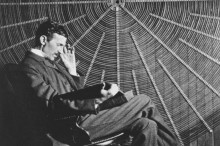
There is a dominant theme in the life of Nikola Tesla. His undoubted genius. Tesla pioneered, if not invented; AC motors, AC power generation and transmission, high voltage generation (Tesla coil), wireless transmission of power and information, radio controlled boats, cold discharge fluorescent lighting, and the ‘death-ray’.
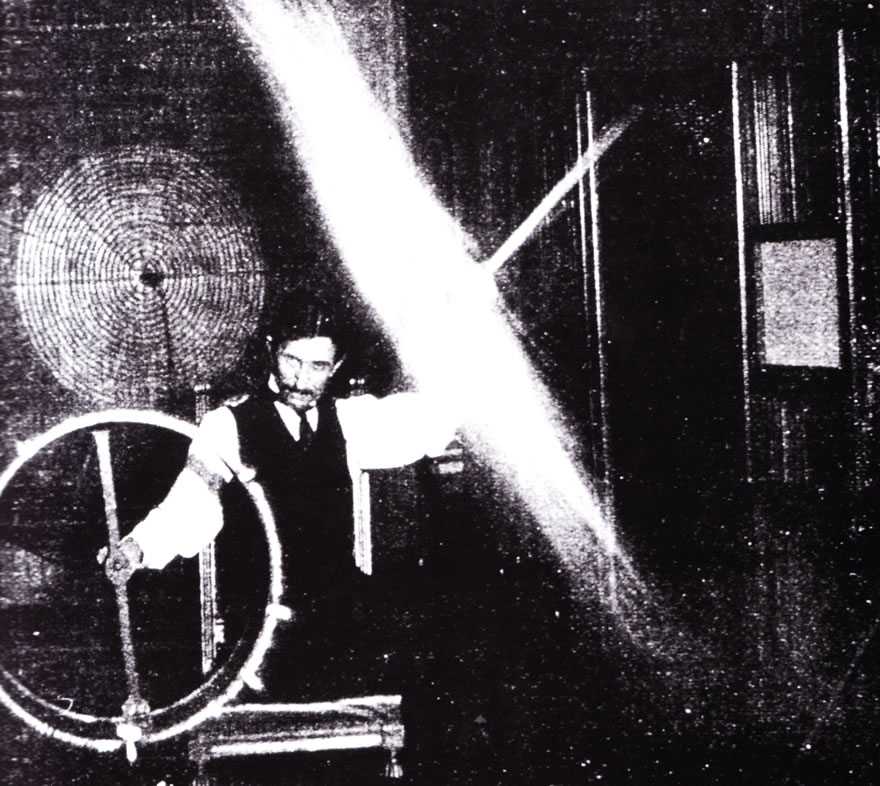
Tesla at his Houston street laboratory in 1898, sending 500,000 volts through his body to light a wireless fluorescent light. Image source Wiki commons.
It also meant that he was ahead of his time, in many cases unable or disdainful to translate what to him was now obvious to those of lesser vision or ability. This resulted in tempestuous clashes with entrepreneurial inventors in three major technologies, technologies that defined this as the ‘Age of Electricity’. Tesla’s was no ordinary progression in life and its colorful and quirky story continues to determine his eccentric place in history – from near invisibility to cult figure.
Two books: many stories
My prompt for this writing this essay was my recent reading of two books on Tesla’s life. His autobiography; My Inventions and other writings, first published serially in 1919 when he was 63, is a technicolour, frenetic meditation on his major discoveries and innovations. It is autobiographical, mixing his life stories with his inventions, the narrative leaping around in time and place as Tesla seemed to in real life. Worth reading to obtain some of the character of Nikola Tesla – even if coloured by his own deliberate self mythologizing.
The second book Wizard: the life and times of Nikola Tesla (by Marc Seifer) captures much of the excitement of this early age of electricity. This book is a chronology of Tesla’s life, informative in its research and illuminating with its vignettes drawn from contemporary memoirs. At the same time its chronological presentation provides a misleading sequential perception of his life.
Seifer also lacks the engineering or science competence to describe in simple terms the genius of Tesla’s inventions. An essential for a biography of someone whose whole life revolved around his work. In the concluding chapters Seifer’s writing starts to take on the ludicrous credulity of the conspiracy theorist – which is a pity the rest of the book is clear of this nonsense.
In defense of Seifer I think it would be challenge for any biographer to tell the whole Tesla story. Tesla was completely consumed by his ideas and inventions, eschewing most intimate contact – to the extreme of apparently being celibate his whole life. To make credible his fantastic life is a challenge. Furthermore, a modern reader, it most cases will struggle in comprehending the archaic technical descriptions and ideas.
The dawn of the Electric Age
This was an age when electricity and magnetism had only recently been linked by the arcane mathematics of James Clerk Maxwell and electricity was still thought to propagate by vibrations of an aether. Tesla was one of the few people alive who understood the physics of what we now call electromagnetism, and could also translate this into tangible inventions.
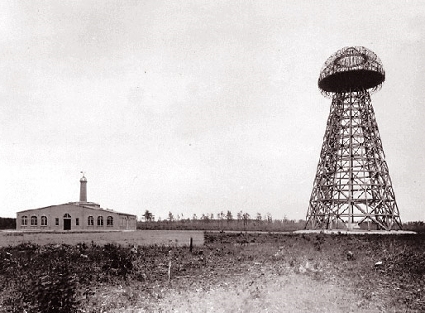
Wardenclyffe, circa 1903. Source Wiki commons.
Tesla’s name is associated with the invention of the rotating magnetic field and the ability of such a field to produce an electric current. By 1882 Tesla had invented and patented the AC polyphase motor – giving the ability to transfer electrical energy into mechanical energy. The reverse of this creates a turbine that converts mechanical energy, from say a waterfall, into electrical energy.
Tesla’s move, in 1884, from Europe to the USA was to develop his own inventions and contribute to Edison’s commercial interests. This collaboration parted ways over what became the AC-DC power war. Edison’s commercial interests were firmly focused on his incandescent lamps and the use of DC power (direct current; such as we get from a battery). Tesla had correctly intuited from first principles that alternating current (AC power as we now operate our homes and industries on), as different to DC power, could be transported by wires over great distances with minimal power loss.
Ultimately Tesla was proved both scientifically and commercially correct. It was his turbine designs that Westinghouse used in the first major hydroelectric power station in the world – the 1894 powering of Buffalo by the might of Niagara falls.
This was a tumultuous period of commercial expansion. The ability to power industry by electricity rather than steam was arguably a bigger leap than from manual to steam power – certainly in commercial terms. The ensuing law-suits and counter-suits over patent precedence in motors, generation and transmission, roiled across the US and Europe, making and breaking reputations and fortunes. These actions bringing Edison General Electric to its knees and forcing it to join with others to become General Electric.
Westinghouse prevailed, at the same time neglecting to pay Tesla royalties that he deserved – despite he not bothering to ensure he had written agreements. This disdain for the corporate conventions of the time cost Tesla both wealth and reputation. He moved onto other new ideas whilst others claimed his inventions in the law and popular press.
Father of the wireless
This was repeated in the next huge modernisation trend – the invention of the wireless transmission of information. By 1893 Tesla was demonstrating the transmission of electric power by wireless means most notably at the Chicago World fair. He delighted in amazing audiences with fantastic high-voltage discharge displays, passing millions of volts through his body and remote lighting of fluorescent tubes by radio frequency.
Already in 1891 he had discussed his “wireless telegraphy” and demonstrated the technology required in 1892. It was 1894 before Guglielmo Marconi would begin his teenage tinkering in the wireless field. So why do we remember the name of Marconi as synonymous with radio? Why did he share the 1909 Nobel Prize with Karl Braun rather than with Tesla?
It would appear from historical evidence that Tesla, in his own mind, had already proved it – and moved on. Whereas the entrepreneur in Marconi, much like Edison, was tenacious in development of his inventions. Tesla at this time had formed a company with the financier Pierpont Morgan to commercialise his wireless technologies. Morgan knew their was a fortune in wireless telegraphy and fluorescent lighting; provided they were developed sufficiently to present to investors as near commercial realities.
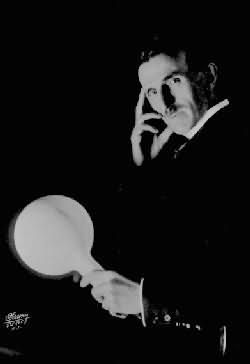
Nikola Tesla illuminated by one of his wireless powered cold arc lamps. Source Wiki commons.
To this end Morgan had tasked him with demonstrating the fluorescent light technologies and maturing their manufacture and demonstrating his wireless by covering off-shore yacht races. The latter would have been a tangible demonstration for both the rich and the Navy. Tesla did neither. he scorned the triviality of the public demonstration – despite his very public earlier electric demonstrations. This left the field of wireless telegraphy (radio) for Marconi and other to develop. instead Tesla squandered the Morgan money on his other big dream – providing wireless transmission of electric power by radio.
Radio power, transmission and weapons
Tesla’s greatest dream was sure to be one not funded by the likes of Morgan. He envisaged a world where power and information were transmitted world-wide – for free. To this end he he used the money from Morgan to plan and start building a gigantic transmission tower, Wardenclyffe, in 1902. His philanthropic ideals and profligate spending meant that by 1906 his funding from Morgan had dried up, and his dream never realised. The tower was destroyed in 1917 by US Government orders to ensure that it was not used by enemies of the state.
In developing this idea he correctly understood the physics of wireless transmission both through the atmosphere and the ground. Laying down the principles that would guide the subsequent invention of both AM and FM radio.
A combination of creditors, stock market upheavals, World War 1 and the stock market collapse of 1930 ensured that Tesla could never raise the money required to bring about this revolutionary idea. A idea revolutionary even by the social standards and upheavals of the time.
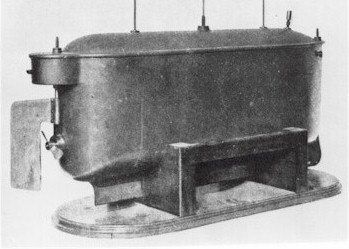
Tesla’s radio controlled boat. Source Wiki Commons
At the same time Tesla was a continuing fountain of new ideas. Perhaps given the turbulent times these included the world’s first radio controlled boat in 1898 which he continually and unsuccessfully tried to interest the US Navy in, improvements on dirigibles, a helicopter plane called a flivver and at the age of 78 a ‘death-ray’.
This latter ‘invention’ was never built nor even prototyped but harked back to experiments of Tesla in the 1890’s that were only a small step away from the invention of the laser. The ideas were sufficiently developed though to serve as mental prototypes for particle-beam weapons and strategic defense shields loved by science fiction writers and some politicians.
Modern nonsense
Apart from the tangible technological legacies left by Tesla’s prodigious genius there are also quixotically hare-brained modern legacies. These Tesla, if he were alive today, would scoff at. None more so than the Tesla “free-energy-generator”
This modern scam is based on the misrepresentation of Tesla’s laudable Wardenclyffe dream and his idea that you could use his generator as a receiver of the, at the time, newly discovered cosmic rays. The radio sophistication and development of radar during and subsequent to WW11 demonstrate the impracticality of large transmitters and receivers of radio power at the levels envisaged by Tesla. We now use networks of smaller powered repeaters (many of these satellites) to ensure uninterrupted radio/telephone/television coverage on a world-wide basis. As for cosmic rays, they are energetic, however of such low density (thankfully for life) that collecting sufficient power from them is impracticable.
That scams based on Tesla exist in this modern age is testament not to conspiracy theories as maintained by these swindlers. Rather it is testimony to Tesla being truly ahead of his time – a time of tumultuous technological growth, which he partially created without ever seeming to inhabit.
A complete biography of Nikola Tesla is still to be written. I believe it will require a writer who understands the science and engineering of Tesla’s age and who has the artistry to weave the many threads of his life into the dynamic, parallel genius of his life – teetering on the precipice of chaos – that was Nikola Tesla.
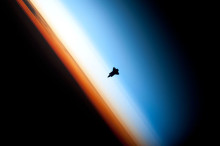
Seven miles above the Earth’s surface, where the weather is born, lies the troposphere – the lowest layer of Earth’s atmosphere. Up there, where the clouds dance around, are bacteria that can make it rain, and are important for the formation of clouds.
The atmospheric microbiome is a concept and field of study that is gaining importance. As we come to grips with a changing climate and environment, understanding more and more our Earth ecosystem remains vital. With hurricane damage in the US and elsewhere seemingly on an exponential increase in recent decades, it is important to mitigate for the worst. It can cost as much as $1 million per square mile for evacuation preparations alone.
In 2010, NASA embarked on one of its largest hurricane research efforts — GRIP (Genesis and Rapid Intensification Processes). The objective was to better understand and characterise how tropical storms form and develop into major hurricanes. With a fleet of aircraft, ground-based instruments, computer models, and satellites, over a period of 6 months, GRIP collected all kinds of data on the nature, structure, dynamics, and motion of hurricanes. Invaluable data. They also collected one other thing — the microorganisms in the atmosphere.
The problem previously, had always been the difficulty in gathering enough microbial biomass to study. And previously, most samples have comes from areas too close to the Earth’s surface to really mean anything. GRIP took things one step further — high-altitude. Over the course of 9 flights across America, the Gulf of Mexico, the Atlantic Ocean, and the Caribbean, GRIP collected bacterial and fungal samples to be analysed. Enough to answer the question: Where does the bacteria in the atmosphere come from? Authors, publishing in the Proceedings of the National Academy of Sciences (PNAS) today give a picture of the composition of the high-altitude (around 10 kilometres above sea level) bacterial and fungal flora, but also what that picture looks like in the aftermath of a hurricane.
The bacteria that swirl around in the air originate from different areas across the Earth’s surface it seems. The organisms they sampled originated from almost all habitats (ocean, soil, freshwater… etc as they put it). Hurricane samples had a higher abundance of marine bacteria, and only in the hurricane samples was there “a substantial signal of bacteria known to be associated with human and animal feces
Obtaining a senior academic position for any aspiring young academic is one of those uphill struggles with roads lined with self doubt, setbacks and sacrifice. Some call it the way to tenure-track, in my mind it’s one of those ill-defined paths through a potentially haunted forest inhabited with monsters, gigantic poisonous spiders and creepy people who communicate by screaming. It can be harder still to even reach that point, particularly for young women. While the number of women professors in Europe, N. America and Australia has increased over the last decade, universities still have a disproportionately small number of women in senior professorial positions.
CSIRO will today launch Australia’s largest publically-funded research initiative focused on the digital economy.
The Digital Productivity and Services Flagship, CSIRO’s tenth National Research Flagship, is a A$40 million research initiative focusing on the services sector and optimising the full value of national broadband infrastructure.
The Digital Productivity and Services Flagship, CSIRO’s tenth National Research Flagship, is a A$40 million research initiative focusing on the services sector and optimising the full value of national broadband infrastructure.
The Director of the Flagship Dr Ian Oppermann says the new Flagship is focused on helping Australia transition from being a predominantly resource-focused nation by developing and delivering more efficient and innovative digitally-enhanced services.
“Australia is faced with the challenge of maintaining a competitive economic edge in an increasingly complex and resource-limited world,” Dr Oppermann says.
“Our labour productivity has declined from around 92 per cent relative to the US in 1998 to around 84 per cent in 2010, meaning Australia’s economic prospects beyond the current resources boom will deteriorate significantly if the decline in our productivity growth performance is not reversed.
“A successful digital economy is essential for Australia’s economic growth and to maintain our international standing. The services sector represents about 80 per cent of Australia’s GDP, so if we are to help Australia grow, we must help businesses and government deliver services in new, faster and better ways.
“CSIRO’s expertise in cybersecurity, broadband technologies and services science positions us as the key organisation to take on this research. While some of our work will be in labs, most of it will happen out in businesses and departments across Australia; finding ways to apply technology to improve the way they deliver their services.”
Dr Oppermann says the Flagship has the potential to transform a range of areas – from the way health services are delivered to the way banks manage their funds.
“For example, we are working to reduce hospital waiting times and identify bottlenecks in Queensland hospitals by predicting how many patients will turn up in emergency departments, and when.
“By investing in our services sector we aim to help Australia remain competitive in the global economy, now and into the future. We are looking forward to working with our government and industry partners to help Australia grow through the digital economy.”
The Flagship builds on CSIRO’s successful track record in health service delivery, logistics, finance and communications. The Flagship will initially focus on four key research areas:
Government Services – develop efficient and effective information use, government services and systems through improved decisions, coordination and customer centricity.
Commercial Services – with a strong focus on financial services, develop efficient and effective commercial services and systems through better use of capital and improved service delivery models and processes across supply chains.
Smart, Secure Infrastructure – extending and securing Australia’s physical and cyber infrastructure, including the extension of wireless broadband services.
Health Services – improving the safety, quality and efficiency of health services for all Australians by delivering technology in partnership with all State Health Departments.
The Australian Centre for Broadband Innovation (ACBI) is also a key platform for facilitating new research projects within the Flagship. The goal of ACBI is to develop and test innovative broadband-enabled services, applications and technologies and their use in real world situations.
Senator the Hon. Stephen Conroy, Minister for Broadband, Communications and the Digital Economy, will officially launch the Flagship with guests from industry, government and innovation sector, at an event in Sydney today. This will also feature a key-note presentation by Sir Tim Berners-Lee, inventor of the World Wide Web, in his first public appearance in Australia in 15 years.
For more information, please visit www.csiro.au/dpas
Last weekend in January brought exciting and interesting events, reports, and readings. Monthly editorial is coming out next week, don’t miss wonderful readings written by Australian Science writers and bloggers. Enjoy in this week science picks, and have a great weekend!
The internet has already had a major impact on how people find and access information, and now the rising popularity of e-books is helping transform Americans’ reading habits. In this changing landscape, public libraries are trying to adjust their services to these new realities while still serving the needs of patrons who rely on more traditional resources. In a new survey of Americans’ attitudes and expectations for public libraries, the Pew Research Center’s Internet & American Life Project finds that many library patrons are eager to see libraries’ digital services expand, yet also feel that print books remain important in the digital age.
In the past generation, public libraries have reinvented themselves to become technology hubs in order to help their communities access information in all its new forms,
Ice cores drilled in the Greenland ice sheet, recounting the history of the last great warming period more than 120,00 years ago, are giving scientists their clearest insight to a world that was warmer than today.
In a paper published on January 24th 2013, in the journal Nature, scientists have used a 2,540 metre long Greenland ice core to reach back to the Eemian period 115-130 thousand years ago and reconstruct the Greenland temperature and ice sheet extent back through the last interglacial. This period is likely to be comparable in several ways to climatic conditions in the future, especially the mean global surface temperature, but without anthropogenic or human influence on the atmospheric composition.
The Eemian period is referred to as the last interglacial, when warm temperatures continued for several thousand years due mainly to the earth’s orbit allowing more energy to be received from the sun. The world today is considered to be in an interglacial period and that has lasted 11,000 years, and called the Holocene.
“The research results provide new benchmarks for climate and ice sheet scenarios used by scientists in projecting future climate influences.”
Dr Mauro Rubino, CSIRO Marine and Atmospheric Research
“The ice is an archive of past climate and analysis of the core is giving us pointers to the future when the world is likely to be warmer”, says CSIRO’s Dr Mauro Rubino, the Australian scientist working with the North Greenland Eemian ice core research project.
Dr Rubino says the Greenland ice sheet is presently losing mass more quickly than the Antarctic ice sheet. Of particular interest is the extent of the Greenland continental ice sheet at the time of the last interglacial and its contribution to global sea level.
Deciphering the ice core archive proved especially difficult for ice layers formed during the last interglacial because, being close to bedrock, the pressure and friction due to ice movement impacted and re-arranged the ice layering. These deep layers were “re-assembled
CSIRO telescope takes temperature of Universe Astronomers using a CSIRO radio telescope have taken the Universe’s temperature, and have found that it has cooled down just the way the Big Bang theory predicts.
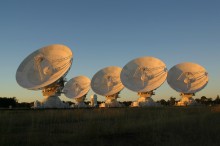
Using the CSIRO Australia Telescope Compact Array near Narrabri, NSW, an international team from Sweden, France, Germany and Australia has measured how warm the Universe was when it was half its current age.
“This is the most precise measurement ever made of how the Universe has cooled down during its 13.77 billion year history,” said Dr Robert Braun, Chief Scientist at CSIRO Astronomy and Space Science.
“This is the most precise measurement ever made of how the Universe has cooled down during its 13.77 billion year history.”
Dr Robert Braun, Chief Scientist, CSIRO Astronomy and Space Science
Because light takes time to travel, when we look out into space we see the Universe as it was in the past — as it was when light left the galaxies we are looking at. So to look back half-way into the Universe’s history, we need to look half-way across the Universe.
How can we measure a temperature at such a great distance?
The astronomers studied gas in an unnamed galaxy 7.2 billion light-years away [a redshift of 0.89].
The only thing keeping this gas warm is the cosmic background radiation — the glow left over from the Big Bang.
By chance, there is another powerful galaxy, a quasar (called PKS 1830-211), lying behind the unnamed galaxy.
Radio waves from this quasar come through the gas of the foreground galaxy. As they do so, the gas molecules absorb some of the energy of the radio waves. This leaves a distinctive “fingerprint” on the radio waves.
From this “fingerprint” the astronomers calculated the gas’s temperature. They found it to be 5.08 Kelvin (-267.92 degrees Celsius): extremely cold, but still warmer than today’s Universe, which is at 2.73 Kelvin (-270.27 degrees Celsius).
According to the Big Bang theory, the temperature of the cosmic background radiation drops smoothly as the Universe expands. “That’s just what we see in our measurements. The Universe of a few billion years ago was a few degrees warmer than it is now, exactly as the Big Bang Theory predicts,” said research team leader Dr Sebastien Muller of Onsala Space Observatory at Chalmers University of Technology in Sweden.
Publication “A precise and accurate determination of the cosmic microwave background temperature at z=0.89”, by S. Muller et al. Accepted for publication in the journal Astronomy & Astrophysics; online at
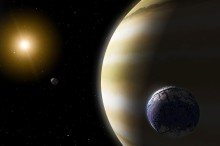
It seems like another day goes by and there’s another discovery of more exoplanets! On January 7, just one week into 2013, astronomers from the Kepler Mission Space Observatory announced the discovery of the latest exoplanet, the creatively named KOI-172.02. At this stage it appears that KOI-172.02 is an Earth-like planet candidate orbiting a star similar to our own sun. It almost seems like old news when scientists announce the discovery of a planet orbiting another star in our galaxy!
As at January 15, 2013 a total of 859 such planets have been identified (details can be found here). These are certainly exciting times for astronomers, but just how do astronomers search for exoplanets?
There are a number of methods used to detect exoplanets including astrometry, the transit method, radial velocity, gravitational microlensing, pulsar timing, eclipsing binaries, circumstellar disks and coronagraphy. Each method of observation has its pros and cons, is used in different circumstances, and produces different results. I will give an overview of each technique:
Astrometry is a technique that requires astronomers to precisely measure a star’s position in the sky, and then make more observations of the stars movement over time. If the star has an orbiting planet or planets, then the gravitational influence of the objects will cause the star to move in a tiny circular or elliptical orbit around the common centre of mass. Finding Earth-mass planets by astrometry requires extreme (sub-microarcsecond or 1 millionth of an arcsecond!!) precision. As the motion of the star is so small, this method has not yet been very productive in detecting exoplanets. However it’s expected that astrometric accuracy from ground-based telescopes will improve and become more useful.
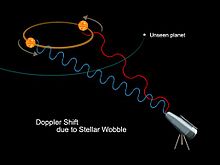
Doppler Shift (Image courtesy of NASA)
One method that is very productive is the Radial Velocity method. This method requires the measurement of the velocity of a star’s centre of mass. Variations in the star’s radial velocity can be deduced from displacements in the star’s spectral lines due to the Doppler effect. If the motion of the star is towards the observer, then the received wavelengths are shorter than those emitted by the source, and longer if the motion is away from the observer. This is similar to the Doppler effect we observe in sound waves when a fire-engine passes us and the pitch of its siren changes! The Anglo-Australian Planet Search was a long-term program that searched for giant planets around more than 240 nearby solar type stars and as of 2010, discovered more than 30 exoplanets using the Doppler method. This method has been by far the most productive method of discovering exoplanets.
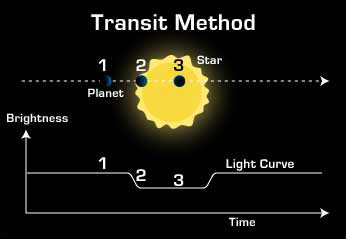
Another popular and effecitve method of detecting exoplanets is the Transit Method which measures the faint dip in brightness of a star when a planet transits the star (passes in front of it as observed from earth). As an exoplanet transits in front of its parent star, the observed brightness of the star drops by a very small amount. This method has emerged as one of the prevailing techniques to search for exoplanets. The amount by which the star dims depends on its size and on the size of the planet. A local example of this phenomenon was the transit of Venus across the face of the Sun in June 2004 and July 2012. The transit method is the second most productive method of detection, though confirmation from another method is usually considered necessary as dips in apparent brightness can arise from events other than a planetary transit. The Kepler Observatory uses the transit method and as of January 2013 it has discovered 2740 candidate exoplanets.
Transit Method (Image courtesy of NASA)
One of the more exciting, yet complex methods is Gravitational Microlensing. This method is used when the gravitational field of a star (close to us) acts like a lens and magnifies the light of a distant background star. When the alignment is exact you might think that the background star would be hidden from view, however the gravitational field of the foreground star bends the light of the background star towards us. This method has the advantage of being very sensitive to planets at large angular separations/distances from the parent stars. This makes gravitational microlensing one method well suited to finding low-mass planets. One major disadvantage is that the event can’t be repeated, as the alignment is unlikely to occur again. Also the planets tend to be very distant, so the other methods are unable to confirm the observations.
A pulsar is a fast-spinning neutron star that emits radio waves at very regular intervals as it rotates. We can use the Pulsar Timing method to discover exoplanets. Slight changes in the timing of its observed radio pulses can be used to track changes in the pulsar’s motion caused by the presence of planets. The presence of a planet orbiting a star affects the timing of the regular signals emitted by the star itself. This phenomenon can be used to detect planets around a pulsar. This method is very sensitive and is capable of detecting planets of a very small mass. In 1992, Wolszczan and Frail used this method to discover the first exoplanet around the pulsar PSR 1257+12. Unfortunately pulsars are pretty rare, so this method is not going to produce a large number of exoplanet discoveries. Also, it’s unlikely that life could survive on planets orbiting pulsars since high-energy radiation there is intense.
When a double star (binary) system is aligned such that the stars pass in front of each other in their orbit, the system is called an eclipsing binary star system. Astronomers can use the Eclipsing Binaries method to discover exoplanets. If a planet has a large orbit that carries it around both members of an eclipsing double star system, then the planet can be detected through small variations in the timing of the stars’ eclipses of each other.
Disks of dust surround many stars, and this dust can be detected because it absorbs ordinary starlight and re-emits it as infrared radiation. The Circumstellar Dust Disks method detects features in dust disks that may suggest the presence of planets. Dust is generated by collisions of small objects, including comets and/or asteroids, and radiation pressure from stars will push the dust particles out into stellar space. Therefore any detection of dust around a star indicates the possibility of recent collisions and other objects.
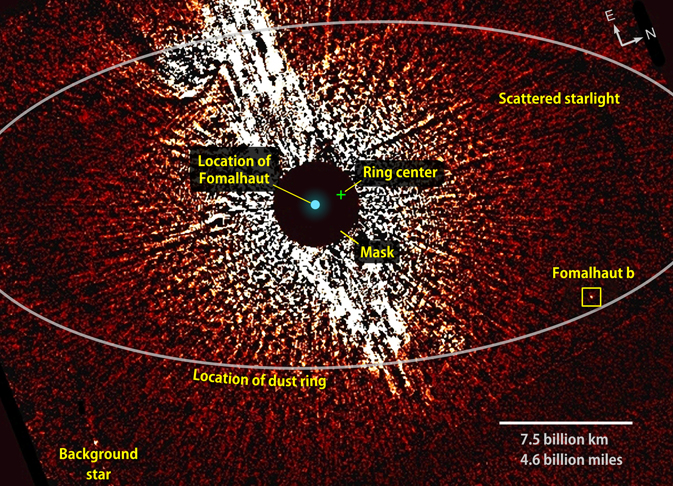
Lastly, a Coronagraph is an object when attached to a telescope, blocks out the direct light from a star so that nearby objects, which otherwise would be hidden in the star’s bright glare, can be observed. In the past coronagraphs have been developed to view the corona of the Sun, but new versions of similar instruments are being used to find extrasolar planets around nearby stars. Coronagraphs can be attached to either ground or space based telescopes. While stellar and solar coronagraphs are similar in concept, they are quite different in design. This is so that observations can be made of exoplanets which are much more distant than our own sun. A stellar coronagraph concept is currently being studied to fly on the Terrestrial Planet Finder mission. On ground-based telescopes, a stellar coronagraph can be combined with adaptive optics to search for planets around nearby stars.
Coronographic Mask showing Dust Disk (Image Courtesy of NASA)
Astronomers at the Harvard Smithsonian Centre for Astrophysics have recently estimated that as many as 17 billion earth sized planets exist in the Milky Way Galaxy alone! Yes, Billion! So I think that we’ll continue to hear about exciting new exoplanet discoveries all the way through 2013 and well beyond. By the way – if you’re really into exoplanets and consider yourself a ‘citizen scientist’ you can help discover new exoplanets! Planet Hunters is an organisation that encourages ordinary folks with no scientific training at all to help find planets from data provided by the Kepler Observatory! If you’re the first person to identify an exoplanet using their data, you’ll be included paper describing the discovery.
This fascinating video, narrated by Leonard Nemoy, gives you a glimpse into the origins of our solar system and NASA Dawn mission’s journey to Vesta & Ceres and its hope to unveil clues as to what was going on at the very beginning of our solar system’s formation!
NASA’s Dawn mission is a spacecraft designed to collect data from the asteroid belt. The ship itself is a marvel. Outfitted with massive solar panel wings that can power it for years, Dawn converts xenon gas into plasma, which it propels from its engine at speeds up to 78,000 miles per hour (or 21 miles per second) for maximum acceleration. In fact, Dawn is the fastest ship NASA has ever launched. Even at top speeds, Dawn required four years to reach its first stop, the asteroid Vesta, the brightest asteroid in the solar system and the only one visible to the naked eye. Departing Earth in 2007, the ship reached Vesta in July of 2011 and departed last September for the asteroid Ceres, which it will reach in February of 2015. Via OpenCulture.
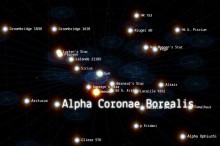
For those visually driven – please take a look at the beautiful interactive map of our stellar neighborhood. With over 100,000 stars in an interactive visualisation, you can take a walk through the stellar neighborhood.
Australian scientists say they have made a breakthrough that could lead to a potential cure for AIDS, modifying a protein in HIV so it prevents against replication and instead protects against the infection.
A FORM of gene therapy developed by researchers at the Queensland Institute of Medical Research may provide hope to sufferers of HIV, preventing the virus from crippling the immune system by manipulating its genetic structure and turning HIV into a weapon against itself.
Dr David Harrich, a naturalised Australian citizen, has utilised a technique that alters the proteins that enable the HIV virus to replicate throughout the body. By modifying the proteins that make up HIV into a mutated form, referred to as Nullbasic, Harrich’s research team have determined that it is possible to block the process of reverse transcription that allows HIV to damage the immune system. This would ultimately render the virus inert, preventing the condition of those infected with HIV from deteriorating further.
Harrich began studying the HIV virus in 1989 while completing his doctorate in experimental pathology at the University of California – Los Angeles. This project explored the issue of genetic expression and the replication of the HIV virus, a research concept he would continue to pursue after moving to Australia in 1997. The initial breakthrough in Harrich’s research occurred in 2007, with the discovery that Nullbasic had the ability to inhibit the spread of HIV.
Harrich told Australian Times: “With money running out, I had my PhD student try one more experiment in late 2007. The experiment was to test ifNullbasic could render HIV non-infectious. The student came back and said it worked, so I told him to do it again and again and again. It works every time.
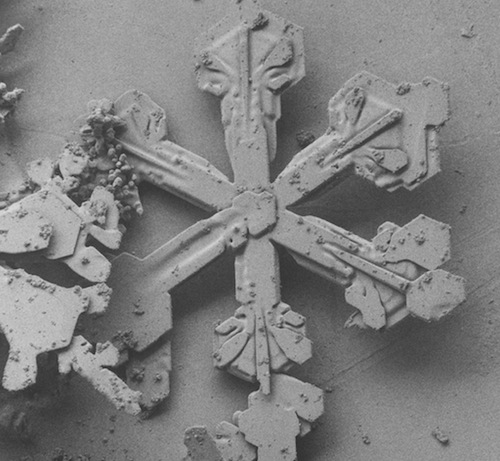
Another week, another collection of weekly science picks! Those of us over here in Northern Europe have been enjoying snowy weather this past few days, with more expected on the way. At the same time, many of us have been keeping a concerned eye on the recent events in Australia – the bush fires being among them.
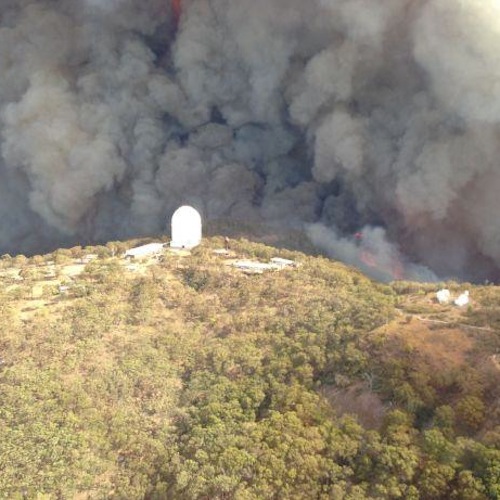
Among the many areas hit by the fires was Siding Spring Observatory. While some buildings were destroyed and others damaged, all of the telescopes appear to be ok. Details on the entire event from a first hand perspective are given by astronomer Amanda Bauer on her blog, Astropixie.
from all accounts i’ve received, heard, and read, the area surrounding coonabarabran is a “disaster zone,” which is heart-breaking news. fire service crews will be working overnight, taking advantage of milder conditions, to put containment lines around the edges of the fire, hoping to protect coona before the winds change.
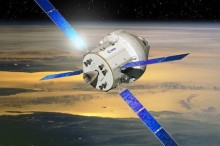
Orion, the spacecraft being developed to replace the Space Shuttle and ease the pressure on Russia’s Soyuz craft, has been a troubled undertaking. As with virtually all NASA projects lately, it’s been hampered by repeated budgetary problems. The latest development in the story is that Europe has now formally agreed to assist in developing the Orion craft, with the long term goal of deep space missions, to the Moon and Mars.
The current plan calls for Europe to build the prototype module for 2017 and a number of components that would be needed for the second vehicle in 2021, although a formal go-ahead to complete this additional model is some years off.
Depressingly, there is still an obvious gender gap in science, though it’s at least heartening to know that this is an issue which some are paying serious attention to. Many are going what they can to fix the problem, while others are disappointingly willing to argue that nothing should be done. One article which caught my eye this week was written by an anonymous senior scientist, arguing that we should be taking a more aggressive approach to tackling this problem. I for one, wholeheartedly agree!
Can it be that women are treated less fairly than men? A deceptively simple piece of research led by Jo Handelsman at Yale University has recently suggested that they are… I should point out here that there was no statistically significant difference between the responses from male or female faculty, nor were there differences between levels of faculty, suggesting this is not a hierarchical bias.
Back in space, new plans for the International Space Station involve blowing something up. Nevada-based Bigelow Aerospace have been contracted to develop an inflatable habitat module for the space station, with the intention of using the new SpaceX Dragon craft to send it up into orbit. Private companies are evidently becoming major players in human spaceflight.
Bigelow hopes the tests done in orbit will prove that inflatable capsules are safe and reliable for space tourists and commercial research, an idea almost as old as NASA itself. The space agency began investigating the concept of expandable spacecraft in 1958. Space stations like this would be easier to launch and assemble than those with metal components, so would be cheaper.
On a final note, while many of us tend to consider invertebrate animals as being inferior, there’s evidence that some of them may be more self aware than we give them credit for. While some research has concluded that fish don’t feel pain in any meaningful way, crustaceans like crabs and prawns probably do. It’s probably about time we extended the laws on humane treatment of animals to cover invertebrates too.
A study has revealed that the shore crab, a close relative of the species we use for food, responds to electric shocks and then goes on to avoid them. Previous research has shown that prawns and hermit crabs also react to painful situations.
Whether you’re dealing with fire or ice nearby, stay safe and have a good week!
Image credits:
Top – NSW Rural Fire Service
Bottom – Electron Microscopy Unit, Beltsville Agricultural Research Center, Maryland.
Featured – ESA
As with many parasites, the nuisance they bring is partly compensated for by new insights they provoke. The African trypanosome is perhaps unique among all of the diseases of developing worlds. The diseases of sleeping sickness, inflicted on man and cattle alike, perhaps drove early man ‘out of Africa’ — in an attempt to avoid tsetse infested areas of the Rift Valley. The Zulu word for powerlessness and useless, “N’gana
SignMedia is an online learning resource that uses sign language to teach vocational written English to deaf media professionals. The project was proud to be a finalist in the recent MEDEA Awards 2012.
The world of broadcast media offers an increasingly rich source of employment for deaf graduates and professionals across Europe, but the focus on communication through written English still proves to be a barrier for sign language users. Essential production documentation contains challenging technical English, as do many of the instructions and descriptors used in software, hardware and on technological equipment.
The SignMedia project aims to break down these barriers with an innovative and accessible online learning resource that uses Sign Language video and interactive tasks. It has pushed boundaries further in eLearning design, bringing video narrative, and an immersive, alternative reality to deaf online education for the first time. To create an authentic media experience for the users, the learning takes place within a fictional deaf production company whilst working on the soap opera ‘Beautiful Days’. All learning
activities are designed around authentic media documentation taken from the production process, such as Risk Assessments, Call Sheets, Treatments and Scripts, thus enabling deaf users to develop language skills that are directly transferrable to their place of work.
The use of Sign Language videos and deaf presenters to teach written English is in itself an innovation. For many years, deaf people have been taught through the spoken word, but recent developments have seen a rise in sign bilingualism across Europe – a teaching method that promotes deaf culture and uses sign language as a method of delivery. Within the SignMedia learning tool, we were determined that Sign Language users would not feel like an afterthought, an ‘added extra’.
The visual medium of Sign Languages also means that print dictionaries are of limited use. As a result, it is a real challenge to make specialist language items and neologisms accessible to the wider deaf community and younger generations. This presents an obvious disadvantage to Sign Language users who wish to break into the media industry. SignMedia addresses this need with the inclusion of a signed glossary with language items selected by deaf and hearing media industry professionals.
Target users have described the tool as engaging, unique and fun. We were especially delighted when feedback revealed that the ‘alternative reality’ learning environment removed the threat and pressure that many deaf people have experienced in formal education. There has also been a powerful response to the Sign Language videos, with deaf adults revealing that they have understood English grammatical concepts for the first time after watching the clips.
The SignMedia project recognises the immense potential of combining the shared visual modalities of e-learning, media and Sign Language. The result is a product that uses contemporary media developments to reflect the vibrancy, creativity and professional aspirations of the deaf community. SignMedia was supported by Leonardo da Vinci Development of Innovation and the consortium included deaf and hearing teams from the University of Wolverhampton (UK), University of Klagenfurt (Austria), University of Turin (Italy) and Mutt&Jeff Pictures (UK). Visit the resource.
By Christine Jolly, University of Wolverhampton, UK