Blog

  • Zorbing: Adventures in a Hamster Ball

    Zorbing: Adventures in a Hamster Ball

    OzBall - Zorbing on the Gold Coast
    OzBall – Zorbing on the Gold Coast

    Zorbing

    It was a cloudy day, but we headed down the M1 towards the Gold Coast. Arriving at our destination around 9/9:30AM. Destination: OzBall.

    It was about a year ago I had seen video of this amazing, thrilling ride. A weatherman on Sunrise 7 strapped inside a huge plastic ball rolled down a hill. This is called zorbing. Apparently it has been around for decades and can be found in quite a few countries. I knew I must try this on my next trip to Australia. Despite bewildered looks and headshakes from my family, I was going zorbing.

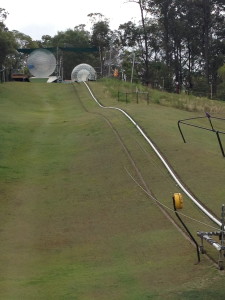
    We left the car in the car park and walked through a field to the entrance to OzBall Park. It’s a little off the beaten track. But there it was, a huge grassy hill, the zorb shining in all its glory at the top. Beckoning, if we dare.

    OzBall has two zorbs. One is the Hydro Ride where 1-3 riders slosh around in water within the zorb. To me, it’s what being trapped in the washing machine on the delicate cycle would look like. The other is the Harness Ride. The real deal; where you’re strapped to the wall of the zorb facing your fellow zorber, all zany-eyed and excited because you’re a self-described thrill seeker! Little did I know that ride was to exert every known (and unknown) calculable physical force on my body. There was no line or wait for the harness ride. Hmmm.

    The Zorb (The Hamster Ball)

    You enter the zorb by pulling yourself through a tunnel-like entrance. The zorb is massive – measuring about 3 metres (10 ft) in diameter. Tucked inside is an inner orb about 2 metres (6 ft 7 in). The space between the two orbs creates a shock absorbing, air cushion, connected by hundreds of small nylon strings. The tough, durable plastic is approximately 0.8 millimetres (0.03 in) thick. Shackled securely in my seat by 3 safety mechanisms: the chest harness, lap belt and ankle restraints; I felt completely safe.

    The Ride

    140 metres (459 ft) is not a long distance. And the speed seemed along the lines of a kid’s carnival ride, reaching up to 30 KPH (19 MPH). I didn’t factor into account the slope of the hill. And it’s not merely an up and down motion, but a side-to-side motion as well. I think you can see where I am going with this. I got way more than the adrenaline rush I bargained for. No projectile vomit or anything of the sort. Just a lot of screaming and wishing for it to be over. It seemed an eternity had passed. The zorb paused. The zorb started moving again. More screaming. The only words I could get out of my mouth were, “Oh, it’s not over yet!” Rolling down the hill, eyes open, eyes shut, trying to stare out the porthole at the grass to fixate my glaze on a constant sight. Finally. The. Zorb. Stopped.

    Lawnmower martini. Not sure what that is, but that’s what I felt like. I could hardly speak, but got out of that zorb as fast as possible. Slight dizziness, wobbly, and an insane amount of belching from all the air trapped inside my stomach. The OzBall operators offered us a free hydro ride for being such good sports. I politely declined the invitation.

    Why Zorbing?

    The point of this story is that it is an incredible opportunity for learning about physics! And how fun science can be when applied to wacky and crazy ideas! I always wanted to go to the theme park on a field trip to ride roller coasters and learn about the forces at work. OK, I really just wanted to ride roller coasters. Man, some science classes were so lucky!

    Whether it’s an activity like zorbing, or riding roller coasters, biking, skiing or skateboarding, science is involved. Tools working in tandem with the human body for the benefit of amusement. How far you decide to delve into the science behind each is up to you. I believe that is how to keep science fun and entertaining and keep the kids coming back from more. Education could take a cue from zorbing’s playbook – just let go and roll down the hill.

    As for me, I’m glad I tried it; ticked the zorbing experience box. If you saw that episode of Modern Family where Phil does everything in his power to remain a roller coaster fanatic so he can retain that bond with his son, Luke; then you know what I’m talking about. But I’m going to lock this one away and slowly try to rebuild my street cred. (Thank goodness we didn’t opt for the video!)

    Warning: Zorbing has been labelled an “adventure sport”, like bungee jumping or skydiving and can be dangerous if the right precautions are not taken. Even riding a roller coaster can sometimes end in tragic results. Deaths from zorbing have occurred, one in Russia just last week. A grassy hill with a catch containment system at the bottom is much different than going down a snowy, rocky mountain. Exercise your best judgement and caution if you are going to attempt zorbing.
     

  • The perils of space exploration: last flight of space shuttle Columbia

    The perils of space exploration: last flight of space shuttle Columbia

    The 28th and last flight (STS-107) of the space shuttle Columbia was ten years ago. Launched on January 16, 2003 Columbia was destroyed at about 0900 EST on February 1, 2003 while re-entering the atmosphere after its 16-day scientific mission. The destruction of the shuttle killed all seven astronauts on board.

    image
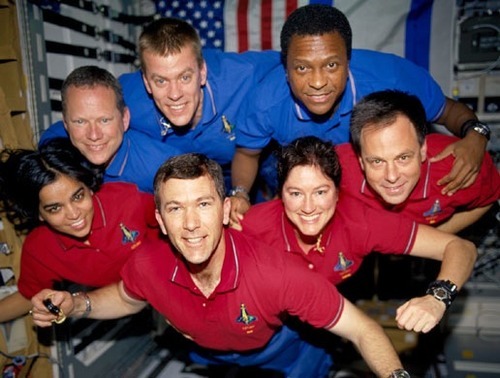
    The traditional “in-flight” picture of the crew. This picture was taken from a camera recovered from the crash debris. Photo credit NASA.

    An illustrious career

    Columbia was the first of the space shuttles to fly, it was successfully launched on April 12, 1981, the 20th anniversary of the first human spaceflight by Yuri Gagarin in Vostok 1, and returned on April 14, 1981, after orbiting the Earth 36 times. The first flight of Columbia (STS-1) was commanded by John Young, a Gemini and Apollo veteran who was the ninth person to walk on the Moon in 1972, and piloted by Robert Crippen, a rookie astronaut who served as a support crew member for the Skylab and Apollo-Soyuz missions.

    Columbia has an illustrious career as part of the US space program, featuring many ‘firsts’. It was the first true manned spaceship. It was also the first manned vehicle to be flown into orbit without benefit of previous unmanned “orbital” testing; the first to launch with wings using solid rocket boosters. It was also the first winged reentry vehicle to return to a conventional runway landing, weighing more than 99-tons as it was braked to a stop on the dry lakebed at Edwards Air Force Base, California.

    image
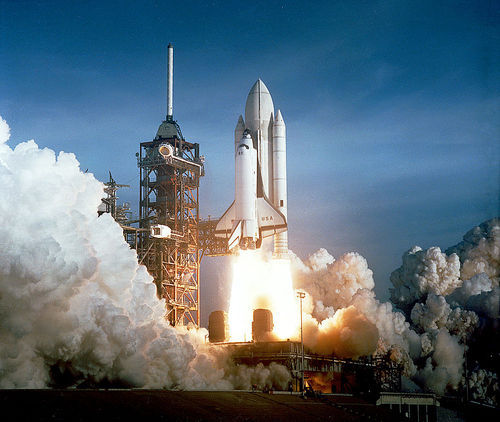
    NASA PHOTO: The April 12, 1981 launch at Pad 39A of STS-1, just seconds past 7 a.m., Columbia carries astronauts John Young and Robert Crippen into an Earth orbital mission scheduled to last for 54 hours, ending with unpowered landing at Edwards Air Force Base in California.

    Its second flight, STS-2 on November 12, 1981 marked the first re-use of a manned space vehicle. A year later it became the first 4-person space vehicle – bumping this to six on its sixth flight (STS-9) on November 28, 1983. This flight also featured both the first flight of the reusable laboratory ‘Spacelab’ and the first non-American astronaut on a space shuttle, Ulf Merbold. STS-93, launched on July 23, 1999, was commanded by Eileen Collins, the first female Commander of a US spacecraft.

    Space Shuttle Columbia flew 28 flights, spent 300.74 days in space, completed 4,808 orbits, launched 8 satellites and flew 201,497,772 km in total, including its final mission. Its penultimate flight (STS-109) was the third of the highly publicised servicing and upgrade flights to the Hubble Space Telescope.

    The fatal flight

    The rockets fire. Amidst the thundering fiery roar the shuttle lifts majestically from the launch pad. Unnoticed at the time, at 81.9 seconds after launch a foam insulating block disintegrates upon hitting the leading edge of the shuttles left-wing. The launch continues as scheduled. One hour after launch Columbia was in orbit and the crew began to configure it for their 16-day mission in space.

    The next day, routine analysis of high-resolution video from the tracking cameras reveals the debris strike. Multiple groups within the mission team review the tapes. They assess the possibility of damage and decide that an image is required of the wing. They make a request to the NASA ground management for imaging of the wing in-orbit.

    However, it was considered “of low concern” that the carbon matrix could be damaged by the foam block. The engineers were over-reacting. The Space shuttle Program managers declined to get the Columbia imaged – or alert the shuttle crew. In fact the crew were told that the impact was a “turn-around issue”, something they had seen before and would be a maintenance check only. Titanic-like the mission continued.

    Scientifically the mission was great success. The shuttle crew worked around the clock to ensure that maximum scientific value was achieved. Including an investigation of the web-spinning abilities of the Golden orb spider under low gravity. An experiment designed by students from Glen Waverley Secondary College, in Melbourne Australia.

    The morning of re-entry all appears calm and normal in the mission control room. As re-entry started the crew are seen to be in good spirits and looking forward to coming home.

    Then while travelling at Mach 24.1, during the 10-minute fiery re-entry, when the leading edge reaches temperatures in excess of 1550 Celsius, the damaged thermal protection panels on the wing overheated – then failed catastrophically. The wing and shuttle disintegrating.

    The nearly 84,000 pieces of debris from the shuttle are stored in a 16th floor office suite in the Vehicle Assembly Building at the Kennedy Space Center.

    The seven crew members who died aboard this final mission were: Rick Husband, Commander; Willie McCool, Pilot; Michael Anderson, Payload Commander; David Brown, Mission Specialist 1; Kalpana Chawla, Mission Specialist 2; Laurel Clark, Mission Specialist 4; and Ilan Ramon, Payload Specialist 1.

    Two other died in the search for the debris: Jules Mier (Debris Search Pilot) and Charles Krenek (Debris Search Aviation Specialist).

    image
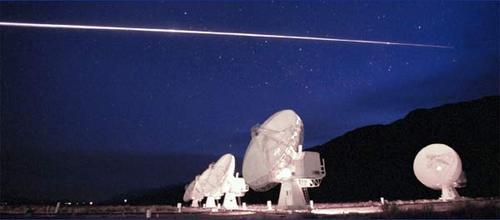
    NASA PHOTO: Final descent, Columbia streaking over the Owens Valley Radio Observatory in Big Pine, California

    Is spaceflight perilous? Or an unforgiving adventure?

    It is rather remarkable that NASA had launched men into space sixteen times during the the Mercury and Gemini programs without a casualty – although there had been some scary moments.

    Compared to the cramped and tiny Mercury capsule the Apollo command module was, in spaceflight terms, a luxury liner. So when a spark ignited the oxygen atmosphere of the Apollo 1 capsule on January 27, 1967 killing three astronauts it was shocking for both NASA and the public. The last communication from the Apollo 1 capsule was not revealed for a long time to the public:

    Fire! We’ve got a fire in the cockpit! We’ve got a bad fire…..get us out. We’re burning up…..

    The last sound was a scream, shrill and brief. After this nothing at NASA would be quite the same again.

    The fatal Apollo 1 fire was also unexpected. At the time of the fire the crew of Gus Grissom, John Young and Roger Chaffee were perched atop an empty Saturn V rocket involved in routine testing of the capsule control systems.

    The 1986 Challenger disaster was equally shocking – and far more public. The explosion 73 seconds after lift off claimed shuttle crew and vehicle. The cause of explosion was determined to be an o-ring failure in the right solid rocket booster. Cold weather was determined to be a contributing factor. The subsequent investigation and changes delayed the next shuttle launch to late 1988.

    image
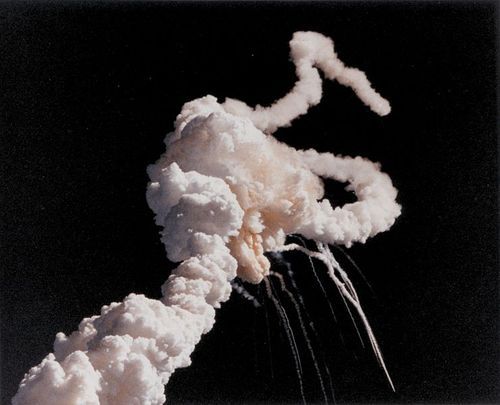
    Space Shuttle Challenger’s smoke plume after its in-flight breakup, resulting in its crash and the deaths of all seven crew members. Photo credit NASA.

    You could say that space exploration in itself is not inherently dangerous. But to an even greater degree than aviation, it is terribly unforgiving of any carelessness, incapacity or neglect. Gus Grissom has been quoted as saying during the pioneering Mercury missions:

    If we die we want people to accept it. We hope that if anything happens to us it will not delay the program. The conquest of space is worth the risk of life.

    I’m not sure that Gus Grissom would have accepted these deaths as an acceptable risk of human spaceflight.

  • Phantom fishing targets turtles in northern Australia

    Phantom fishing targets turtles in northern Australia

    14 January 2013

    Phantom fishing targets turtles in northern Australia CSIRO scientists working with GhostNets Australia and Indigenous rangers are identifying hotspots where lost fishing nets are threatening our marine biodiversity.

    Worldwide, around 640 000 tonnes of fishing gear is lost or discarded each year. These ‘ghostnets’ can continue fishing for decades, entangling huge numbers of marine animals, including threatened and commercially valuable species.

    “Our research goes beyond discovering where ghostnet fishing is taking place, to actually estimating its impact on biodiversity, in particular on threatened marine turtles.”

    Dr Denise Hardesty, CSIRO Ecosystem Sciences

    Ghostnets, originating mainly from fisheries in Asia and Australia, are a particular problem in Australia’s Gulf of Carpentaria, where they can reach densities of up to three tonnes/km, among the highest recorded worldwide.

    “Our research goes beyond discovering where ghostnet fishing is taking place, to actually estimating its impact on biodiversity, in particular on threatened marine turtles,” Dr Denise Hardesty of CSIRO said.

    “Using a model of ocean currents and data collected by Indigenous rangers on the number of ghostnets found during beach cleanups, we simulated the likely paths ghostnets take to get to their landing spots on beaches in the Gulf of Carpentaria,” Dr Hardesty said.

    “Combining this with information about the occurrence of turtles in the area, we found that entanglement risk for turtles is concentrated in an area along the eastern margin of the Gulf and in a wide section in the southwest extending up the west coast,” she said.

    “Most ghostnets enter the Gulf from the northwest and move clockwise along its shore. This means we can help protect biodiversity in the region by intercepting nets as they enter the Gulf, before they reach the high density turtle areas along south and east coastlines,” she said.

    Australia is home to six of the world’s seven threatened species of marine turtle. During a recent cleanup of ghostnets on beaches in the Gulf, 80 per cent of animals recorded in nets were marine turtles, including Olive Ridley, Hawksbill, Green and Flatback turtles.

    “Our predictions of the distribution of turtles washing ashore entangled in ghostnets matched the actual frequencies of turtles found in ghostnets during beach surveys, suggesting our model is accurate,” Dr Hardesty said.

    Ghostnets are a global problem, capturing seabirds, marine mammals and sea turtles worldwide. Lost or abandoned fishing gear makes up only 20 per cent of marine debris but has a disproportionate effect because it is designed to capture wildlife.

    “Our research shows that combining models of marine debris with species occurrence data could identify global hot spots for impact, helping pinpoint where prevention and clean-ups could really make a difference to biodiversity,” Dr Hardesty said.

    This research used information on ocean currents generated by the BLUElink Ocean Data Assimilation System to simulate the paths of ghostnets.

    Ghostnet impacts on globally threatened turtles, a spatial risk analysis for northern Australia [external link]‘ was published by CSIRO and GhostNets Australia in the January 2013 online early issue of Conservation Letters [external link].

    Image: A turtle washed ashore caught by a ghostnet (Image: Alistair Dermer)

  • Tricks of the mind

    Tricks of the mind

    Have you ever experienced a sudden feeling of familiarity while in a completely new place? Or the feeling you’ve had the exact same conversation with someone before?

    This feeling of familiarity is, of course, known as déjà vu (a French term meaning “already seen

  • Weekly Science Picks

    Weekly Science Picks

    datatunnelI’ve just returned from a fantastic holiday in Australia (sad I had to leave). The great thing about travel is that it opens your mind and exposes your senses – elevates it to a higher level of thinking, thinking that is clear and uninterrupted. The not so great thing about travelling to far away places is the resulting jet lag…that can lead to not so clear and uninterrupted bouts of thinking at 3AM. What follows is a hodgepodge of the collection of science stories I encountered over the past week.


    This first article opens up a much-needed debate on the policy of biodiversity and species preservation. Whether it is rhinos, right whales, snow leopards, I think it’s time we had a conversation on how present day society moves forward with species interaction.

    Rhino poaching in South Africa reaches record levels by Matt McGrath

    “Rhinos are being illegally killed, their horns hacked off and the animals left to bleed to death,” says Traffic’s director of advocacy Sabri Zain, “all for the frivolous use of their horns as a hangover cure.”


    While in Brisbane, I had the great pleasure to meet with the director of Australian Science, Dan Petrovic. We had an hour-long conversation about artificial intelligence. I’m not sure how much interaction I want with my search engine in the future, but the beauty of his story is in the intricate details and the possibilities that may soon be reality. This story technically wasn’t from last week, but that is when I read it. So if you haven’t given it a read, sit yourself down with a cup of coffee or tea and do so. We would love to host a Google+ hangout and get some reader feedback on this topic.

    Conversations with Google by Dan Petrovic

    This article explores the future of human-computer interaction and proposes how search engines will learn and interact with their users in the future.


    I love science. How did I not know about io9? No idea. But thank goodness I have added it to my weekly reading list. (Thanks Dan!) This next story is about humour more than anything. And in science, a sense of humour is an important character trait to have. The U.S. may not be building a Death Star, but kudos to them for the response and taking the opportunity to highlight STEM. My nieces in Ohio are hard at work on building the Lego Death Star they received from Santa. So in a way, the U.S. is getting a Death Star and two aspiring scientists. Maybe thousands!

    The White House will not build a Death Star, tells us in hilariously geeky fashion by Lauren Davis

    If you do pursue a career in a science, technology, engineering or math-related field, the Force will be with us! Remember, the Death Star’s power to destroy a planet, or even a whole star system, is insignificant next to the power of the Force. –  Response from Paul Shawcross, Chief of the Science and Space Branch at the White House Office of Management and Budget


    Apparently Shell experienced an incident with its Arctic drilling on New Year’s Eve, with no catastrophic consequences. Arctic drilling seems like a horror movie. You’re sitting on the couch watching TV, the music is loudening, suspense is growing, you know something bad is about to happen at any second…

    An energy analyst from the Brookings Institution mentions in the article that oil and gas companies don’t have a choice when it comes to Arctic exploration and drilling. In order to remain competitive, they have to go up there.

    In Kulluk’s Wake, Deeper Debate Roils on Arctic Drilling by Traci Watson

    Fortunately for the energy industry, the Arctic has become more hospitable to drilling just as other locations have become more hostile. The Arctic sea ice melted away to a record low in 2012, according to the U.S. National Oceanic and Atmospheric Administration, spelling easier access for drill ships, though melting ice also brings new problems.

    Fortunate. Back to the drawing board. So many plans and policies, so little time.

    As always, stay thirsty for knowledge.

  • Telecommunications and the NBN Infrastructure Revolution

    Telecommunications and the NBN Infrastructure Revolution

    According to the 2011 Deloitte Access Economics for Google report, The Connected Continent, the contribution of the Internet to the Australian economy is about $50 billion, or 3.6% of the national GDP, and this number has been increasing substantially and rapidly over the years [1]. This number also does not take into account huge savings in many areas of life made possible by the increase in productivity due to the use of high speed internet. This is the primary reason why the old telecommunications technologies, which were used back in the day when the Internet did not have so many advanced business purposes, are gradually becoming more and more obsolete.

    Communication has always been one of the most significant aspects of the progress of human society and culture, and in this increasingly globalised world, telecommunication, the means of communicating by sending different types of signals over a distance using technology, is one of the principal means of progress. The first organised communications network in Australia was the postal network back in the 19th century. The first means of telecommunication dates back to the use of smoke signals, and telecommunication technologies include telegraph, radio, telephone, satelite technologies and the most recent fibre optics. The beginning of the 20th century was marked by the development of the first wireless technologies with the creation of the first radio communication technologies. The beginning of the 21st century is marked by the fast spreading of the fibre optic telecommunications network all over the globe.[2]

    Most Australian households and businesses are currently still using a limited bandwidth, copper wire network which is over a century old. This network was initially designed for telephones, and the quality of the signal sent through this network decreases significantly with distance, so, by today’s standards it does not support high Internet speeds, which is one of the main requirements of modern life. This is why the Australian government started building the National Broadband Network, abbreviated as NBN. The NBN is a cutting edge fibre-optic broadband network, that is currently being built across Australia in order to provide the telecommunications infrastructure necessary for the further development of the Australian economy in today’s online business world.


    NBN for Business by Macquarie Telecom [3]

    With the growth of downloaded internet volume increasing by over 50% last year [4], significant investments in the development of the Australian telecommunications infrastructure, and specifically in NBN, is more timely and crucial than ever before.

    The NBN service will bring an increase in internet speed of 20% up to the incredible 200% over the next decade. It has already been rolled out in most urban areas in Australia, but the plan is for the fribre optic network to cover over 93% of Australian households and businesses by the completion of the project. The new, nation-wide fibre optic network is expected to increase the effectiveness, quality and productivity of not only businesses, but also government, health and educational institutions.[5]

    In today’s digitised world, it is highly important to keep in mind that the development and the application of new technologies, especially when it comes to the telecommunications infrastructure, and every investment into the development of a future-proof, strong economy, are absolutely crucial for advancement of Australia in today’s increasingly knowledge-based Australian and global economy.

    References:

    [1] “The Connected Continent”. Deloitte Access Economics. August 2011. Web. 10 April 2013 Available at http://connected-continent.appspot.com/media/illustrations/download.pdf
    [2] “Plagiarism.” Wikipedia, The Free Encyclopedia. Wikimedia Foundation, Inc. 8 April 2013. Web. 10 April 2013. Available at http://en.wikipedia.org/wiki/Telecommunication
    [3] “NBN for Business”. Macquarie Telecom. Web. 10 April 2013. Available at http://www.macquarietelecom.com/corporate/data-voice/nbn
    [4] “Internet Activity, Australia, December 2012”. Australian Bureau of Statistics. 9 April 2013. Web. 10 April 2013. Available at http://www.abs.gov.au/ausstats/abs@.nsf/mf/8153.0
    [5] “Why is the NBN important?”. Australian Government, Department of Broadband, Communications and the Digital Economy. Web. 10 April 2013. Available at http://www.nbn.gov.au/nbn-advertising/why-is-the-nbn-important/

  • Morphine Hurts

    Morphine Hurts

    Why does Morphine cause pain?

    He was diagnosed with testicular cancer at the age of 27. At the age of 39 he was in so much pain he begged his doctors to die. He was in pain because of morphine. In the 12 years he lived since he was diagnosed he had a therapeutic regimen that allowed him to have a good quality of life. His pain was controlled by bursts of sustained-relief morphine twice a day. Up until a family trip in November of 2000 there were no problems. Then the pain got inexplicably worse.

    “Beating, shooting, stressful, squeezing, piercing, constant and terrifying” were the words he used to describe his torment. Any movement made it worse. In the end he had to lay “very, very still

  • Unknown Corals of the Deep

    Unknown Corals of the Deep

    Corals are some of the most beautiful things to be found under the sea, blossoming in clusters like gardens off tropical coasts worldwide. Easily the grandest display is to be found in Australia with the Great Barrier Reef, and it seems that the reef may contain even more diversity than was once thought. The latest surveys have found Australian corals thriving at depths far greater than was ever before thought possible.

    The Ribbon Reef lies near the Torres Strait at the edge of the Australian continental shelf, and certain parts of it are normally very difficult to get to. The University of Queensland’s Seaview Survey has been fastidiously charting the waters off the Australian coast with a diving robot, and were extremely fortunate to be able to use an unusually calm day to explore the windward side of the reef – normally a perilous exercise due to huge waves and cyclones. Exploring the depths of the reef, they found a huge surprise.

    While deepwater corals are known in other parts of the world, their appearance in the waters here was a surprise. At a depth of 125 metres, in dark waters where very little sunlight ever reaches, they found corals. Corals which had only been recorded at depths of 70 metres previously, giving Ove Hoegh-Guldberg, the chief scientist of the team, reason to suspect that the finding may be able to give a deeper understanding of how coral reefs spawn and grow.

    Hoegh-Guldberg is also quoted as saying, “What’s really cool is that these corals still have photosynthetic symbionts that supposedly still harvest the light,” which is especially remarkable because the waters in which these corals have been found are so inky and dark that human divers would have trouble seeing without artificial illumination. As well as photosynthesis, shallow water corals have reproductive cycles which are synchronised by the phases of the moon. With so little moonlight being able to penetrate to the depths at which these corals live, their spawning patterns are presently a complete mystery. It could be that these corals lead a lifestyle very different to their shallow water brethren.

    The deepwater corals have also fared far better in the storms which have caused massive damage to the shallower parts of the reef. The team are now investigating how conditions such as ocean acidification and global warming are affecting these deeper reef dwellers.

    The Seavew Survey has proven to be extremely successful so far, with a number of specimens which they’re currently investigating. Some species they’ve found are thought to be previously unknown in Australia, and others may even be newly discovered species. Hoegh-Guldberg summed up the team’s discoveries quite succinctly with the statement, “We are yet to discover many corners of the Earth.” Indeed we are. It’s exciting to know that there’s still more for us to discover about our planet!

    Image credit: InvaderXan/flickr

  • The Oldest Fossils in the World

    The Oldest Fossils in the World

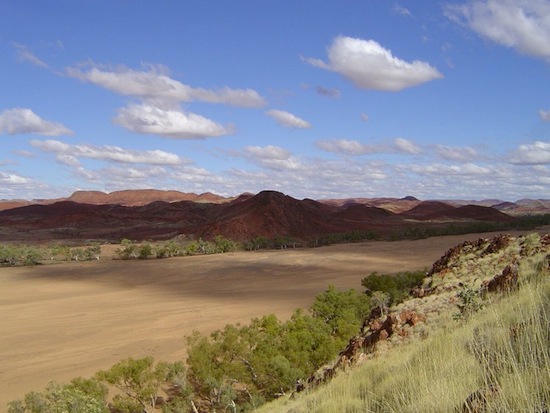
    Life has existed on planet Earth for a long time. Precisely how long, however, is a question which many are still searching for an answer to. The most recently discovered piece in that puzzle may put us another step closer to finally answering that. Discovered in Pilbara, Western Australia, are what are quite probably the oldest fossils discovered on Earth so far!

    At approximately 3.49 billion years old, these fossils come from a time long before complex organisms like us existed. Before evolution forged living things into the structures we recognise around us today, and before distinctions like “plant” and “animal” had even been drawn, our world was populated by bacteria and other single celled life. In fact, on a cosmological timescale, this wasn’t long after our planet had formed.

    Being left by bacteria, these fossils appear as little more than patterns left behind in sandstone, but after careful analysis they’ve been found to very definitely be fossils and not simply mineral formations. Discovered in some of the best preserved sedimentary rocks on Earth, at Strelley Pool in Pilbara, these fossils offer a fascinating glimpse at some of the oldest known life on Earth. Excitingly, as well as the discovery of this life, these is some evidence that it may have had some organisation to it as well.

    Found preserved in quartz sand grains, the fossils show several cell-like structures all of a similar size, much like bacterial colonies still found on Earth today. The age of these fossils can also be estimated with some precision, due to the rocks in which they were found. These particular rocks were formed between two volcanic successions, which means that their age can be determined down to a few tens of millions of years!

    Interestingly enough, any life this old would have been living without any oxygen – oxygen wasn’t abundant in Earth’s atmosphere until around 2.4 billion years ago. It’s quite likely then, that these bacteria had a metabolism based around sulfur, just like bacteria found in marshes and other oxygen-poor environments in the world today.

    The most exciting implications behind this find are those for life on other planets. If life could form so soon on planet Earth, it means that life might well have existed on other planets in the solar system too. Venus before it developed its hellish greenhouse effect and Mars before it lost all of its water, may have been home to similar primitive life. While few are hopeful of finding life on our neighbouring planets today, it still gives hope of discovering fossils as we continue to explore them. For astrobiologists hoping to find life on planets outside our solar system, it means that where life develops, it may occur quite soon after planets form.

    Some of the oldest rocks on Earth

    Image credits: Top – D. Wacey/UWA, Bottom – Abigail Ailwood

  • Remembering to forget

    Remembering to forget

    Memories influence our behaviour for better or worse. A traumatic incident, experienced once, can darken our lives for ever more. Drug or alcohol addiction – driven by remembered rewards – can render the idea of “normal life

  • Weekly Science Picks

    Weekly Science Picks

    With 2012 firmly behind us, with no more reflections and no more top ten lists, let’s begin…

    The BBC. As warm and comforting as mother’s milk. A beacon for the rest of the world to follow. Journalistic integrity, and more bang for your buck than any other establishment I can think of. There is nothing the BBC does so well as documentaries, namely nature documentaries. BBC Africa is the latest in the long line of documentaries, in the grand tradition of nature documentaries. Then there is David Attenborough. A man no one can find fault with. And the voice of Mother Nature! If you have a chance to catch this series, do not miss it. If your country is not fortunate enough to be bestowed with the British Broadcasting Corporation… then emigrate!

    This time of year that virus from Norwalk is always in the news. I’ve written about it before. Norovirus is the perennial winter vomiting bug. It seems, this year’s outbreak was particularly one of note — causing over 1 million cases in the UK alone. Carl Zimmer explains why it is “possibly the best pathogen

  • 2013: The Year to Come

    2013: The Year to Come

    The 21st century is now a teenager. We prospered. We suffered. But most of all, we survived. Here’s to 2012 and the year ahead. 2012 was a remarkable year, especially for science. There were world firsts and breakthroughs. The story of the Higgs boson definitely made the top of many lists. The relentless march of scientific progress is always long and 2013 will mark another chapter.

    Where will the science firsts and breakthroughs come from? Of course we can never predict where the big science stories will come from. And that is part of the beauty. But at least 2012 has told us where to look.

    The NASA Mars rover Curiosity still treks on. NASA’s Mars Science Laboratory Project is using Curiosity during a two-year prime mission to assess whether areas inside Gale Crater ever offered a habitable environment for microbes. So there are still much to discover on the red planet. Curiosity explores the Glenelg region during the early part of the year. Then it will venture on, a 6 to 9 month journey across the martian landscape taking in the sights and seeing what is there to discover.

    In 2013 expect the comet Ison to garner some column inches towards the back end of the year. In early 2013 October it will pass very near Mars and possibly be visible to rovers and orbiting spacecraft. The newly discovered comet could develop a spectacular tail, becoming as bright as the full Moon as it passes by our Sun. The comet is currently falling toward the Sun from between the orbits of Jupiter and Saturn. There is a chance it won’t survive this encounter. Whatever survives will then pass nearest the Earth in late 2013 December.

    In 2012, disaster relief made prime time news. In our ever-changing climate, disasters are becoming more of a recurring topic. Hopefully, 2013 will give us a little bit more foresight in this department. We have to mitigate better, and lessen the damage and destruction of human life.

    In 2013, we shall eradicate guinea worm. Polio is also on the list, but progress is slow on that one. Smallpox, rinderpest, and guinea worm makes three. More remarkable than the other two because we will do it without any cure or drug treatment. Our science has produced no miracle cure, no vaccine, no treatment, and yet guinea worm will be gone.

    We are constantly at the frontiers of science and we don’t know quite what to expect. What we can be sure of is that as the news breaks, the science will be covered by bloggers and journalists, at both ends of this new media scale. The science writing ecosphere has seen very little change in 2012. The furniture was rearranged as some writers found new homes for their blogs. But for the most part, the living room stayed the same. If anything there was a proliferation of new voices to add to the mix. PLoS Blogs added a nice mix of public health bloggers to their roster. Mind the Science Gap continues to prove to be a great experiment in letting new voices into the science writing game. A new batch of bloggers takes to its site in January for another 10 week stint. Certainly here at Australian Science we’ve added a long list of new bloggers. Expect this to continue.

    So here’s looking forward to what 2013 has in store.

  • Our Galaxy’s ‘Geysers’ Are Towers of Power

    Our Galaxy’s ‘Geysers’ Are Towers of Power

    thgfht
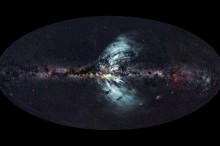
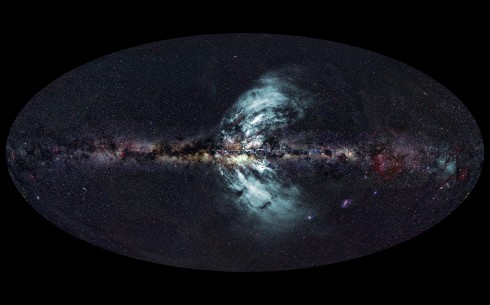
    This shows the “geysers” (in blue) shooting out of the Milky Way. Credit: Optical image – A. Mellinger, U.Central Michigan; radio image – E. Carretti, CSIRO; radio data – S-PASS team; composition – E. Bresser, CSIRO

    “Monster” outflows of charged particles from the centre of our Galaxy, stretching more than halfway across the sky, have been detected and mapped with CSIRO’s 64-m Parkes radio telescope. Corresponding to the “Fermi Bubbles” found in 2010, the outflows were detected by astronomers from Australia, the USA, Italy and The Netherlands. The finding is reported in the Jan 2 issue of Nature.

    “These outflows contain an extraordinary amount of energy — about a million times the energy of an exploding star,” said the research team’s leader, CSIRO’s Dr Ettore Carretti.

    But the outflows pose no danger to Earth or the Solar System.

    The speed of the outflow is supersonic, about 1000 kilometres a second. “That’s fast, even for astronomers,” Dr Carretti said. “They are not coming in our direction, but go up and down from the Galactic Plane. We are 30,000 light-years away from the Galactic Centre, in the Plane. They are no danger to us.”

    From top to bottom the outflows extend 50,000 light-years [five hundred thousand million million kilometres] out of the Galactic Plane. That’s equal to half the diameter of our Galaxy (which is 100,000 light-years — a million million million kilometres — across).

    Seen from Earth, the outflows stretch about two-thirds across the sky from horizon to horizon. The outflows correspond to a “haze” of microwave emission previously spotted by the WMAP and Planck space telescopes and regions of gamma-ray emission detected with NASA’s Fermi space telescope in 2010, which were dubbed the “Fermi Bubbles.”

    The WMAP, Planck and Fermi observations did not provide enough evidence to indicate definitively the source of the radiation they detected, but the new Parkes observations do.

    “The options were a quasar-like outburst from the black hole at the Galactic Centre, or star-power — the hot winds from young stars, and exploding stars,” said team member Dr Gianni Bernardi of the Harvard-Smithsonian Center for Astrophysics, in Cambridge, Massachusetts. “Our observations tell us it’s star-power.”

    In fact, the outflows appear to have been driven by many generations of stars forming and exploding in the Galactic Centre over the last hundred million years.

    The key to determining this was to measure the outflows’ magnetic fields.

    “We did this by measuring a key property of the radio waves from the outflows — their polarisation,” said team member Dr Roland Crocker of the Max-Planck-Institut fuer Kernphysik in Heidelberg, Germany, and the Australian National University.

    The new observations also help to answer one of astronomers’ big questions about our Galaxy: how it generates and maintains its magnetic field. “The outflow from the Galactic Centre is carrying off not just gas and high-energy electrons, but also strong magnetic fields,” said team member Dr Marijke Haverkorn of Radboud University Nijmegen in The Netherlands.

    “We suspect this must play a big part in generating the Galaxy’s overall magnetic field.”

  • Predicting the next epidemic

    Predicting the next epidemic

    In some parts of this world the rains predict disease, and a hot, dry, dusty wind is the harbinger of a meningitis outbreak that is yet to come. Now, from where you sit, Google will soon predict the next great epidemic.

    At this time of year, ever since that 2009 paper was published on flu trends, seasonal influenza and how we predict it, is a recurring topic.

    It seems we are always moments away from the next great flu epidemic. This year saw a novel coronavirus make the rounds. A virus that usually causes nothing more serious and common than a cold, was the source of severe respiratory illnesses in the Middle East, with reported cases coming from Qatar, Saudi Arabia and Jordan, and resulting in 5 fatalities.

    The curious case of the novel coronavirus is a new strain of virus that has not been previously identified in humans. The hypothesis is that it jumped the species barrier, but, as of yet, a definitive origin has not been identified.

    When a disease will decide to jump the species barrier is hard to predict. Some of the most serious afflictions of humans in recent times have had their origin in animal diseases. HIV/AIDS and ebola being the prime example. Seasonal influenza is another — causing tens of millions of respiratory illnesses and up to half a million deaths worldwide each year.

    In mankind’s eternal struggle against disease, as the adage goes, prevention is better than a cure. But how do we prevent disease? How do we mitigate for an oncoming plague or pestilence? A part of this prevention is predicting it.

    Currently, we can only really predict an epidemic when it is currently in motion. Hospitalizations are the only way we can really track a disease. When it is possibly already too late. When people are already sick.

    In the week the world was supposed to end, the European Centre for Disease Control (ECDC) released its weekly report on influenza surveillance, like it had done since week 40 of this year. The report aggregates data on influenza-like illnesses reported in primary health care facilities, as well as virological and clinical data.

    Flu surveillance, in Europe and similarly in the US, is based on nationally organised sentinel networks of physicians, mostly general practitioners (the first person you go see when you’re ill), covering at least 1 to 5% of the population in their countries. Each sentinel physician reports the weekly number of patients seen with influenza-like illnesses and acute respiratory illnesses.

    The report is essentially there to tell us when a flu epidemic is going to break out. In week 49, ECDC announced that the season of influenza transmission had begun.

    Along with the direct methods of detecting and monitoring disease, in recent years new and innovative non-direct methods have been tested. From sales of over-the-counter medication to online activity. The idea is to try and record health-seeking behaviour… ie before the disease has taken hold in a population.

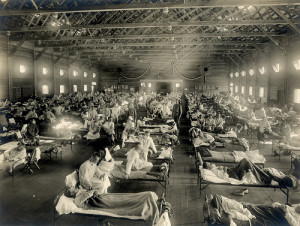
    Emergency hospital during flu epidemic
    Emergency hospital during influenza epidemic, Camp Funston, Kansas.

    Monitoring disease, 140 characters at a time…

    Flu is a disease very amenable to being searched and turning up in social media. Health-seeking behaviour — in this day and age, we google every ailment. However, diseases which are more serious probably won’t follow this social pattern.

    The concept is essentially trying to “predict the present