Science Sunday! Our recurring collection of some of the week’s blogs and science articles that you may have missed.
World AIDS Day
The month of December begins, as it always does, with World AIDS Day. A day to raise awareness about HIV/AIDS and demonstrate international solidarity in the face of the pandemic. A day to reflect on how much we have accomplished and how much is still left to be done. Our very own Rayna Stamboliyska, writing in Future Challenges, asks the question “when will we live in an AIDS-free world?
Brussels, 6 December 2012 — Breaking new ground in providing access to the most comprehensive technological information, the European Patent Office (EPO) and the State Intellectual Property Office of the People’s Republic of China (SIPO) today launched the Chinese-English component of the EPO’s free automatic translation service Patent Translate.
As a result, the collections of the two largest languages in patents are now united as full-text documents on the same website through the EPO’s global patent database, Espacenet, and linguistically accessible for innovators from both regions using a single tool, Patent Translate. Under the new arrangement with SIPO, Espacenet has grown by 4 million Chinese language documents, adding to the 75 million documents already available.
Making the announcement at the annual bilateral meeting of the two offices in Brussels today, EPO President Benoît Battistelli said: “The launch of the Chinese-English machine translation tool opens a new dimension in patent information. Thanks to the close relations between the EPO and SIPO, millions of patent documents in the two most important languages of technology are now freely available for engineers, inventors and scientists the world over. This is a major contribution to strengthening the competitiveness of European businesses. The European economy as a whole will benefit, as innovating companies will now be able to better target their R&D work by searching Chinese patent documents, while further improving the substance of their patent applications. Patent offices, too,
will be able to use the service in their daily work, which will positively impact on the quality of the patenting process. This step underlines the leading role of the EPO in patent information.”
SIPO Commissioner Tian Lipu said: “Automation is one of the key areas of SIPO-EPO strategic co-operation and the launch of the Chinese-English machine translation service is another milestone of all these years’ successful co-operation. It is estimated that by the year 2013, the total volume of Chinese patent documentation will be over 10 million and since 1 July 2012, Chinese patent documentation had become the minimum PCT documentation. The machine translation service will help European IP users to conquer the Chinese language barrier in a direct and effective way. It will further promote the science and technology communications between China and Europe, and eventually serve global innovation development.
Australia’s national soil databases can now be accessed in real time online through a new iPad app called SoilMapp.
The new app provides open access to the best and most up-to-date information for soil at any location in the country within a matter of seconds.
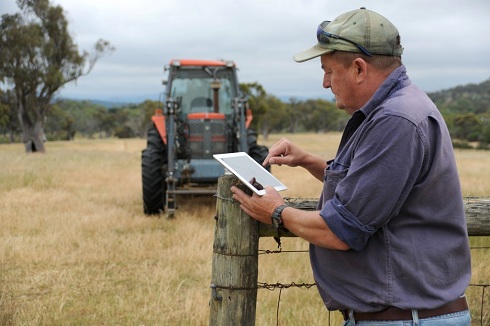
The SoilMapp for iPad will allow farmers and others to access real time information about their soils from in the field.
Information such as soil depth, acidity, salinity, soil carbon, soil water holding capacity and other attributes will help land managers, farmers and rural advisors make on-the-spot, decisions about how to more effectively manage their land.
This mobile device technology will deliver detailed scientific information on soils directly into the hands of farmers, rural consultants, agronomists, and potentially other soil enthusiasts like real estate agents, hobby farmers and keen bushwalkers.
The app has been developed by the Australian Collaborative Land Evaluation Program (ACLEP) and CSIRO, with funding from the Grains Research and Development Corporation (GRDC), because understanding soils is essential for sustaining healthy, natural environments and productive agricultural landscapes.
CSIRO’s Mike Grundy said soils are one of the most important building blocks of our agricultural and ecological systems and are a precious natural asset.
“They sustain food production, biodiversity, water quality and play a key role in human health. Understanding the characteristics of soil allows us to ensure we make decisions about its management to ensure maximum productivity and maintain or improve its health for today and future generations,” Mr Grundy said.
SoilMapp is the first app developed by CSIRO and it is being launched at the Joint Australian and New Zealand Soil Science Conference in Hobart on Tuesday, in time for World Soil Day on Wednesday. The app taps into soil information from the Australian Soil Resource Information System (ASRIS) and APSoil, the database behind the farming systems model, the Agricultural Production Systems SIMulator (APSIM), which is used worldwide.
Both these databases are stocked with contributions from thousands of individuals and organisations including the Australian Government Department of Agriculture, Fisheries and Forestry (DAFF), state and territory agencies responsible for land resource assessment, Geoscience Australia, and soil research and industry groups. The databases contain information about approximately 85,000 samples from nearly 15,000 locations, some dating back to the 1950s.
“There’s a lot of information about Australian soils stored in these two databases and the beautiful thing about SoilMapp is that it provides a user friendly mechanism for accessing that information in real time, on location,” Mr Grundy said.
“Although that information is already available through the web, it is now of far more use to famers or consultants working out on the land because it can be at your fingertips in the field, and at no cost. Importantly, as our soil agencies improve their data collections, SoilMapp will provide access to later releases,” he said.
Senior Agronomist Steve Richmond from Kerin Landmark Rural said the app will be a welcome addition to his decision making toolkit when speaking with growers.
“By understanding the soil’s characterisation, water holding capacity and amount of organic carbon, we can make calculations about how much nitrogen to use on certain crops. This could lead to improvements in fertiliser use efficiency as well helping prevent soil acidification from the overuse of nitrogen. That provides a productivity benefit as well as environmental and economic benefits,” Mr Richmond said.
“Farmers are the custodians of vast tracts of Australia, and the decisions they make daily will impact on the short and long term future of this country’s ability to feed itself, meet growing global demands and to sustain its natural beauty. The more informed we can be when making these decisions, the greater benefit we can deliver for both productivity and environmental health. It’s a win-win,” he said.
While SoilMapp for iPad currently accesses Australian information, other users may soon be able to get the benefit of this technology, with CSIRO exploring the possibility of working with partners in New Zealand, Indonesia and the Pacific Island countries to widen the scope of SoilMapp.
SoilMapp was developed by CSIRO through the Australian Collaborative Land Evaluation Program (ACLEP) and the Grains Research and Development Corporation (GRDC) project Doing it better, doing it smarter — managing soil water in Australian agriculture.
SoilMapp for iPad will be available from the App Store soon.
Media are invited to attend the Joint Australian and New Zealand Soil Science Conference on Monday and Tuesday to use SoilMapp and speak with the researchers that developed it.
Take a moment to consider Neptune. The eighth planet in our solar system, the planet farthest from the Sun, and the third most massive planet in our solar system. Also one of the least visited, and consequently one of the least understood planets in our solar system. Neptune was discovered in 1846. Forty years later, in 1886, astronomer Sir Robert Ball wrote ‘Besides this brief sketch of the discovery of Neptune, we have little to tell with regard to this distant planet. With a good telescope and a suitable magnifying power we can indeed see that Neptune has a disc, but no features on that disc can be identified’.
Unfortunately in the last 126 years not much has changed. Due to its enormous distance from Earth (~ 30 Astronomical Units) Neptune remains little more than a blurry disk in the eyepiece of the most powerful ground based telescopes. In the past astronomers studied Neptune by examining the planet as it occulted, or passed in front of the light of another object, usually a star, allowing scientists to calculate its diameter, chemical composition, and temperature. The opportunity to study the gas giant only improved when Voyager flew by Neptune in 1989, and the Hubble Space Telescope was launched in 1990.
Voyager 2 launched in 1977, and reached Neptune on the 25th of August 1989 (click here for an impressive animation of the Voyager 2 flyby of Neptune). Although Voyager 2 began imaging the planet from about 35,000,000 million miles out, most of the data we have today is from a 24 hour period, during which Voyager 2 passed 4,500 kilometres above Neptune’s north pole at an eye watering 67,000 km per hour. During the trip to Neptune Voyager gathered about 5 trillion bits of information or about .5 of a Terabyte of data. That doesn’t sound much now, but back in 1977 the 3 computers on the Voyager spacecraft had a combined memory of 68Kb, so Voyager sent back almost 15 million times more data that could be stored in it’s memory!!
Scientists were thrilled by the data from Voyager 2 and set to work learning as much as they could about the distant blue planet. We learnt that Neptune is mostly composed of gas, is likely to have a rocky or metallic core, and that the majority of Netpune’s mass is hydrogen and helium, with traces of water, methane, ammonia, and other compounds. Thanks to Voyager 2 we learnt an enormous amount about Neptune’s atmosphere, weather systems, magnetic field, moons, and ring system. But that was over 30 years ago – and we now have more questions than answers.
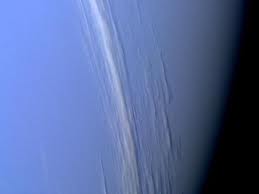
Images from Voyager 2 showed that the most obvious feature of Neptune is its stunning blue colour, the result of methane in the atmosphere. Voyager 2 also revealed a more dynamic and turbulent atmosphere than anyone expected. Neptune’s atmosphere consists of layers of clouds, banded features, and unexpected structures, including what was termed the Great Dark Spot (GDS). Neptune generates the strongest jet streams anywhere in the solar system, reaching speeds of up to 2,400 kms per hour. Voyager detected weak auroras, similar to those on Earth, but because of Neptune’s complex magnetic field, the auroras appear over wide regions of the planet, not just near the planet’s poles. Despite what we do know, the structure and composition of Neptune’s atmosphere remains poorly understood. What accounts for the relatively high percentage of methane and lack of hydrogen and helium? What is the energy source responsible for powering the incredibly high speed winds and variable storm systems? What happened to the Great Dark Spot (observed by Voyager in 1989, but no where to be seen when Hubble observed the planet in 1994). Why is the temperature of Neptune’s thermosphere, a staggeringly high 750K (4760 degrees celsius)? How can Neptune be so cold and distant from the Sun, and yet radiate so much energy?
Thanks to Voyager 2 we know that Neptune’s magnetic field is approximately 25 times stronger than Earths, and that it’s lopsided (like Uranus), at 47o to the rotation axis and offset from the planet’s centre. Although we suspect that Neptune’s magnetic field is generated by currents within Neptune’s icy mantle – we do not fully understand why Neptune’s magnetic field is oriented the way it is, or what processes could generate such an off-kilter magnetic field.
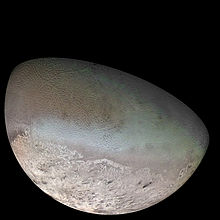
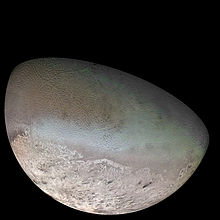
Voyager 2 image of Triton (Credit NASA)
Before Voyager 2, Neptune was thought to have 2 moons, Triton and Nereid. Voyager 2 discovered 6 new moons, and since Voyager’s visit, astronomers have discovered a further 5 moons. Most of what we know of Triton, Neptune’s largest satellite, was acquired in a single encounter by the Voyager 2 spacecraft, which imaged about 40% of its surface. If scientists were surprised by the images from Neptune, they were stunned by the images of Triton. Triton, is an icy moon with a surface temperature of -235o, the coldest place known in the solar system. Voyager’s images revealed a geologically active planet, geysers spewing nitrogen gas and dust particles high into the atmosphere, rocky outcrops, canyons, and plains of frozen methane. Triton has a very thin nitrogen atmosphere with small amounts of methane, above a scarred and cracked surface. Triton showed no fresh impact craters, an indication of an active planet experiencing periodic resurfacing. But there’s still a lot to learn. Perhaps the most tantalising questions are about Neptune’s largest moon. Was Triton formed near Neptune, or is it a captured object from the Kuiper belt? What is the composition of Triton, and what causes the geologic activity, and has the distribution of the ice geysers changed dramatically since the Voyager flyby? Will further analysis of Triton tell us more about the solar system, and our place in it? Is there a sub surface ocean? Could Triton harbour life?
Earth-based observations during the 1980s suggested that there were a number of partial rings surrounding Neptune, and Voyager 2 discovered a system of equatorial, circular rings. Although Voyager 2 gave us a good look at Neptune’s rings, the details of their composition is still uncertain, we don’t know how long they’ve been there, or even if they are stable.
Despite the valuable insights bought to us by the Voyager mission, the Hubble Space Telescope and other studies, clearly there are still a number of questions about Neptune that still need to be answered. Technology has advanced enormously since 1977 and any new mission would be well equipped to examine Neptune, its rings and a number of its moons. A mission to Neptune would enable us to learn more about our outer solar system, and exploration of Triton may provide our best opportunity to examine the surface and atmosphere of a Kuiper Belt Object in orbit around a planet in our solar system. In 2003 NASA proposed a Neptune Orbiter/Triton Explorer, however, that mission appears defunct. Neither NASA nor ESA have any current or future plans for the exploration of Neptune.
It’s the last day of November, my research project is getting into its final stage, and here I’m wrapping up this exciting month with plenty of wonderful science and technology stories, events, and new sci-blogging contributors. We have new female bloggers joining the Australian Science knowledge and sci-blogging community. The initiative I had in mind couple of weeks ago, to invite and encourage girls and women in science, technology, and education, is coming to fruition. We started a Women in Science section, encouraging young female scientists and bloggers to write, interact, and get their ideas and voice heard.
Also, we started the new initiative called Education Thursdays (hashtag #EducationThursdays) where teachers and curriculum leaders at different levels of education blog and write about their experiences and share their ideas on gender issues in science, STEM, participation, and engagement. I invite here, both students and teachers/educators, if interested, to write and join our team and, each Thursday, contribute and share with others.
Take a look at the wonderful stories and articles on neuroscience, space, genetics, biology, environment, astrobiology, cosmic evolution, physics, quantum mechanics, education, publishing, and technology. The best of Australian Science for November 2012:
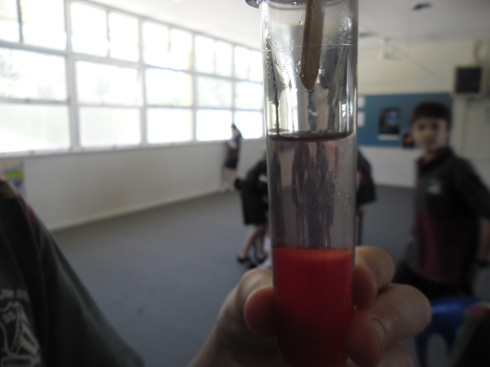
Hands on science activities to engage students in scientific inquiry and investigation are key in the early years to develop skills and knowledge in all areas of science. No one knows this better than Mrs Suzanne Clarke who is the founder of the mini-scammers science club at Mitchelton State School, a feeder club for SC@M (Science Club at Mitchie).
Hands on learning in the early years.
Established just this year, the junior science club encourages students in the early years to formulate hypothesis, carry out experiments and discuss their findings with their peers directly mirroring the similar process used in later years. Student work in multi-aged groups to manipulate materials and equipment, generate solutions and compare their results. As Mrs Clarke highlights “this method of discovery learning engages all children and promotes the use of multiple intelligences
A worldwide survey of more than 10,000 Internet users in 20 countries conducted by the Internet Society revealed attitudes towards the Internet and user behavior online. The Global Internet User Survey is one of the broadest surveys of Internet user attitudes on key issues facing the Internet. This year’s survey covered areas such as how users manage personal information online, attitudes toward the Internet and human rights, censorship, and the potential for the Internet to address issues such as economic development and education.
“Today’s online users have high expectations for the Internet and its impact on our lives and society, while also expressing concerns over censorship and excessive governmental controls,” said Lynn St. Amour, President and CEO of the Internet Society. “As part of realizing the Internet Society’s vision of an Internet that is for everyone, this survey uniquely focuses on users and their experiences, attitudes, and opinions on how to meet the challenges and opportunities facing the Internet and society in general. We are committed to the Internet’s continued open growth and evolution, not only for those who enjoy the Internet today, but until everyone is able to access and benefit from an open Internet.”
Key Findings
Key findings from this year’s survey cover a broad range of topics.
The Internet and Human Rights:
Eighty-three percent of respondents agreed or agreed strongly that access to the Internet should be considered a basic human right.
Eighty-nine percent agreed or agreed strongly that Internet access allows freedom of expression on all subjects, and 86 percent agreed or agreed strongly that freedom of expression should be guaranteed.
Sixty percent of respondents agreed or agreed strongly that Internet access has contributed significantly to civil action and political awareness in their country.
Internet censorship:
Thirty percent of users agreed strongly that censorship currently exists on the Internet.
Sixty-six percent of respondents agreed or agreed strongly that governments in countries with no Internet censorship have a responsibility to keep the Internet free of censorship in countries where the Internet is being censored/controlled/shut down.
More than 70 percent of users agreed or agreed strongly that more government involvement would make the Internet too controlled or would limit content they can access.
More than two-thirds agreed or agreed strongly that increased government control would inhibit the growth of the Internet and/or stifle innovation.
Online privacy and identity:
Even when users know they are sharing personal data with a site or service, most users (80 percent) do not always read privacy policies and a significant fraction (12 percent) of respondents admitted that they never read privacy policies.
Of users who logged into online services, only half reported that they logged out.
Nineteen percent of respondents were aware of circumstances in which personal data was used in a way they did not expect. The most commonly reported consequences were: unsolicited communications, stolen personal data, private data becoming public, impersonation, and financial loss.
The Internet and economic and societal issues:
Nearly two-thirds of respondents agreed or agreed strongly that the Internet would play a significant role in solving global problems, including reducing child mortality (63 percent), improving maternal health (65 percent), eliminating extreme poverty and hunger (61 percent), and preventing the trafficking of women and children (69 percent).
An even higher percentage of respondents agreed or agreed strongly that the Internet would increase global trade and economic relationships (81 percent), improve the quality of education (80 percent), and improve emergency response during a natural disaster (77 percent).
A majority of respondents felt strongly that the Internet plays a significant role in making improvements to business, science, and technology in areas such as: expanding the availability of goods and services (66 percent), allowing entrepreneurs to conduct business across all countries (65 percent), and advancing science and technology and creating a technologically recognized workforce (61 percent).
Attitudes towards the Internet:
Ninety-eight percent of users agreed or strongly agreed the Internet is essential for their access to knowledge and education.
More than 80 percent agreed or agreed strongly that the Internet plays a positive role for their individual lives as well as society at large.
Nearly 75 percent of users strongly agreed that access to the Internet allows them to seek any information that interests them.
General Internet usage:
Internet users nearly universally (96 percent) indicated they accessed the Internet at least once a day.
More than 90 percent of Internet users surveyed globally indicated they use social media, with a majority (60 percent) using it daily, an increase of 10 percent over 2011.
Connection speed (73 percent) and reliability (69 percent) ranked slightly above more affordable monthly fees (68 percent) among factors that would increase usage. Other factors included more content in their local language (50 percent) and more online availability of government and/or community services (49 percent)
The Internet Society’s Global Internet User Survey (GIUS) provides reliable information relevant to issues important to the Internet’s future. As an ongoing effort, the survey provides information, informs and supports the activities of the global Internet Society community, and makes the data it collects openly available for all. While other ICT surveys focus on economic, infrastructure, or other Internet use indicators, the GIUS focuses on users, which are the source of innovation that has driven the Internet’s development, evolution, and dramatic growth over the past four decades. The first GIUS in 2011 gathered the responses of 6,088 Internet users in 11 countries.
This year, the GIUS was conducted on behalf of the Internet Society from July to August 2012 by Redshift Research, a leading business market research firm. The survey questionnaire engaged 10,789 Internet users in 20 countries: Argentina, Brazil, Chile, China, France, Germany, India, Indonesia, Italy, Kenya, Peru, Philippines, Poland, Russia, Saudi Arabia, South Africa, South Korea, Spain, UAE, and the United States. Of the respondents, 53 percent were male and 47 percent were female. Results from the survey varied across countries; future reports will provide additional insight into these variations.
The complete questionnaire, full results—including results by country—and more information on survey methodology are available at: http://www.internetsociety.org/survey
Monarch butterfly (Danaus plexippus), Source: Wikipedia Commons
Citizen Scientists
An interesting report released last week from the UK Environmental Observation Framework reveals the benefit of citizen scientists to governmental environmental organisations. The Nerc Centre for Ecology and Hydrology and the Natural History Museum in London, reviewed 234 projects – ranging from small surveys to large-scale programmes. The results found the involvement of volunteers offers “high value to research, policy and practice”.
Given the increasing number of complex scientific problems facing our communities, states and countries; coupled with the ever dwindling supply of cash on hand to fund research projects, it behooves governments to dial into this untapped source of volunteer environmental monitors and data collection specialists. People enjoy going to their local botanical gardens, taking the kids and grandkids to learn about the natural world surrounding them. A large majority of the population love their parks for taking walks and having picnics and for exercise. They want to see these lands, with the flora and fauna contained within them protected. People volunteer for things they believe in and causes they want to see sustained. That is the movement around science and the environment and why the citizen scientist movement is growing.
Scientists should be working with their governmental departments, or university outreach extension centers, to coordinate community science volunteer days. Measuring leaf litter in a forest, or tree ring growth, or monitoring a stream for the presence of certain harmful bacteria or toxic chemicals, or tallying the number of a threatened bird species are a few such projects that could be undertaken by community members. Scientists and their research teams and graduate assistants could customize their research projects with a component where they served as project managers working with the community to accomplish a piece of the data collection puzzle.
The Value – Minuses and Pluses
Of course, not every project will be appropriate for citizen scientists and a fair amount of training may have to be done, given the nature of the project. And the report touches on the fact that although the quality of the data collected by citizen scientists could be excellent, it may not be fully recognized by all researchers or policymakers. This seems to be an area that would require some policy work in setting up standards to ensure the legitimacy and recognition of such projects undertaken with contributions from citizen scientists. That minus shouldn’t be so hard to turn into a plus. Volunteer-collected data possesses a bevy of potential benefits. The use of smartphones continues to increase among consumers and with that comes development technologies in the form of apps that could play an easier role in data collection. A scientist could quite easily dispatch his volunteer army with marching orders to perform observations of the monarch butterfly (Danaus plexippus) over a 5-acre area of the park and have his/her data collection completed within a month’s time. And of course, the benefit that every bureaucrat or department chair loves to hear: it’s a cost-effective way to collect environmental data and could help meet the demands of increasing governmental reporting and compliance requirements.
Getting Started
I think it’s up to each and every one of us to identify the actions we can take that will help continue to make our environment habitable. And becoming involved in a citizen scientist program seems like an ideal way to start to make a difference in your community. Whether you are a scientist or a volunteer, the guide, produced alongside the report by the UK Environmental Observation Framework, is a great place to begin identifying and mapping out strategies for a collaborative citizen science project.
Angela Saini, in her book Geek Nation: how Indian science is taking over the world, wants to convince us that Indian science is taking over the world. Now any well read student of the physical and mathematical sciences will be able to provide you with notable scientific contributions. Even the Indian constitution abjures: “It shall be the duty of every citizen of India to develop the scientific temper”. Does “Indian science” exist, and if so what makes it special?
First, pause and contemplate the following statistics. India is the world’s largest democracy: with a population over 1.23 billion (more than 1 in 6 of the world’s 7.14 billion total population are Indian). India has 415 living languages, with 22 having more that 1 million native speakers – 41% of the population speak Standard Hindi – India’s official language. Some states have their own language as the sole language; Maharashtra (capital Mumbai) has 72 million native Marathi speakers. There are 28 Indian states, the smallest Arunachal Pradesh has 1.3 million people, while the largest, the Hindi speaking Uttar Pradesh, has 199.6 million people, and includes the growing cities of of Lucknow and Kanpur. India is also birthplace to four of the world’s major religions, of which Hinduism has 80.5% of the Indian population as followers. India has a large Muslim following at 13.4% of its population, the third largest Muslim population in the world. Despite so many languages the 2010 adult literacy is 63%, with 8% internet users and a staggering 61 mobile phones per 100 of population. With an improved 88% having satisfactory water facilities only 31% of the population has satisfactory sanitation facilities.
These statistics underlie what a competent revelation Saini’s book is. The diversity of topics is to be applauded. Saini has a breezy, almost whimsical style in introducing topics and providing Indian settings for an perspective of each topic.
In particular I liked her mature handling of two hot-button topics: nuclear power and genetically modified foods. To many in the developed world energy and food security are lifestyle discussions – in India they are of life-and-death importance for many millions of the population, both now and the future.
Saini manages a well-reasoned discussion of the energy option for India – looking in detail at one important option. A visit to the Bhabha Atomic Research Centre provides a first hand glimpse of India’s nuclear aspirations, and reasoning behind it. The ensuing discussion on the indigenous development of thorium based nuclear technologies was both fascinating and compelling. From an economic point of view this development would seem to be a necessity if India is to manage its growth and not burn coal and become a major polluter such as the USA or China. They see this as a crucial intermediate step to a solar energy future. My caution is that India is yet to sign either nuclear ratification or nuclear weapons non-proliferation treaties, a point the author fails to mention.
Similarly a trip around the markets provides a great introduction into genetically modifies crops. India is by both legislation and custom a country of small rural-family run farms. These rural communities are poor and very much at the mercy of the elements. Saini presents a reasoned and sensitive discussion on the development of genetically modified crops (such as a long-life banana) that are relevant to ordinary Indians. There is a greater acceptance of these crops amongst the rural farmers than you first might imagine – provided they are cheap and preferably developed in India.
In addition Saini provides a fascinating look at the development of tuberculosis drugs, the use of electronic documents to speed up the notoriously slow bureaucratic and legal systems of India, as well as electronics and information systems companies. We are taken to the Vikram Sarabhai Space Centre to get a first-hand update on the Indian space program and aspirations. Saini comments, “There’s something unimaginably ambitious about the speed and scale of India’s space programme, as if it’s no longer content fulfilling its early goals of sending up satellites so ordinary people could have colour television and cheaper mobile phone connections. Now it seems India has something else to prove.” With a successful first moon-shot India has established itself as a space power – only lacking a manned mission.
In amongst all of this excellent investigation and examination there was one discordant section. “The mindreading machine” discusses a the use of an Indian lie-detector test based on brain wave measurements. The test has been used as legal evidence in cases, including one of murder, in Indian courts. Saini voices disquiet at this ‘science’ yet at no stage does she state the obvious – that this is not science. There are no theories supporting its claims, no peer review nor double-blind tests to give any credence to the claims. I expect that a science writer would point this out, explicitly; Saini doesn’t.
Including this item in the book highlights a very fascinating aspect of what Saini sees as quintessential Indian science. Indian science nurtures the nutty, allowing questions to be asked and curiosity to be followed before they are shouted down by a conservative mainstream view of what is appropriate science. Interesting scientific and technological achievements aside this for me, is the book’s the defining point – India is having an impact far beyond the scientific statistics and measures. Saini’s book is a welcome and worthwhile look at the the idiosyncrasies and successes of the scientific and technological side of India. I’m not convinced it will take over the world, it will certainly influence and impact the direction of science and technology – that will be interesting to participate in.
The midlife crisis is more complicated than first thought. It might be time to stop blaming troubled marriages and feeling obsolete in a sea of younger colleagues. A study published in the Proceedings of the Natural Academy of Sciences has revealed that chimpanzees and orangutans also experience a midlife crisis.
Having a midlife crisis may not just be the result of a troubled marriage or the thought that life may be halfway over. It might be part of primate biology. That’s right, hardwired into us.
“Maybe discontent lights a fire under people, causing them to achieve more for themselves and their family.”
A shiny new red sports car might just indeed lead to better things.
Danielle Spencer runs a science club at Mitchelton State School in Queensland and explored where gender stereotypes in science began. Where does the perception that men do the “hard” sciences and women do the “soft” sciences come from? A group of 45 primary school students were surveyed and it was found that a majority of students thought that science was accessible to both genders.
When asked why there are more men than women in engineering roles, the students responded with gender based answers like “Girls like dancing and other jobs.” and “Women are more suited to caring and developing jobs like childcare and nursing.”. There was no response that challenging this observation. This was despite 75% of the group thinking that science was accessible to them. It is disheartening to hear.
Students were asked whether their science club should be split into a boys only and girls only science club, there was overwhelming support for a combined science club. There was an appreciation and acknowledgement that irrespective of gender, everyone had a valuable contribution. At the moment this cohort of students believe that science is something that everyone can do. The question remains though, how do we get adults to believe this?
As this week drew to a close, attention focused on NASA’s Jet Propulsion Laboratory in Pasadena, California. A story broke at NPR reporting that the Curiosity Rover may have found some exciting news. Project Scientist at the Mars Science Laboratory, John Grotzinger was quoted to saying:
“We’re getting data from SAM as we sit here and speak, and the data looks really interesting.”
SAM, the Sample Analysis at Mars is a miniaturised chemistry lab. On board is a Gas Chromatograph, Quadrupole Mass Spectrometer, Tunable Laser Spectrometer as well as sample processing systems that allow heating and chemically treating samples. Normally these instruments would fill the space in a laboratory but on Curiosity it’s around the size of a microwave. SAM is being used to collect information about the past and present chemistry of Mars. As well as this SAM is also identifying organic and inorganic chemical molecules known to be important to life on Earth.
So what has SAM found? Nothing has been confirmed but it does sound like there is something especially when Grotzinger says:
“This data is gonna be one for the history books.”
We will have to wait at least several weeks before NASA makes an announcement.
New Zealand’s volcano, Mount Tongariro made it into this week’s news with an eruption on Wednesday. Luckily there have been no reports of damage or injuries. However, a group of travellers and journalists hiking at the time witnessed and filmed the eruption.
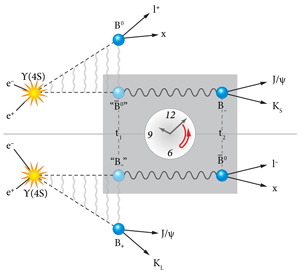
Electron-positron collisions at SLAC produce a Υ(4s) resonance that results in an entangled pair of B mesons. Source: http://physics.aps.org/articles/v5/129
Recall the outrageously cool movie from the 1980s, Back to the Future? Marty McFly and Doc Brown were stretching scientific boundaries, righting the future, all while making sure not to meet their future selves. Fast-forward and time travel may be closer than we think. (Close, relatively speaking of course.)
If you like exceptions to the rule, well, you’re in luck because the Department of Energy’s (DOE) SLAC National Accelerator Laboratory has achieved something quite impressive – the BaBar experiment.
The BaBar experiment investigates the most fundamental questions about the universe by getting back to basics with elementary particles. It’s a global collaboration of physicists delving into the nature of antimatter, the relationship of quarks and leptons and crossing over into areas of physics yet to be explored.
Earlier this week, scientists working on the BaBar project made the first direct observation of a violation to the concept known as time reversal symmetry. Their work was published in Physical Review Letters if you want to journey into the world of B mesons.
How did they do it?
Data from billions of particle collisions, nearly 10 years worth, were poured over and sifted through by researchers on this project. They examined a chain of particle transformations in which B mesons flipped between two different states called B-zero and B-even. This quantum entanglement of B mesons enables information about the first decaying particle to be used to determine the state of its partner at the time of the decay. This allowed the team to find that these transformations happened six times more often in one direction than the other.
Largely by thinking there was something wrong with the picture they were looking at was how missing pieces of the puzzle were filled in, according to the physics coordinator for BaBar, Fabio Anulli of the National Institute for Nuclear Physics in Rome. The BaBar data they had showed evidence of change-parity symmetry violation, so this was a good place to start looking. In fact, just looking at the data in a slightly different way allowed them to the see time violation.
Given the abundance of data the BaBar team had to work with, they were able to measure the T-violation to the 14 sigma level – a high level of statistical significance. Basically meaning there is only 1 chance in 1043 that this effect is not real. Recall the Higgs boson discovery this past summer; that was granted a 5 sigma level. The results demonstrate that the direction of time matters, at least for some elementary particle processes. This provides a strong confirmation that a few subatomic processes like to do things on their own schedule – they have a preferred direction of time, changing into one another much more often in one way, than they change in the other. Time does not run the same forwards as backwards.
The findings – full of futuristic possibilities
What does this mean for the future? This discovery may rock our world in ways we haven’t even conceived of yet. It could have implications for business, for communications, for me getting to Brisbane instantaneously without first stopping for a layover at LAX. We may have perhaps inched closer to that time travelling ease marvelously displayed in Star Trek. Stay tuned.
Discoveries such as this make us think about the beauty of science. The vectors and numbers and B mesons – scientists work that stuff out to provide the beautiful possibilities that are so important to the human race. It may be small now, but we’re definitely on to something bigger. Think how many picture frames we may just be able to tilt to get the answers we seek.
Minister for Innovation, Services and Small Business Louise Asher today announced that two world leaders in storm-water management and bioinformatics, Professors Ana Deletic from Monash Water for Liveability and Terence Speed from the Walter and Eliza Hall Institute, have won the 2012 Victoria Prize for Science and Innovation.
Professor Deletic is the first female scientist to be awarded the Prize in its 14 year history.
Speaking at a ceremony to award the winners of the Victoria Prize for Science and Innovation and the Victoria Fellowships, Ms Asher said the Victorian Coalition Government was committed to supporting science and innovation and had awarded two $50,000 Victoria Prizes this year instead of one, as well as increasing the number of $18,000 Victoria Fellowships from six to 12.
“The Coalition Government has invested $1.7 million in Victoria’s innovation researchers since 2011, and has committed to treble this investment over the next three years to $4.8 million,
Nearly three years ago a 10-year-old Queensland primary school student beat the rush of entries in a national competition to find a name for Australia’s new Marine National Facility research vessel.
The current Marine National Facility research vessel, Southern Surveyor.
The Federal Minister for Science deemed Clare Cameron’s entry, The Flinders Investigator, the joint winner as it linked the planned A$120 million research vessel to Australia’s maritime history – Matthew Flinders first circumnavigated the continent in His Majesty’s sloop Investigator.
The new state-of-the-art 93.9 metre vessel has been named Investigator and is under construction. The vessel will herald a new era in marine and atmospheric research for Australian scientists when it arrives in late 2013.
The new Investigator provides a huge leap forward in capability, being equipped to accommodate 40 scientists and travel for up to 60 days at sea compared with the current research vessel’s, Southern Surveyor, capacity of 15 scientists and 28 days at sea.
Clare Cameron and her family, who live in Runaway Bay, have been invited to tour theSouthern Surveyor while the vessel is in Brisbane for a short port period prior to its next research voyage. Clare will meet the team of Australian and international scientists who will have returned from their research voyage in the Coral Sea.
The Chief Scientist onboard, Dr Maria Seton from the School of Geosciences at the University of Sydney, and her team have been working in a little explored region between the Solomon Islands, Vanuatu, and New Caledonia taking rock samples from the ridges and plateaus at depths of up to 3.5 km. They also have mapped about 8000 kilometres of seafloor under their voyage track and taken gravity and magnetic data.
“These data will help us to better understand the type of crust that underlies the region and the age of these basins and will give us a more complete geologic and tectonic history of the area during the last one hundred million years,” Dr Maria Seton said.
“We are trying to understand what’s going on with the Earth’s crust in this part of the world by mapping what we call hotspots, which are a series of extinct underwater volcanoes and this fundamental research helps us to determine how the Australian continent has moved.”
“We believe on this voyage we may have found remnants of the Australian continent which would have splintered from mainland Australia when eastern Gondwana starting breaking apart. It will be at least a year before our hypotheses can be confirmed.”
Dr Seton and her team will explain some of their findings to Clare and her family and show them rock samples taken from the deep seafloor, kilometres below the surface.
[Washington, D.C. and Geneva, Switzerland] — A new Internet Exchange Point (IXP) was launched on 16 November in Kinshasa, Democratic Republic of the Congo (DRC). The Kinshasa IXP (KINIX) was funded through the Internet Society’s Community Grants Programme and managed by the DRC ISP Association (ISPA-DRC), as part of its DRC-IX project, which aims to establish IXPs in Kinshasa, Lubumbashi, and Goma.
KINIX will serve as a catalyst for innovation and development of Internet services and applications in the DRC, and will support Government efforts to implement E-government services and lower the cost of developing local hosting and application development. The presence of KINIX will improve local Internet resilience by eliminating the dependence on international connectivity for local Internet services and Internet-based communications.
DRC is largely dependent on satellite connectivity for its Internet access. As the DRC waits to get connected to the West Africa Cable System, the time to access locally hosted content will be reduced significantly from over 500ms to less than 50ms through KINIX.
Initially, KINIX will connect six Internet Service Providers (ISPs): AfriNET, Cielux, Cybernet, Global Broadband Solutions, Microcom, and Vodacom. Twenty-six (26) engineers from these ISPs, including the regulator (ARPTC); Central Bank of Congo; local universities; and the tax, customs and revenue authorities among others have received technical, hands-on training prior to the launch through the Internet Society Africa Interconnection and Traffic Exchange (ITE) programme. The training sponsored by the Internet Society, and in partnership with Netnod and Jaguar Network, will also enable the network providers in the DRC to prepare their networks for interconnection with the rest of the world once the submarine cable connection is activated.
The Internet Society’s Africa Interconnection and Traffic Exchange programme has been actively supporting the development of IXPs and regional interconnection in the region. The programme aims to have 80% of Internet traffic exchanged in Africa by 2020, keeping local traffic local. This objective has been boosted by the appointment of the Internet Society to implement the African Union’s African Internet Exchange System (AXIS) programme, http://www.internetsociety.org/axis-announcement.

 Brussels, 6 December 2012 — Breaking new ground in providing access to the most comprehensive technological information, the European Patent Office (EPO) and the State Intellectual Property Office of the People’s Republic of China (SIPO) today launched the Chinese-English component of the EPO’s free automatic translation service Patent Translate.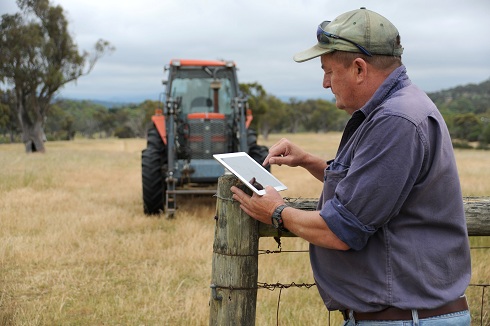

 It’s the last day of November, my research project is getting into its final stage, and here I’m wrapping up this exciting month with plenty of wonderful science and technology stories, events, and new sci-blogging contributors. We have new female bloggers joining the Australian Science knowledge and sci-blogging community. The initiative I had in mind couple of weeks ago, to invite and encourage girls and women in science, technology, and education, is coming to fruition. We started a