BioGrid Australia has won the hotly contested People¹s Choice Excellence in Business Intelligence Award for 2012 for its application of information technology in e-health.
The Excellence in Business Intelligence Award, sponsored by BusinessMinds, was won by Telstra for a customer centric solution using nearreal time BI.
In the People’s Choice Award, the delegates at the Big Data Summit in Sydney held 29-30 October, voted BioGrid Australia as a clear winner. The award recognises how the BI solutions BioGrid Australia provides researchers helps to save lives.
Maureen Turner, CEO of BioGrid Australia, said This award recognises the value and importance of BioGrids collaborative technology which connects data from multiple institutions to enable research projects with sample sizes of thousands of patients allowing Australian research to compete on an international scale.
She said the award was a clear demonstration of the not for profit organisation¹s skills and ability in establishing, maintaining and using business intelligence to drive results.
In essence, BioGrid Australia is paving the direction for the future of how e-health in Australia will operate in the future, enabling a more comprehensive view of a patient, their history and how they have been treated.
The organisation links 26 health services and research organisations across Australia using a web based platform. Data is physically located across jurisdictions and dynamically queried and analysed using SAS statistical analysis software.
BioGrid was initially set up by clinical researchers who were trying to find more effective solutions to clinical problems. Their aim was to use a federated platform to connect individual data and enable researchers to use it effectively.
Recent research using BioGrid showed the significant impact of the national bowel screening program as researchers were able to analyse data from more than 1200 bowel cancer patients from 19 sites around Australia.
The analysis produced showed the government the importance of the bowel screening program. It indicated that early diagnosis of bowel cancer not only significantly improves the chances of patient survival but it also reduces the cost of treatment per patient as advanced bowel cancer requires expensive drugs to treat. The 2012 federal budget included $50 million to extend the program for another four years.
The People Choice Award highlights the recognition within the business world as well as IT and medical research of the role that BioGrid is playing: it is enabling research that will inform and change the way patients are viewed and treated, she said.
The other finalists in the BI Awards were Commonwealth Bank, NRMA and Open Universities Australia.
More info on BioGrid Australia (www.biogrid.org.au).
The Open Knowledge Foundation is dedicated to promoting the creation, sharing and application of Open Knowledge in the Digital Age.
Yesterday, a working group at OKFN Australia gathered data geeks from around the country. The opening the Australian chapter of the Open Knowledge Foundation happened via a Google hang-out. The group includes internet public servants, data scientists, data visualisation specialists, data journalists, and others dedicated to the idea that, when it comes to knowledge and information, open is better.
OKFN Au is a community initiative to create a bridge between the many and varied open knowledge communities in Australia, including hackers, data journalists, scientists, Gov 2.0 and open data peeps, knowledge and change management enthusiasts and civil society.
OKFN Au is part of the global OKFN community, established originally in the UK. It brings together people interested and active in opening up and using data to create and share knowledge.
The goal of OKFN Au is to support, promote and bring together the active and diverse open knowledge communities in Australia. Member communities come from a variety of backgrounds where open knowledge is already being practically applied. Australia has some well established tech communities, research groups, open government communities, emerging data journo communities and loads more that could all benefit through being connected to each other, even if just peripherally. It makes it easier to understand the breadth and skills of our community which, in turn, makes it easier to connect with each other and collaborate on common goals or projects.
October was a busy month with plenty of events, meet-ups, moving, research progress, writings, beautiful change of season, new members of the sci-blogging community, and other exciting things. Also, lot of wonderful writings by Australian Science authors, science bloggers, and new intiatives and design of the site that we are working on for some time now.
Check out our great stories on astronomy, genetics, biology, environment, physical geography, seismology, genetic engineering, public policy, biodiversity, marine biology, oceanography, education, publishing, and technology. The best of Australian Science for October 2012:
Whether you are a parent, teacher, student or simply an interested enthusiast, here are a number of interesting sites, podcasts, and social media people for you to draw on as you get going in amateur astronomy. Podcasts provide an amazing resource – all free. Most are available via iTunes, the original publishers’ websites, or a raft of other podcast aggregators. There are very good apps to allow you to download podcasts to your smartphone for listening when suitable. Read more>>>
The world’s largest and most productive dedicated infrared observatory just went on the market in an unprecedented attempt to try and prevent it from being shut down and dismantled. In a bold move, the directors of the United Kingdom InfraRed Telescope (UKIRT), based on Mauna Kea in Hawaii, have just released a prospectus detailing the telescope’s impressive achievements and capabilities in the hopes that they can find sponsorship and save the observatory from certain doom. That may sound melodramatic, but doom genuinely is the most fitting description. Read more>>>
How long until we live forever? The general consensus is that we are getting older and living longer. Despite consequences and kryptonite, it is getting easier to stay alive. Heaven can wait, it seems. Every year each baby born is expected to live 3 months longer than its predecessor of the previous year. This has been the case for the last 160 years. A stunning display of the ability we humans have to prolong the length of life. Read more>>>
The Soviet Union launched Sputnik 1 into an elliptical low Earth orbit on October 4, 1957. This surprise precipitated the space age and triggered the space race. The success ushered in new technological, political, military, and scientific developments.
On April 12, 1961, Yuri Gagarin became the first person in history to leave the Earth’s atmosphere and venture into space. His flight aboard a Soviet Vostok rocket lasted 108 minutes, at the end of it he had ignited the manned space race.
Who were men who responded to these Soviet firsts, launching America into space and then onto the moon?
NASA selected the first US astronauts, the Original Seven (also referred to as the Mercury Seven and Astronaut Group 1), on April 9, 1959. This was the only astronaut group with members who flew on all classes of NASA manned orbital spacecraft of the 20th century — Mercury, Gemini, Apollo, and the Space Shuttle.
The Mercury Seven stand in front of a F-106 Delta Dart. Photo credit NASA.
The first American launched into space was Alan Shepard, followed by Gus Grissom. Their ballistic flights were followed by orbital flights by John Glenn then Scott Carpenter, each managing three orbits. Wally Schirra made six orbits and Gordon Cooper completed the Mercury project with 22 orbits. Cooper was the first American travelling in space for over a day and the last American to be launched solo into Earth orbit. Deke Slayton, was grounded in 1962 due to a heart arrhythmia, but reinstated in 1972 and flew on the Apollo-Soyuz Test Project in 1975.
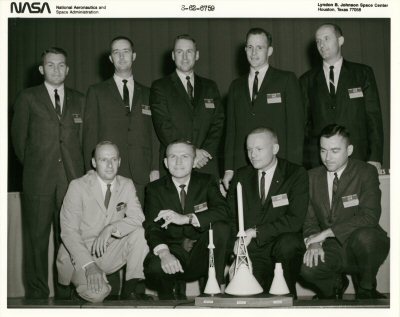
The New Nine. Back row: See, McDivitt, Lovell, White, & Stafford. Front row: Conrad, Borman, Armstrong, & Young. Photo credit NASA.
With the announcement of the Gemini program and planning of the Apollo program a second group of astronauts were selected by NASA and announced on September 17, 1962. The New Nine augmented the original Mercury 7. While the original seven had been selected to accomplish the simpler task of orbital flight, the new challenges of rendezvous and lunar landing led to the selection of candidates with advanced engineering degrees (for four of the New Nine) as well as test pilot experience.
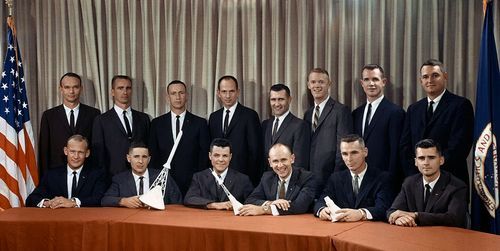
The Fourteen (seated, left to right) Aldrin, Anders, Bassett, Bean, Cernan, and Chaffee. Standing (left to right) are Collins, Cunninham, Eisele, Freeman, Gordon, Schweickart, Scott and Williams. Photo credit NASA.
Group 3 was the first group to include candidates with no test pilot background. They are the only ones of the first 19 NASA astronaut groups to have no members at all fly on the Space Shuttle.
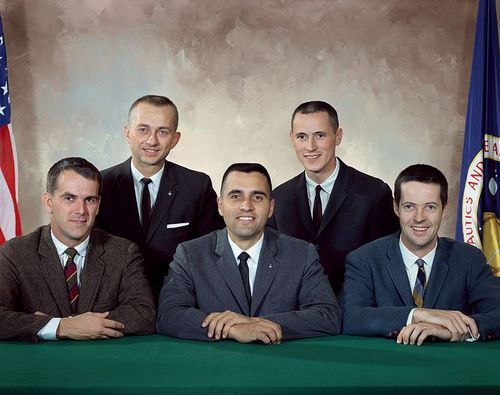
The fourth group of astronauts, the Scientists, selected by NASA in June 1965, came as a rude shock to the existing astronauts. While the astronauts of the previous three groups were required to have college and some advanced degrees, they were chosen for their test pilot expertise. The six members of this group, on the other hand, were chosen for their research and academic backgrounds. Doctorate degrees were required and minimum flight time requirements were waived for this group.
Scientist-Astronauts: Front row, L-R: Michel, Schmitt, and Kerwin. Back row, L-R: Garriot, and Gibson. Photo credit NASA.
John Young labelled the next astronaut group, selected by NASA in April 1966, the “Original Nineteen” in parody of the original seven Mercury astronauts. Of the six Lunar Module Pilots that walked on the Moon, three came from this group (Charles M Duke Jr, James B Irwin, and Edward D Mitchell). This group is also distinctive in being the only time when NASA hired a person into the astronaut corps who had already earned astronaut wings, X-15 pilot Joseph “Joe” H Engle.
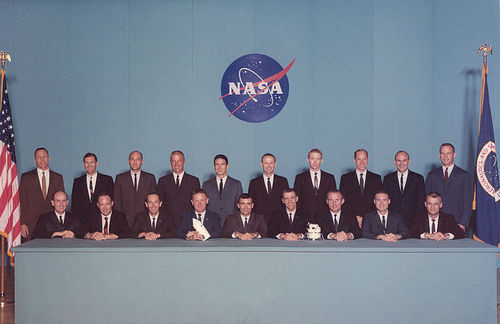
The final group of this era, the second group of scientist-astronauts, were appointed by NASA on August 11, 1967. They were labelled the “excess Eleven” with only five, including the first Australian born astronaut Philip Chapman, given formal assignments in the Apollo Program, and these were all non-flying. These were: Joseph P Allen, Chapman, Anthony W England, Karl G Henize, and Robert A R Parker. Chapman resigned from NASA in July 1972 due to lack of space-flight opportunities. Three others, Donald L Holmquest, Anthony A Llewellyn, and Brian T O’Leary resigned earlier from the group for various reasons.
The Excess Eleven civilian scientists. Seated at the table, L to R: Chapman, Parker, Thornton, and Llewellyn. Standing, L to R: Allen, Henize, England, Holmquest, Musgrave, Lenoir, and O'Leary. Photo credit NASA.
Assignments for the group were delayed by the requirement to spend a full year to become qualified as jet pilots (as were the Group 4 scientists before them). This requirement for scientists to be trained as jet pilots was eventually lifted with the creation of the Mission Specialist position in the Shuttle Program. The seven members (Allan, England, Henize, William “Bill” Lenoir, Story Musgrave, Parker, and William E Thornton) of Group 6 who stayed with the program after Apollo went on to form the core of Shuttle Mission Specialists, accomplishing a total of 15 flights.
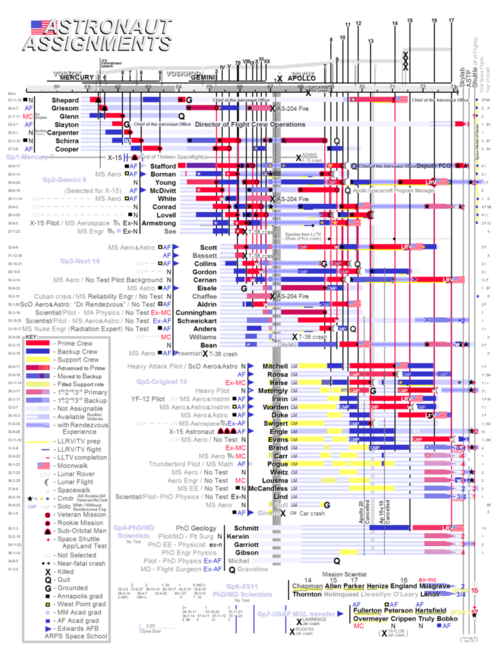
This chart organizes each NASA astronaut group by order of their assignment to fly. Codes as explained in the legend illustrate each person's skills and accomplishments. Image credit: Tdadamemd
In all 66 men became NASA astronauts during this first era of manned space exploration. No women were included – although there was an unofficial group called the First Lady Astronaut Trainees– not being jet test pilots there were ineligible to become astronauts.
Was this a “boys’ own adventure”? Was this a period of great social upheaval in the USA? Did this era cement in the US politicians and public the image of supremacy and isolationism in space endeavors? Yes, is the answer to all three questions.
There are a myriad of stories from these groups’ exploits. These stories have a contemporary relevance as we reach an era of: new commercial space opportunities (leisure, exploration and mining), new entrants (China and India), and find the US and Europe hampered by self-imposed budget challenges and hurdles.
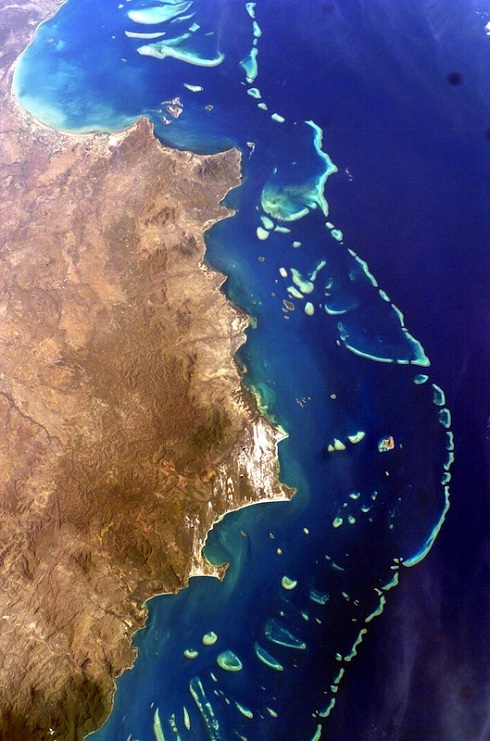
The Great Barrier Reef is easily among the world’s great natural wonders. A world heritage site since 1981, it’s known everywhere as a showcase for the beauty which Earth’s oceans are capable of producing. The world’s largest system of coral reefs, it’s actually composed of over 2900 smaller reefs, stretching along Australia’s coastline for 2600 kilometres. In modern times, it’s a major tourist attraction, and for a lot longer, it’s been part of the culture of Aboriginal Australian people. Unfortunately, the modern world hasn’t been kind to the Great Barrier Reef. A variety of environmental factors are conspiring to make the future for these Australian corals look rather bleak.
Alarmingly, in a study run by the US National Academy of Science earlier this year, it was found that over the past 27 years, the Great Barrier Reef has lost 50% of its corals. Half of the corals in the sites surveyed have disappeared since 1985, and it’s unlikely to be any better in any other locations. Alarmingly, two thirds of the corals lost, have been lost since 1998. Instead of slowing down, it seems that the damage is becoming more rapid over time.
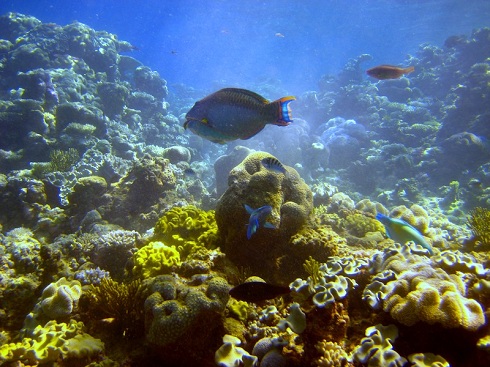
The Great Barrier Reef is, in effect, the Amazon Basin of the Ocean. It’s a huge and bustling hub of biodiversity, rich with all manner of aquatic plant and animal species. Like a land-based rainforest, a vast number of self-contained ecosystems can be found within the reef, and many vulnerable and endangered species make their homes there. Species known to depend on the reef include turtles, crocodiles, dugongs, and sharks, as well as thousands of species of fish and invertebrate – including, of course, the corals themselves.
Climate conditions have been increasingly harrowing for the denizens of the reef, however. Inclement weather, including tropical cyclones, can cause severe damage to coral growths. Global warming is having a lethal effect on corals living near the edge of the reef, which are already at the high end of their temperature tolerance. The warm waters cause corals to expel their zooxanthellae (the symbiotic organisms with live with the coral, photosynthesising and providing around 90% of the coral’s energy requirements) resulting in coral bleaching and, eventually, death as the corals die of starvation. And then there’s the crown of thorns starfish, a natural predator of corals which has seen a sharp increase in numbers in recent years. While the starfish is actually in indigenous inhabitant of the reef, some suspect that overfishing of the starfish’s natural predators has contributed to their recent population explosion.
In light of the troubling findings, Australia’s Environment Minister, Tony Burke, said in an interview to ABC news that “We’ve all heard about damage to the reef over the years, but that 50 per cent figure, I think, rang a warning bell loud and clear for many people.” He also admitted that “there’s no doubt that there’s been a level of neglect for decades which, if it had been dealt with otherwise, we’d be in a much better situation now,” which is at least a sign that the problem is being given the recognition it deserves.
Australia has, in fact, put together its Reef Rescue programme over the past 5 years, spending millions of dollars on protecting the reef from human activities such as run off from land. While there’s not much which can be done about the cyclones which have done the most damage, work is also underway to cull the starfish which are currently the reef’s second biggest threat. Unfortunately, this is painstaking work, as each starfish has to be individually removed by hand. There’s simply no other suitable method.
The question then is how to safeguard the reef in the long term and hopefully help it to recover to its former glory? With one of the biggest future threats to the reef is global warming and the warmer waters which it causes, the method to be used to protect the reef is still under debate. Natalie Ban, who works for the ARC Centre of Excellence in Coral Reef Studies, is reported as saying, “In some areas summer is coming earlier and lasting longer; in others, both summers and winters are warmer than in the past.” Currently, there are two schools of thought on how to go about this – some argue that the most protection should be given to the areas which have suffered least, so that they can act as a haven for reef animals to help repopulate the area; while others would prefer the most vulnerable reef areas to receive the most protection.
Whatever means is chosen, it’s safe to say that Ban speaks for many of us in saying that she hopes for the best way of managing and protecting the reef during “what will undoubtedly be momentous environmental change.”
Images:
Top – Eric Johnson/NOAA
Middle – NASA
Bottom – Toby Hudson/Wikimedia Commons
With the exponential growth of scientific research, there were a plethora of articles which could have been reported this week. A few that caught my attention are listed below.
A Future of Genetically Superior Humans
On Wednesday it was reported that geneticists have moved into an area of research previously believed to be highly unethical. Researchers at the Oregon Health and Science University took steps to prevent women from giving birth to children with genetic diseases. “That kind of genetic engineering has been ruled off-limits,” says Marcy Darnovsky of the Centre for Genetics and Society. As the Dartmouth bioethicist Ronald Green mentions, this kind of research could lead to generations of genetically superior humans. A concerning concept, I’m left with visions of the novel Brave New World by Aldous Huxley warning of such actions. http://www.npr.org/blogs/health/2012/10/24/163509093/geneticists-breach-ethical-taboo-by-changing-genes-across-generations
The Dangers of Pumpkin Carving
In light of Halloween this Wednesday
, this article caught my attention as families throughout Canada and the USA begin carving pumpkins in preparation for this spooky holiday. “Even with optimal treatment, injuries from pumpkin carving accidents may leave people with compromised hand function,
Analysys Mason’s new study published this week entitled ‘How the Internet continues to sustain growth and innovation’ reveals how the market forces that have always ensured the sustainability of the Internet in developed countries also extend to developing countries.
Analysys Mason (www.analysysmason.com) is a global specialist in telecoms, media and technology (TMT). The Internet Society (www.internetsociety.org) commissioned Analysys Mason to study the impact of increased demand for new Internet services and concerns about the sustainability of the ensuing growth.
The new study shows how, in the past, Internet challenges have been continually met in developed countries, based on a combination of new technology and investment to increase capacity, and changing business models to distribute content. Further, the report shows how investment and innovation are already addressing new demands in developing countries today.
“Challenges in the past followed the increase in demand from the first commercial web browsers, and the widespread take-up of Internet video. Today, concerns about the sustainability of the Internet in developed countries have arisen from the increased availability of mobile broadband services,
We wrote about Open Access many times: here, here, here, here, and here, and since it’s Open Access week everywhere in the world- it is good to be reminded what is OA – Open Access. This time Nick Shockey and Jonathan Eisen take us through the world of open access publishing and explain just what it’s all about.
“Jack! Did you see that potato move?! He’s a GM, that one, he’s sprouted eyes and I bet he’ll grow legs next! He’s gonna round up his buddies and take over the farm!
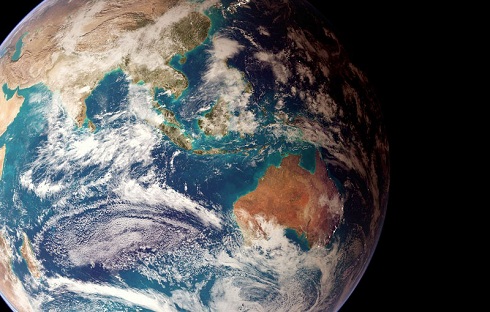
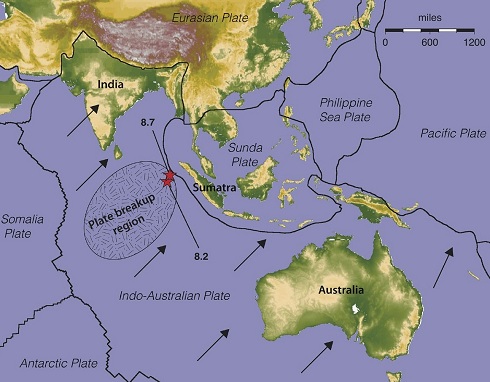
What do Australia and India have in common? The answer is that they both share one of Earth’s tectonic plates – the drifting eggshell-like pieces of Earth’s crust, on which all of our planet’s continents sit. However, the Indo-Australian Plate is a slightly unusual one, and the two countries may not share it for much longer. Recent Earthquakes beneath the Indian Ocean suggest that this plate may be in the process of breaking in two.
We generally think of the surface of our planet as being fixed and unchanging. The reality though, is that this isn’t true. Earth’s continents and the tectonic plates which make them up are not fixed at all, drifting slowly across the planet’s surface. For instance, as you’re reading this, most of Africa is moving slowly to the North West and quietly tearing the beginnings of a new ocean into Earth’s surface. Meanwhile, Hawaii is moving at a speed of about 7cm per year which is about as fast as your fingernails are growing.
Of course, these movements are tiny, compared to the size of the Earth and its continents, but they still cause pressure to build up in Earth’s surface. Sometimes, seemingly without warning, that pressure continues to build up and– SNAP! Something in Earth’s crust cracks or ruptures. This jostles the plates and can cause earthquakes which rattle entire countries. Any places situated at the edges of tectonic plates are particularly prone to earthquake activity, with California and Japan being high profile examples. With enough quakes, however, dramatic changes can happen in Earth’s crust. On rare occasions, larger tectonic plates can sometimes break apart into smaller ones – and that’s exactly what’s happening somewhere beneath the Indian Ocean right now.
Breaking point – where the Indo-Australian plate is starting to rupture and split
April 11 this year saw two massive earthquakes strike west of Indonesia in quick succession, measuring 8.7 and 8.2 on the Richter scale. The result was a dramatic quadruple fault rupture in Earth’s crust (a rare event which is more or less exactly what it sounds like!) which caused shockwaves to reverberate around the whole planet. Around a week later quakes occurred across the world as the whole planet shivered in response.
Geologists, alarmed by what could have caused such a major event, took to analysing the quake. What they found was remarkable. Within roughly 160 seconds, four fault lines (existing fractures in the rock) tore apart under pressure. Remarkably though, this wasn’t at a plate boundary where this kind of activity is expected. It was right in the middle of the Indo-Australian plate. To the geologists looking at this data, this was like a smoking gun. A telltale sign that, as many had suspected, this particular tectonic plate is starting to fracture and split into two.
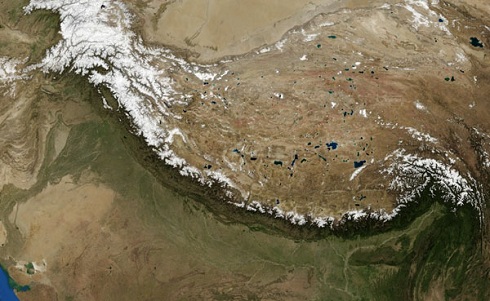
The Indo-Australian tectonic plate is already a bit of an oddity, being a rather thin and unusual shape compared with the others. The reason being that it was formed some 43 million years ago when two smaller plates (carrying the landmasses which would eventually become India and Australia) fused together. Since then though, it’s collided with the much more massive Eurasian plate. That collision has already caused enough pressure in Earth’s crust to create the Himalayas, one of the world’s most impressively tall mountain ranges. However, the Indo-Australian plate is still trying to move northwards. The western part of the plate is still pushing against the Himalayas, moving at about 3.7 centimetres per year, but the eastern part, including the entire continent of Australia, is moving at a much faster speed of around 5.6 centimetres per year. This is causing the whole tectonic plate to quite literally buckle, which is the root cause behind all of the quakes in the region over the past decade.
So what does this mean for anyone who happens to be living on that plate? Well, there are not going to be any sudden apocalyptic changes. After all, according to theories, this is not actually a new event – the Indo-Australian plate began to deform around 10 million years ago! Over millions of years, a new tectonic plate boundary will start to form under what is currently the Indian Ocean. This will cause thousands of similarly large earthquakes, but over such a length of time that they won’t be much more regular than they already are for those living around South-East Asia. All the same, planetary scientists are likely to continue watching this region with interest over the coming years.
Satellite view of the Himalayan mountain range – perhaps the most dramatic example of the force with which the Indo-Australian plate is pushing into the Eurasian plate!
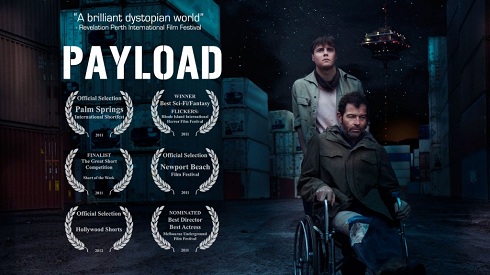
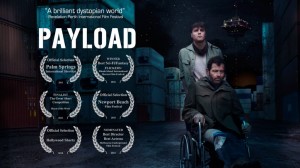
This may not be the usual topic for a blog post normally displayed on Australian Science, but when our editor Danica mentioned she saw this great Aussie short and asked if one of us writers wanted to do a narrative, I jumped at it. The next 17:55 of my lunch break left me in awe.
A movie doesn’t have to be a full length feature to have an impact or drive home a message. And Payload really packs a punch. There were so many messages; messages of a society that travelled down a drainpipe. Clarke’s Town is a place that would have just about every council of the United Nations mired in details and confusion and working round the clock. The issues raised in this fictional setting being human trafficking, prostitution, the sale of human organs or body parts, smuggling, security, poverty, gender, food, clothing, education… corruption is everywhere. You get a sense of normalcy among the Carter clan, but that normalcy is faced against the outside operations of a world that does not make sense,which is far bigger than the Carters. Sacrifice is the only way for survival.
Clarke’s Town is a functioning spaceport, which is a character in and of itself in this story. This spaceport, this crawler, is painted as an escape to freedom and perhaps to normalcy – from dystopia to utopia. Is that why the mother never came back? Is Davinia “Dave” Carter now saved from what one can only suspect was to be a dreadful and despairing existence? Simon Carter may have been doing what he had to do, but he is Davinia’s hero. The main characters – Simon, Adam Carter (the father) and Kate Henshaw – each went through a visible transformation, almost a metamorphosis of sorts. They took what little there was of a moral high ground when it came to the reasoning of right and wrong (no matter how wrong). With Davinia, as she says goodbye to Simon at the spaceport, she leaves you with the thought that her transformation, her payload, is yet to come. I find it rather apropos the meaning of the name Davinia/David is “beloved”.
I’m having a hard recalling when exactly was the last time a movie moved me as much as this little motion picture has. From the setting, to the haunting yet soothing tones of the music, it makes you think what society, our world, would be like without some of the resources we take for granted every day. More so, I think it makes you think about some of the countries, or communities, in this world just struggling to gain access to basic resources.
Writer and director Stuart Willis mentioned extending Payload into a feature – set 10 years later when Earth is being evacuated. Will answers be given to the questions raised in the short? My synapses are already firing up hypothetical synopses. If there were a motion picture category for the Nobel Prize, I would say award it to Mr. Willis straight away.
It boasts, struts, and flaunts with that kind of assurance that only comes from the mentality of knowing that you are right, and that even if you may be wrong, others will admire you for it. This is Paris.
Where other cities flowed and spilled out to occupy a space larger than its originality, Paris said enough is enough and contained itself. To this day only the “arrondissements
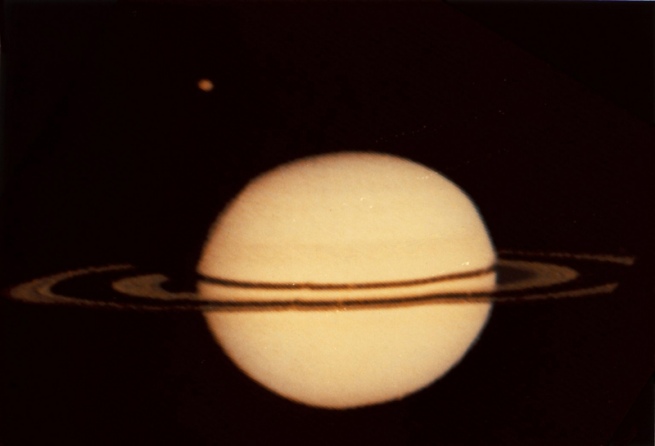
Pioneer 10 and 11unveiled the solar system during the golden-age of robotic exploration. Their missions were a success; Pioneer 10 threading the asteroid belt to provide our first close view of Jupiter and its moons, Pioneer 11 catapulting past Jupiter and foraying through the plane of Saturn’s rings.
Saturn and its moon Titan imaged by Pioneer 11 in 1979. Photo credit NASA/JPL.
The Pioneers, true to their name, kept travelling – out of the solar system – into space legend. We lost communication with Pioneer 11 in 1995, and with Pioneer 10 in 2003 when it had reached a distance 80 times further than the Earth from the Sun. Some years prior to this, when the probes had traveled only one quarter of this distance, scientists realized both were thousands of kilometres closer to the Sun than expected.
Space exploration depends on precise measurements of every factor involved in the mission – particularly distance. Beams of radio waves were sent and bounced off the Pioneer spacecraft to measure the probes’ movement. The distance to the spacecraft and its speed were calculated from the photons’ round trip time and their Doppler shift (the frequency change you hear as an ambulance siren approaches and then recedes from you).
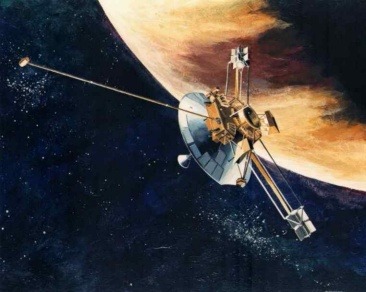
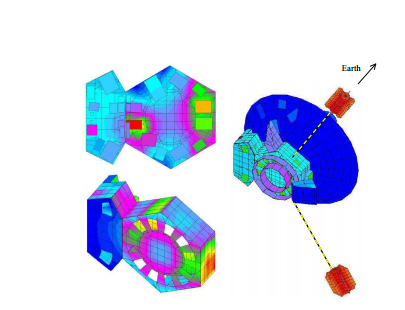
Gas leakage, measurement error or other mundane reasons might explain the Pioneer anomaly. Heat, unevenly radiating off the probes, slowing their voyage, is proposed by Jet Propulsion Lab scientists, in a new Physical Review Letters article, to account for the anomaly. After constructing a finite-element thermal model of the two spacecraft, the authors modeled the effects of thermal recoil forces on Pioneer 10 at various distances from the Sun.
Finite element analysis of thermal radiation from Pioneer 10. Image credit JPL.
A second paper in a sister journal, Physical Review D, proposes a totally different cause and conclusion. Flat (neither expanding nor contracting) background spacetime with a solar system gravitationally isolated from the rest of the Universe is the cornerstone of current theory. The new study extends this theoretical concept, formalizing the description of particles and photons moving in the gravitational field of a localized astronomical system now embedded in an expanding universe.
The proposed changes to the astrophysics theory are mathematically complex, the paper is densely populated with “post-Newtonian cosmological field equations” – the conclusions though are emphatically clear. Terms, proportional to the local expansion of the universe, are missing from the equations of light propagation currently used by space navigation centres for fitting distance and speed observations of satellites and celestial bodies. With this correction the Pioneer anomaly disappears; the photons were moving faster than expected from the theory, the spacecraft were actually travelling the correct speed.
NASA New Horizons space probe. Image credit NASA/JPL.
So which of these two competing papers explains the Pioneer anomaly? Which will solve this nagging problem and be of benefit to future interstellar travel? We may need to wait beyond 2015 to find an answer. With no new Pioneer data, proof will rely on measurement from NASA’s New Horizons mission, launched in 2006 and set to reach Pluto in 2015.
Doesn’t time fly? I don’t know about anyone else, but my week has absolutely flown past. As I take a moment to relax and consider picking a few favourite topics from this week’s news, I realise that perhaps this is because it’s been an exciting week, full of interesting discoveries and unusual events. In fact, I’ve had quite a lot to choose from, but I eventually managed to trim it down to these few articles which particularly caught my eye…
First and foremost, a planet has been discovered in our neighbouring star system, Alpha Centauri. This is something which I find thrilling for various personal reasons. An interesting discussion of the discovery itself and some of its implications are given by Paul Gilster in the blog Centauri Dreams:
There was a sense of exhilaration in the air on Tuesday as the buzz around an Alpha Centauri planet built, and when the embargo was lifted, reports of the find filled the social media as the early articles began to appear online. Just how big a deal is Centauri B b? A skeptic could point out that while finding an Earth-mass planet is significant, it must still be confirmed, and in any case, this is an Earth-mass planet that is nothing like a clement, habitable world.
From a neighbouring star to a neighbouring planet, the Curiosity rover has been finding some very curious shiny objects in the martian soil. Wired Science gives a brief overview of what’s been happening on the red planet:
NASA’s Curiosity rover took three scoops from a small Martian sand dune and found several bright particles in the soil. Scientists think these are unrelated to the odd bright object that Curiosity saw last week, which turned out to be plastic that fell from the probe, and are probably indigenous Martian mineral flecks.
Closer to home, this week saw a world record being broken by Austrian skydiver Felix Baumgartner, who leapt from a balloon at an altitude of 39 km. A fantastic achievement and a daredevil stunt! However, could more of an effort have been made to add some depth to the stunt and give us all some more background about it? Science historian Amy Shira Teitel at Vintage Space takes a detailed look at the full background and a few tricks which were missed with respect to communicating the science behind such a stunt:
In the 1960s, pilots were pushing the envelope of supersonic flight at high altitudes. But this was a dangerous approach. While it’s easy to fly fast in the thin upper atmosphere it’s harder to control an aircraft. With no air for control surfaces to push against, aircraft tend to tumble, and when aircraft tumble pilots tend to eject. Tests with dummies showed that when falling from high altitudes, human bodies tended to get into a flat spin. It would be like rolling down a hill really fast but without the hill, and the G-forces would certainly be fatal.
Image: AP Photo/Red Bull Stratos, Luke Aikins
And finally, there was a rather informative little discussion piece by Dave Hone in the blog Lost Worlds. In emphasising some of the difficulties faced in palaeontology, he poses a rhetorical question – did Tyrannosaurus Rex have feathers?
Note that there is a rather important scientific distinction here, no facts have changed since the 70s, but we have many more facts. And the best interpretation of all of the available data is now a little different to that which we had before. The fossil record is incomplete and we have to extrapolate from the available evidence and apply parsimony the best way we can.

 The Excellence in Business Intelligence Award, sponsored by BusinessMinds, was won by Telstra for a customer centric solution using nearreal time BI.
 Yesterday, a working group at OKFN Australia gathered data geeks from around the country. The opening the Australian chapter of the Open Knowledge Foundation happened via a Google hang-out. The group includes internet public servants, data scientists, data visualisation specialists, data journalists, and others dedicated to the idea that, when it comes to knowledge and information, open is better.
 Check out our great stories on astronomy, genetics, biology, environment, physical geography, seismology, genetic engineering, public policy, biodiversity, marine biology, oceanography, education, publishing, and technology. The best of Australian Science for October 2012:



 Climate conditions have been increasingly harrowing for the denizens of the reef, however. Inclement weather, including tropical cyclones, can cause severe damage to coral growths. Global warming is having a lethal effect on corals living near the edge of the reef, which are already at the high end of their temperature tolerance. The warm waters cause corals to expel their zooxanthellae (the symbiotic organisms with live with the coral, photosynthesising and providing around 90% of the coral’s energy requirements) resulting in coral bleaching and, eventually, death as the corals die of starvation. And then there’s the crown of thorns starfish, a natural predator of corals which has seen a sharp increase in numbers in recent years. While the starfish is actually in indigenous inhabitant of the reef, some suspect that overfishing of the starfish’s natural predators has contributed to their recent population explosion.








 Doesn’t time fly? I don’t know about anyone else, but my week has absolutely flown past. As I take a moment to relax and consider picking a few favourite topics from this week’s news, I realise that perhaps this is because it’s been an exciting week, full of interesting discoveries and unusual events. In fact, I’ve had quite a lot to choose from, but I eventually managed to trim it down to these few articles which particularly caught my eye…