Blog

  • For sale: One world class infrared telescope

    For sale: One world class infrared telescope

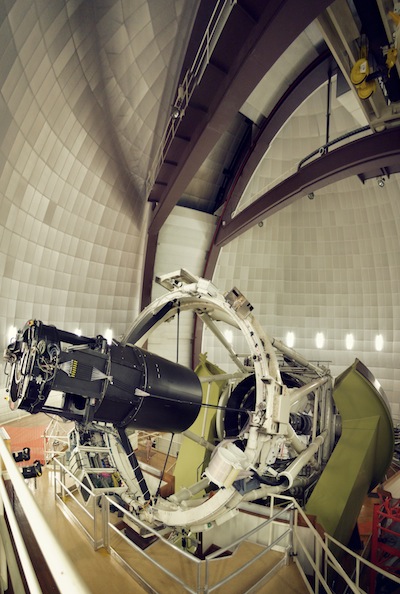
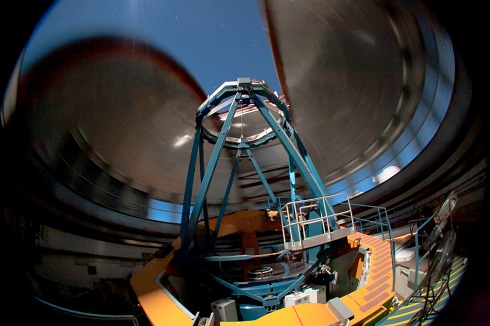
    Image © Tom Kerr/A Pacific View

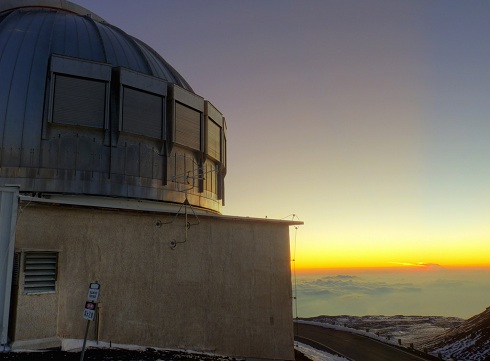
    The world’s largest and most productive dedicated infrared observatory just went on the market in an unprecedented attempt to try and prevent it from being shut down and dismantled. In a bold move, the directors of the United Kingdom InfraRed Telescope (UKIRT), based on Mauna Kea in Hawaii, have just released a prospectus detailing the telescope’s impressive achievements and capabilities in the hopes that they can find sponsorship and save the observatory from certain doom. That may sound melodramatic, but doom genuinely is the most fitting description.

    The Anglo-Australian Telescope, also abandoned by the UK, but still safe in the care of the Australian government. (Image Credit: Ahilan Parameswaran/Wikimedia Commons)

    UKIRT’s death knell has, in fact, already been tolled. At the start of Summer, the UK’s Science and Technology Facilities Council announced that it would be terminating funding and that all telescope operations were to cease by September 2013. The UKIRT board released an official statement explaining their grim disappointment over the decision, and morale has been low for everyone involved with the telescope ever since.

    Unfortunately, since their formation in 2007, the STFC have seemingly been determined to rid the UK of its telescope access. Another casualty was the Anglo-Australian Telescope (AAT). Constructed at Siding Spring Observatory in New South Wales, the AAT was originally built and operated in partnership between Australia and the UK, but since it’s 36th birthday in 2010 it has been owned and funded solely by Australia. The AAT is still the largest optical telescope in Australia and it continues to the crown jewel of the Australian Astronomical Observatory. Sadly, the future for UKIRT looks rather more bleak.

    Should they fail to find funding to continue it’s operation, then in September 2013 UKIRT will have to be dismantled and erased from Mauna Kea. Under the agreement originally made with the Hawaiian government, any telescope no longer in operation must be removed, and the mountain must be returned to its natural state. This once proud telescope will simply be no more – a heartbreaking prospect in the eyes of a great many astronomers worldwide.

    The most tragic part is that UKIRT is actually at its most productive right now. After being the world’s largest dedicated infrared observatory for over three decades, UKIRT is currently boasting a record level of productivity. Being as it’s exceptionally cheap to run and maintain (compared to other world-leading telescopes, it costs little more than pocket change), it’s easily one of the most productive telescopes in the world. And the directors are quite literally offering it to anyone in the world who may have the money to finance it. A dramatic move – no world class telescope has ever been simply offered up for sale on the global market before. Now, all the astronomical community can do is to hope that someone is willing to buy it.

    Whether you happen to be a billionaire playboy philanthropist interested in owning a telescope, or just curious to know more about UKIRT, their prospectus is online for all to see.

    Image © Tom Kerr/A Pacific View
  • Amy Cuddy at TED: Your body language shapes who you are

    Amy Cuddy at TED: Your body language shapes who you are

    Body language affects how others see us, but it may also change how we see ourselves. Social psychologist Amy Cuddy shows how “power posing

  • My mega grab-bag of astronomy resources for teachers, students, telescope beginners and space fans

    My mega grab-bag of astronomy resources for teachers, students, telescope beginners and space fans

    Whether you are a parent, teacher, student or simply an interested enthusiast, here are a number of interesting sites, podcasts, and social media people for you to draw on as you get going in amateur astronomy.

    Podcasts provide an amazing resource – all free. Most are available via iTunes, the original publishers’ websites, or a raft of other podcast aggregators. There are very good apps to allow you to download podcasts to your smartphone for listening when suitable – Podcruncher is my choice for the iOS platform – brilliant app and service. Just don’t bother trying to use the Apple Podcasts app – it’s a total lemon. Good podcast apps also allow you to increase the playback speed up to double normal (Podcruncher goes in quarter increments) and surprisingly you learn to follow it. In fact, it can get so listening at normal speed is far too slow!

    Many of these links also have Twitter accounts (where noted), so you can keep right up to the minute!

    Astronomy podcasts:

    In Australia there is the wonderful StarStuff, an independent project run by Stuart Gary but sponsored by the ABC, with the 30-minute podcasts at ABC. @abcstarstuff


    Canberra’s Steve Nerlich produces Cheap Astronomy, regular 10-minute shows of varying complexity. @cheapastro

    Overseas, despite a truly ugly website, the fantastic Naked Scientists from UK’s Cambridge University have a stack of brilliant podcasts on general, science, archaeology, earth sciences, oceans, Africa, great kitchen-friendly experiments, and the monthly 60-minute Naked Astronomy, steered by Ben Valsler.

    Tony Darnell works in the Space Telescope Science Institute and as a hobby runs Deep Astronomy, with videos and podcasts generally about 10-minutes.

    There are a stack of NASA video and audio podcasts. Of interest are the space telescope ones for Hubble, Spitzer, Chandra, plus This Week @ NASA, Universe, Earth…where to stop? You’ll be amazed at how much NASA is doing – for an agency that altogether too many people think has shut up shop!

    365 Days of Astronomy is a real mixed bag of 10-minute podcasts – one for every day of the year. And it’s well worth looking back over previous episodes. Following are some specific ones worth checking out.
    Teachers could start with four of the best called ‘Wonders From Class’ by Diane Turnshek from Carnegie Mellon Uni. Over four podcasts and with great passion, she describes how she engages and interests her students with the field of astronomy. Part 1Part 2Part 3, and Part 4. Some others for beginning viewing and then a bit more:
    Common Q&As about telescope use – from RapidEye Observatory
    8 Telescope Tips for Beginners – by Telescope Man
    Buying your first telescope – Telescope Man again
    Have a plan – by Ed Sunder of flinstonestargazing.com
    How to be an armchair astronaut – From Riding With Robots – now there’s a site to spend some time at!
    Armchair astronauts exploring the solar system – by Doug Ellison ofunmannedspaceflight.com @doug_ellison
    Exploring space with your computer – a guide to computer simulation tools by Bruce Irving of JPL
    Moving onto photographing what you see:
    Introduction to astrophotography – by Adam Pender
    Webcam astrophotography – by Alexander Hobson
    Amateur astrophotography for beginners – by Richard Drumm
    Astroimaging under light polluted skies – by Robert Vanderbei
    Expanding further – into spectroscopy:
    Basic spectroscopy for amateurs  and Part 2 – by Mark DeVito and Tom Field

    And if you’d like to go a bit further, you can subscribe to an entire university astronomy course via podcast – all the learning but no horrible assignments or exams! Here’s one in audio format from Ohio State Uni. There are others too, including video. Check iTunes, or iTunesU, the app for which includes study notes and the ability to record your own notes as you go along.

    Observing podcasts:

    The Sydney Observatory posts a monthly podcast summarising the night sky viewing for the month – great for Southern Hemisphere viewers and East Coast Australians in particular. They have the added benefit of a transcript so you can print and highlight the key bits as a night sky viewing plan. @sydneyobs

    NASA’s Jet Propulsion Lab has a short monthly video podcast, plus there’s a stack of related brain food on their site.

    Observing with Webb – another USA podcast by Rod Webb, but many of the sights will be visible here, just in different locations.

    Telescope Man – look for the monthly viewing summaries. No nonsense, best viewing tips, with catalogued numbers if you have a go-to scope, but based on Texas. Plenty of other good beginner podcasts too.

    Non-podcast observing resources:

    The Hayden Planetarium (part of the American Museum of Natural History and headed up by none other than Neil deGrasse Tyson @neiltyson) has a good monthly sky report. You can see a lot of what they discuss, but of course not all. You’ll also find their 3D atlas to the Universe.

    Slooh has several large telescopes around the world and you can view the feeds for free. They have guest speakers during regular events. @slooh

    Heavens Above allows you to register and enter your location, then get schedules of when key objects will pass over your patch of the sky – from GPS satellites to the International Space Station. Find out why the brightness scale goes backwards, planet and comet locations, and more.

    If you just want to focus on passes of manned vehicles like the ISS or Soyuz, then check the RSS subscription for your location at NASA Human Spaceflight.

    Stellarium – a free public domain computer planetarium. Free-standing once installed with no need of web access, so you can switch to red mode and take your notebook computer out with you.

    Celestia – another free planetarium. This one lets you explore off-planet, and even check out various space missions.

    Eyes on the Solar System – NASA’s mission tracking simulator. Go for a ride along with every NASA space mission past and present. A great way to piggy back onto the Mars Curiosity rover and relive her descent to Mars last August!

    Non-podcast astronomy resources:

    NASA’s Breaking News is a good resource, and has a useful RSS feed – check out Google Reader for how to collate key websites simply via RSS feeds, and Feedler Pro is a great app for viewing your Google Reader subscriptions on iThings. @NASA

    NASA also has a comprehensive education section, with specialist information for teachers at different levels, students and a kids club. Too much to list and it seems to grow every time you return. It’s not all about the US either – they have an international Scientist for the Day competition running right now for school students.

    It’s hard to go past Space.com for some of everything you want, and great RSS and Twitter feeds. They have a good shop too – from meteorites to kids’ spacesuits, genuine gone-to-space memorabilia to clothing. I mean, you’ve got to look the part for your classes right? @spacedotcom

    With broadband, giant televisions with network sockets, and a high definition feed from NASA TV, there’s never been a better time for live viewing rocket launches, spacewalks, and more. Keep an eye on the schedule for education shows too. Be warned though, spacewalks are REALLY long and slow-mo. Some younger viewers will have a short attention span for them. But launches…Phroar! Crank up the volume.

    The Square Kilometre Array is the project to build the world’s biggest radio telescope – right here in Australia. And in South Africa. It will be the biggest science project ever in our history. Good video clips explaining the project.

    Bad Astronomy blogger Phil Plait sorts the facts from the nonsense. @BadAstronomer

    Universe Today by Fraser Cain, who also does weekly virtual star parties with Dr Pamela Gay via Google+, YouTube and Cosmoquest. Also does the Astronomy Cast podcast.

    The Space Tweep Society has great articles, photos and videos from spacefans on Twitter who travel the world to attend Tweetups – key space events like launches – and hang out with other fans who use Twitter to share their experiences with their followers. The travels to Russia are brilliantly recounted.

    Registax allows you to stack multiple photos or frames from a video clip to produce a single sharp picture. Free!

    Galaxy Zoo is a citizen science website that allows anyone to help the scientists categorise galaxies as seen by Hubble. There have been a number of people credited on scientific journals for the new wonders they discovered on Galaxy Zoo! And now on a spin-off you might help find exoplanets…

    Tweeps you should follow:

    @NASAKepler – the search for exoplanets
    @SpaceflightNow – space news up to the moment, from Florida
    @Nightskyonline – Australian amateur astronomer, alerts to sights
    @SpaceX – the future of manned missions
    @elonmusk – the boss of SpaceX – a real-life Tony Stark
    @MarsRovers – updates from Opportunity on Mars
    @MarsCuriosity – updates from the Mars Science Laboratory herself
    @matt_heverley – lead Mars Curiosity rover driver
    @marsroverdriver – Scott Maxwell, formerly driving Opportunity, now Curiosity
    @spaceroboticist – Vandi Thomas – there are women driving Curiosity too
    @NASAWebbTelescp – the future of space telescopes, being built now
    @twisst – alerts of ISS passes over your location
    @Aussie_Starman – Mark Rigby, head of the Brisbane Planetarium
    @NASAJuno – Juno is heading to Jupiter
    @carolynporco – the wonderful head of the Cassini mission around Saturn
    @PULSEatParkes – high school students taking over The Dish at Parkes!
    And all the other ones named earlier.
    Apps:

    Lastly, iPhone and iPad apps are simply brilliant for finding out exactly what you are looking at in the sky.
    Star Walk – virtual planetarium, my favourite, $3 – worth every cent!
    Distant Suns – virtual planetarium, free
    SkyOrb – virtual planetarium, free
    Pocket Universe – first off the line with this whole virtual planetarium approach, $2
    3D Sun – know about and watch solar flares before anyone else, free
    Cassini – find out what this probe is doing around Saturn, free
    APOD – astronomy picture of the day – website and iPhone app, free
    Exoplanet – the latest on every exoplanet discovered, free
    NASA – their own app, and simple access to NASA TV – never miss another launch! Free
    Mars Images – what it says on the box, free
    ISS Spotter –  brilliant way to make sure you don’t miss passes of the Space Station – live maps and smart alarms, free
    Mission Clock – don’t miss your dose of roar, $5
    Meteor Counter – help scientists monitor meteor density, free, great activity for families.

    Anyway, that’s enough for now. But rest assured, it is only scratching the surface. There’s a whole world of astronomy resources out there online for you.
  • Does my Science look big in this? October edition

    Does my Science look big in this? October edition

    Science this month tackled many of the big questions: Where did life on Earth originate? How do we learn? How can we live healthy lives? and, What is it with scientists and sticky-tape?

    Lithopanspermia is the idea that basic life forms are distributed throughout the universe via meteorite-like planetary fragments. Eventually, another planetary system’s gravity traps these roaming rocks, which can result in a transfer of any living cargo.

    Researchers reported that under certain conditions there is a high probability that life came to Earth — or spread from Earth to other planets — during the solar system’s infancy when Earth and its planetary neighbors orbiting other stars would have been close enough to each other to exchange lots of solid material.

    Image Credit: Shutterstock

    Previous research suggests that the speed with which solid matter hurtles through the cosmos makes the chances of being snagged by another object highly unlikely. This research reconsidered lithopanspermia under a low-velocity process called weak transfer in which solid materials meander out of the orbit of one large object and happen into the orbit of another. In this case, the researchers factored in velocities 50 times slower than previous estimates, or about 100 meters per second.

    Using the star cluster in which our sun was born as a model, the team conducted simulations showing that at these lower speeds the transfer of solid material from one star’s planetary system to another could have been far more likely than previously thought.

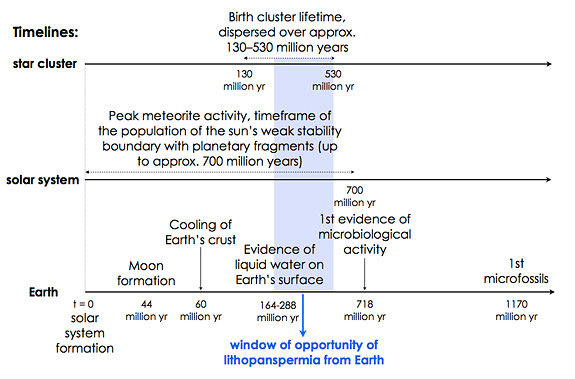
    The researchers suggest that ideal conditions for lithopanspermia in the sun's birth cluster, in the solar system and on Earth overlapped for several hundred million years (blue shaded area). Rock evidence suggests that the Earth (bottom line) contained surface water during a period when the relative velocities between the sun and its closest cluster neighbors (top line) were small enough to allow weak transfer to other planetary systems, and when the solar system (middle line) experienced high meteorite activity within the sun's weak gravitational boundary. If life arose on Earth shortly after surface water was available, life could have journeyed from Earth to another habitable world during this time, or vice versa if life had an early start in another planetary system. Image credit: Amaya Moro-Martín

    The researchers suggest that of all the boulders cast off from our solar system and its closest neighbor, five to 12 out of 10,000 could have been captured by the other. Earlier simulations had suggested chances as slim as one in a million.

    This research highlights that life could have originated away from earth. The theory that it did is yet to be demonstrated.

    Research has again shown that you can indeed “teach old dogs new tricks.” The brain you have at any stage of your life is not necessarily the brain you are always going to have. It can still change, even for the better. This time however the researchers observed changes in the brain’s white matter.

    Most people equate “gray matter” with the brain and its higher functions, such as sensation and perception, but this is only one part of the anatomical puzzle inside our heads. Another cerebral component is the white matter, which makes up about half the brain by volume and serves as the communications network.

    The gray matter, with its densely packed nerve cell bodies, does the thinking, the computing, the decision-making. Projecting from these cell bodies are the axons – the network cables. They constitute the white matter. Its color derives from myelin – a fat that wraps around the axons, acting like insulation.

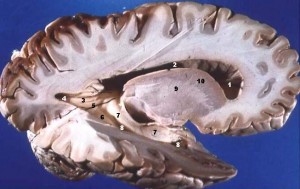
    Human brain right dissected lateral view, showing grey matter (the darker outer parts), and white matter (the inner and prominently whiter parts). Photo credit: John A Beal, Dep't. of Cellular Biology & Anatomy, Louisiana State University

    This study looked at a really complex, long-term learning process over time, actually looking at changes in individuals as they learn a language. The work demonstrates that significant changes in the mylenation were observed in adults as they were learning. This research demonstrates how learning is a many step process in our brain.

    The flip-side of learning is the persistence of misinformation. Why does that kind of ‘learning’ stick? A new report explores this phenomenon. According to the researchers rejecting information actually requires cognitive effort. Weighing the plausibility and the source of a message is cognitively more difficult than simply accepting that the message is true. If the topic isn’t very important to you or you have other things on your mind, misinformation is more likely to take hold.

    Misinformation is especially sticky when it conforms to our preexisting political, religious, or social point of view. Because of this, ideology and personal worldviews can be especially difficult obstacles to overcome.

    Even worse, efforts to retract misinformation often backfire, paradoxically amplifying the effect of the erroneous belief.

    Though misinformation may be difficult to correct, all is not lost. According to the report, these strategies can set the record straight.

    • Provide people with a narrative that replaces the gap left by false information
    • Focus on the facts you want to highlight, rather than the myths
    • Make sure that the information you want people to take away is simple and brief
    • Consider your audience and the beliefs they are likely to hold
    • Strengthen your message through repetition

    Research has shown that attempts at “debiasing

  • Best of Science blogging – September 2012

    Best of Science blogging – September 2012

    Lot of events happening this September and I’m looking forward to share with you some wonderful articles and interesting posts, interviews for you to read. We have weekly science blogging picks with the guest editor each week, now it’s almost a tradition called #ScienceSunday, you can search for it on Google Plus as well.  We are coming out soon with the new design for the Australian Science and some new interesting initiatives.

    Contact us if you’d like to join our team of science and tech bloggers and authors – please read the Editor’s note, also if you’re interested in Weekly Science Picks scroll down the article to find about it more. The Australian Science recap of the September 2012:

    Lighting the Imagination in Science by Kelly Burnes

    Let’s think about the role of imagination in science. The process of imagination is on display everywhere in an early childhood classroom. But by the time they reach middle school, students seem to burn out and tire of science. Where is the imagination? What is driving the curiosity?

    Got Science? Australian Science on Display at Mitchelton State School is part two of the previous article by Kelly, an interview with Mitchelton State School staff :

     McIntyre indicated that in addition to exposing children to science, it’s also essential “to develop the attributes of curiosity that are necessary to the investigations around science.

  • Hubble goes to the eXtreme to assemble the deepest ever view of the Universe

    Hubble goes to the eXtreme to assemble the deepest ever view of the Universe

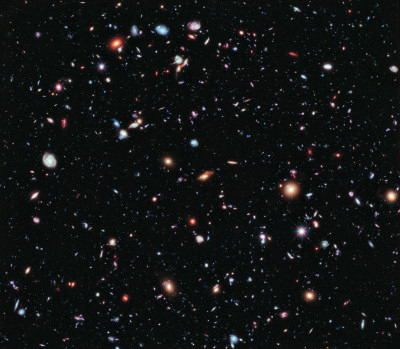
    Like photographers assembling a portfolio of their best shots, astronomers have assembled a new, improved portrait of our deepest-ever view of the Universe. Called the eXtreme Deep Field, or XDF, the photo was assembled by combining ten years of NASA/ESA Hubble Space Telescope observations taken of a patch of sky within the original Hubble Ultra Deep Field. The XDF is a small fraction of the angular diameter of the full Moon.


    The Hubble eXtreme Deep Field (XDF)

    The Hubble Ultra Deep Field is an image of a small area of space in the constellation of Fornax (The Furnace), created using Hubble Space Telescope data from 2003 and 2004. By collecting faint light over one million seconds of observation, the resulting image revealed thousands of galaxies, both nearby and very distant, making it the deepest image of the Universe ever taken at that time.

    The new full-colour XDF image is even more sensitive than the original Hubble Ultra Deep Field image, thanks to the additional observations, and contains about 5500 galaxies, even within its smaller field of view. The faintest galaxies are one ten-billionth the brightness that the unaided human eye can see [1].

    Magnificent spiral galaxies similar in shape to the Milky Way and its neighbour the Andromeda galaxy appear in this image, as do large, fuzzy red galaxies in which the formation of new stars has ceased. These red galaxies are the remnants of dramatic collisions between galaxies and are in their declining years as the stars within them age.

    Peppered across the field are tiny, faint, and yet more distant galaxies that are like the seedlings from which today’s magnificent galaxies grew. The history of galaxies – from soon after the first galaxies were born to the great galaxies of today, like the Milky Way – is laid out in this one remarkable image.

    Hubble pointed at a tiny patch of southern sky in repeat visits made over the past decade with a total exposure time of two million seconds [2]. More than 2000 images of the same field were taken with Hubble’s two primary cameras: the Advanced Camera for Surveys and the Wide Field Camera 3, which extends Hubble’s vision into near-infrared light. These were then combined to form the XDF.

    The XDF is the deepest image of the sky ever obtained and reveals the faintest and most distant galaxies ever seen. XDF allows us to explore further back in time than ever before,” said Garth Illingworth of the University of California at Santa Cruz, principal investigator of the Hubble Ultra Deep Field 2009 (HUDF09) programme.

    The Universe is 13.7 billion years old, and the XDF reveals galaxies that span back 13.2 billion years in time. Most of the galaxies in the XDF are seen when they were young, small, and growing, often violently as they collided and merged together. The early Universe was a time of dramatic birth for galaxies containing brilliant blue stars far brighter than our Sun. The light from those past events is just arriving at Earth now, and so the XDF is a time tunnel into the distant past when the Universe was just a fraction of its current age. The youngest galaxy found in the XDF existed just 450 million years after the Universe’s birth in the Big Bang.

    Before Hubble was launched in 1990, astronomers were able to see galaxies up to about seven billion light-years away, half way back to the Big Bang. Observations with telescopes on the ground were not able to establish how galaxies formed and evolved in the early Universe.

    Hubble gave astronomers their first view of the actual forms of galaxies when they were young. This provided compelling, direct visual evidence that the Universe is truly changing as it ages. Like watching individual frames of a motion picture, the Hubble deep surveys reveal the emergence of structure in the infant Universe and the subsequent dynamic stages of galaxy evolution.

    The planned NASA/ESA/CSA James Webb Space Telescope (Webb telescope) will be aimed at the XDF, and will study it with its infrared vision. The Webb telescope will find even fainter galaxies that existed when the Universe was just a few hundred million years old. Because of the expansion of the Universe, light from the distant past is stretched into longer, infrared wavelengths. The Webb telescope’s infrared vision is ideally suited to push the XDF even deeper, into a time when the first stars and galaxies formed and filled the early “dark ages” of the Universe with light.

    Notes

    The Hubble Space Telescope is a project of international cooperation between ESA and NASA.

    The HUDF09 team members are G. Illingworth (University of California, Santa Cruz), R. Bouwens (Leiden University), M. Carollo (Swiss Federal Institute of Technology, Zurich (ETH)), M. Franx (Leiden University), I. Labbe (Leiden University), D. Magee and P. Oesch (University of California, Santa Cruz), M. Stiavelli (Space Telescope Science Institute), M. Trenti (University of Cambridge), P. van Dokkum (Yale University), and V. Gonzalez (University of California Observatories/Lick Observatory).

    [1] The faintest objects detected in the XDF are 31st magnitude.

    [2] The total exposure time is approximately two million seconds, or 23 days. Because Hubble can only observe for about 45 minutes of every 97-minute orbit, the observations that make up the XDF represent 50 days of telescope time.

    Image credit: NASA, ESA, G. Illingworth, D. Magee, and P. Oesch (University of California, Santa Cruz), R. Bouwens (Leiden University), and the HUDF09 Team
    Links

    Source: http://sci.esa.int/science-e/www/object/index.cfm?fobjectid=50874

  • Growth of Scholarly Open Access Agricultural Repositories in India

    Growth of Scholarly Open Access Agricultural Repositories in India

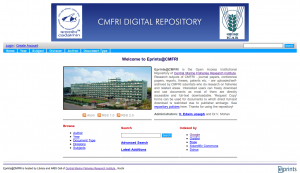
    Screen Shot of Eprints@CMFRI

    After the successful organisation of workshop and seminar on Open Access Indian Academy of Sciences (IAS), Bangalore and Indian National Science Academy (INSA), New Delhi at Bangalore and Pune in 2002 and 2003 respectively, the M S Swaminathan Research Foundation (MSSRF) had organised two workshops on Open Access at Chennai in 2004. In these workshops, researchers and policy makers from Indian Council of Agricultural Research (ICAR) and others from various State Agricultural Universities in India have participated. However, there was no activity on Open Access in Agriculture in India. During 2006 in the first AGRIS workshop on open access in agricultural sciences and technology held at ICRISAT, Hyderabad, the participants had decided to suggest the establishment of the two pilot open access information repositories in the agricultural domain in India and in 2009, the ICRISAT has formally launched its Open Access Repository for its scientific publications mandating every researcher at ICRISAT to send a authors final copy for deposit upon acceptance of the publication. In the same year (2009), the National Agricultural Innovation Project (NAIP) supported consultation on enhancing Open Access in Indian agriculture was held at ICRISAT. In the consultation, the researchers from ICAR and the Agricultural Research Service Scientists’ Forum (ARSSFagreed to build Open Access agricultural research publications repository either within Agropedia, a digital knowledge repository with the open platform for learning and sharing information related to Indian agriculture or establishment of institutional repositories so that the researches in ICAR would be be able to deposit their research articles for wider reach.

    The fall out of the meeting held at ICRISAT in on Open Access (2009) resulted in establishment of Eprints@IARI, an Open Access Institutional Repository of Indian Agricultural Research Institute (IARI). and OpenAgri, an open access agricultural research repository in 2009 and 2010 respectively. These developments made for the establishment of Eprints@CMFRI, an Open Access Institutional Repository of  Central Marine Fisheries Research Institute (CMFRI); DSpice@IISR, an Open Access Institutional Repository of Indian Institute of Spices Research (IISR) and E-Repository@IIHR, an Open Access Institutional Repository of  Indian Institute of Horticultural Research (IIHR)

    In the National Agricultural Research System (NARS) of India, apart from the ICAR and NAIP established repositories, exclusive thesis repository for agricultural sciences in India was initiated in 2008 under the name ‘Krishiprabha‘. It houses all the doctoral dissertations submitted to various agricultural universities in India (NARS). It is now housing, 7624 dissertations and is hosted by Chandhary Charan Singh Haryana Agriculture University, Hissar. However, it is only open to the consortium partners and other constituents of the NARS. Whereas, the ETD@UASD, thesis repository established by University of Agricultural Sciences, Dharwad in 2011 is freely available to public for download and use. It has total 1119 thesis submitted to the university since year 2005. Under the NAIP’s Rice Knowledge Management Portal (RKMP), India Rice Research Repository (i3R) is established in 2010.

    Though the efforts are being made to make agricultural research publicly available since 2004 in India, the pace at which it needs to be taken forward is very slow and the concept of Open Access had not reached all the stakeholders of National Agricultural Research System (NARS) especially, the researchers and the research managers. The records in Eprints@IARI are 229; Dspice@IISR 497; E-Repo@IIHR 193. The only most populated repository in ICAR/NARS is Eprints@CMFRI with 8978 records. The ICAR needs a policy on ‘Open Access’ and the researchers and the research managers should consider Open Access as an important agenda for taking forward the movement of making all the publicly funded research publicly available and accessible in India.

    To take forward the concept of Open Access and to advocate it, Open Access India (OAIndia) an online group is formed by the researchers, librarians and students in NARS. The OAIndia is quite active on facebook with ~2290 members and is involving its members to discuss and debate on ‘Open Access’ – why it is needed and what needs to be done and what are the bottlenecks and how to overcome them and is now looking for establishment of its online repository which would harvest all the publicly available research information (meta-data) and make it accessible to all the stakeholders in NARS.

  • A long time ago in a galaxy far, far away

    A long time ago in a galaxy far, far away

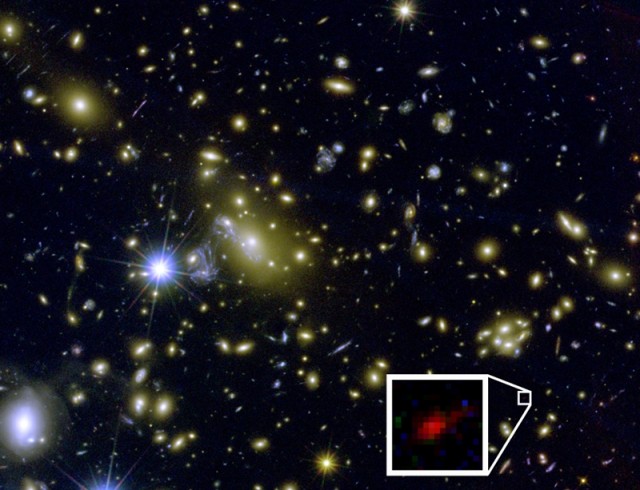
    Feast your eyes on this image…

    Image credit: The CLASH team/Space Telescope Science Institute

    The tiny object in that inset may not look like much. A blurry smudge of red pixels. Not nearly as dramatic as the stunning bouquet of galaxies all around it. But in astronomy, not everything is quite so straightforward. That small red smudge is probably the most exciting thing in this whole image. You see, it too is a galaxy. An unimaginably ancient one.

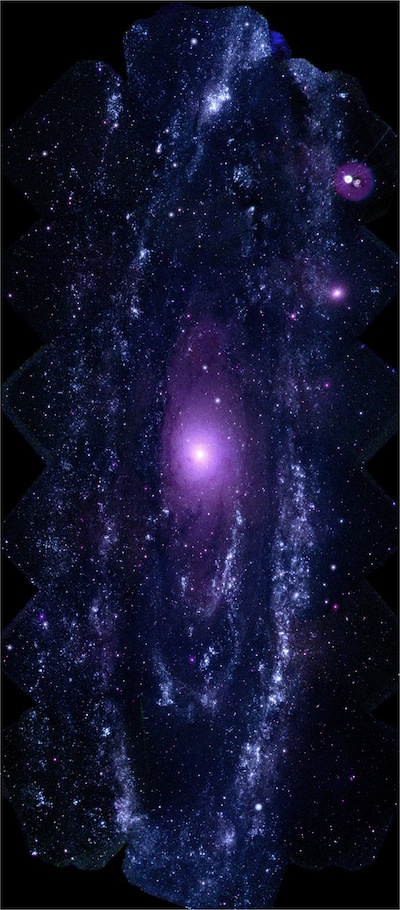
    An ultraviolet image of the nearby Andromeda Galaxy – possibly similar to what we might see of MACS 1149-JD if we could get a more detailed view… Credit: NASA/Swift/Stefan Immler (GSFC) and Erin Grand (UMCP)

    The light that made this unassuming red dot left its source less than 500 million years after the Big Bang and the birth of the Universe. The photons that make up that light have been travelling for over 13.2 billion years. This galaxy was blazing brightly as the oldest known stars in our own galaxy, the Milky Way, were just starting to shine. Back when the gas which would one day become the Sun was still drifting silently amongst stars which are now long dead, and before planet Earth was even a whisper of interstellar dust. Before a massive star forged the iron atoms in your blood, and before a supernova scattered those atoms into space. Before anything we know from the world around us existed, even the stars we see as we look up to the night sky, this galaxy was shining in the dark.

    The Universe was a much smaller place back then. Over the billions of years these photons have been travelling, the Universe itself has expanded with them in the midst of it – stretching them out, redshifting them to longer and longer wavelengths. The light we see here as red was probably ultraviolet once, when it left the galaxy which created it.

    Ancient galaxies like these are difficult to see, purely because they’re so distant. So few photons make it this far that only the most sensitive telescopes can make them out, and even then they need a helping hand. The bloom of galaxies in this image is a massive galaxy cluster called MACS J1149+2223. A collection of galaxies bound together by gravity, clusters like these are some of the largest and most massive objects in the Universe. With that much mass gathered together, gravity starts to do some interesting things, and one of the most interesting is gravitational lensing. Because the gravity of all of those galaxies distorts spacetime, it actually causes the space around the galaxies to act like a titanic lens. A gravitational lens. The ancient red galaxy in this image is only visible because it’s magnified, not only by the Hubble Space Telescope, but by that gravitational lens too.

    It would be naive to assume that this galaxy, dubbed MACS 1149-JD, is special somehow. Instead, it’s most likely to be one of a huge number of primordial galaxies. Except that this one just happened to be in the right place at the right time. A whole population of these ancient galaxies were likely shining brightly at the time, full of hot stars which were driving the reionisation epoch – the time when the Universe went from being an opaque, dark fog, to a clear place where photons could travel long distances. The photons in this image may well have been some of the first photons to have travelled through that ancient and newly transparent Universe.

    The scientific paper is available from Nature – DOI: 10.1038/nature11446

  • Botanist Wins Prestigious Nature Conservancy Award to Work on Grass Trees

    Botanist Wins Prestigious Nature Conservancy Award to Work on Grass Trees

    24 September 2012.  MEDIA RELEASE

    Botanist Todd McLay has won the 2012 prestigious Australian Conservation Taxonomy Award to delve further into the mysteries of the iconic Xanthorrhoea genus ­ or, Australia¹s native grass trees.

    PHOTO CREDIT: © Ted Wood

    The Nature Conservancy and The Thomas Foundation launched the award last year to foster research by young scientists into important taxonomic works with significant implications for conservation in Australia.

    Dr James Fitzsimons, director of conservation with The Nature Conservancy, said the $10,000 award would be used to ³interpret the evolutionary history of the grass tree with a view to underpinning conservation in the global  biodiversity hotspot of Western Australia.²

    ³The last major look at the Xanthorrhoea family was in 1986 for the Flora of Australia, and it showed a level of uncertainty about some aspects of the grass tree. We urgently need to learn more about its biological make-up in order to better protect it.²

    Mr McLay, a postgraduate student at the University of Melbourne, will assess and revise the species-level taxonomy of Xanthorrhoea in Western Australia, including the identification of potentially undescribed species.

    Two species of Xanthorrhoea ­ thortonii and nana ­ are found in the Great Western Woodlands, the world¹s largest intact temperate woodland. These species are biogeographically distinct from other recognised species of grass trees that grow in the subregions of western Australia.

    ³Knowing what species exist and their ecological requirements are essential elements of conservation and we are confident that Mr McLay, with his passion for plants, will help provide more answers,² Dr Fitzsimons said.

    The Australian Conservation Taxonomy Award was presented to Mr McLay at the Australasian Systematic Botany Society conference. The award is administered by the Australasian Systematic Botany Society.

    The Thomas Foundation was established in 1998 by David Thomas and his wife, Barbara. The conservation of biodiversity has always been part of the Foundation¹s focus. The Foundation adopts a strategic planning approach to its grant making and considers its grants to be investments in forming social capital. The Foundation¹s mission is ³Arresting the decline of biodiversity in Australia and encouraging others to do likewise.²

    About The Nature Conservancy One of the world¹s largest science-based conservation organisations, The Nature Conservancy delivers large-scale conservation projects across Australia. The NGO is currently influencing conservation over nearly 30
    million hectares of Indigenous lands across northern Australia¹s vast savannas from the Kimberley to Cape York and Central Australia¹s arid lands. The Nature Conservancy is working with Indigenous groups and other key partners and has helped to protect more than 6 million hectares of lands and waters in Australia since 2000. This includes securing 29 high priority additions to the National Reserve System, including some of the largest private protected areas in Australia.

    Media inquiries: John Myers ­ 03 9818 8540 or mediawise@mediawise.net.au

  • Weekly Science Picks

    Weekly Science Picks

    It’s been an interesting week for science news, and I’ve been lucky enough to be asked to give this week’s science picks! This made me spend a little while sipping contemplatively on a cup of vanilla iced coffee and wondering where to even start…


    The articles I’ve selected are, of course, slanted towards my own (rather geeky) interests, but all the same I hope you find them all as fascinating as I did!


    First up, the news that Star Trek style warp drives may actually be possible, at least in theory, made me exclaim “Oh wow!” out loud. Fortunately, people who spend any time with me are generally used to me talking to myself while staring at a computer screen…

    Warp Drive May be More Feasible than Thought

    “Everything within space is restricted by the speed of light. But the really cool thing is space-time, the fabric of space, is not limited by the speed of light.”
    – Richard Obousy, president of Icarus Interstellar


    Artists impression of Mimivirus, the first giant virus to be discovered. Image Credit: InvaderXan/Wikimedia Commons

    From the vastness of space to life under the microscope, biologists have been debating for years whether or not viruses qualify as a form of life. The latest evidence is that they may indeed be a life form in their own right, and an old one at that!

    Giant Viruses are Ancient Living Organisms

    They found that many of the most ancient protein folds in living organisms were present in the giant viruses, which “offers more evidence that viruses are embedded in the fabric of life,” Caetano-Anollés said.


    Heritage Daily had a fascinating article about the archaeology of the future, and what precisely our distant descendents may one day think of us and the way we lived…

    The Archaeology of the Future

    The point is that most of what survives will not be determined by conscious decisions on our part. This may not be for want of trying, as shown by the current popularity of time capsules. The most impressive of these must be the KEO satellite, due to be launched in 2014 and to return to Earth 50,000 years later.


    And speaking of what we know of the past, it’s been shown again and again that our primitive relatives, the neanderthals, were likely not the brainless savages they’re often depicted to be. Evidence suggests that neanderthals liked to collect bird feathers as ornaments.

    Neanderthals Used Feathers as ‘Personal Ornaments’

    “I think this is the tip of the iceberg,” said Prof Finlayson: “It is showing that Neanderthals simply expressed themselves in media other than cave walls. The last bastion of defence in favour of our superiority was cognition.” Neanderthals, he said, may have been “different”, but “their processes of thinking were obviously very similar”.


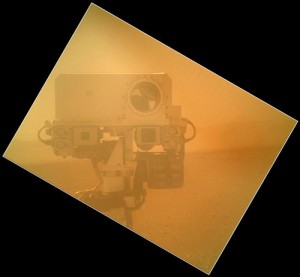
    Curiosity self-portrait. Image Credit: NASA/JPL-Caltech/Malin Space Science Systems

    As the Curiosity rover settles into its new home in Gale Crater on our neighbouring planet, one small worry is growing in the backs of the minds of certain NASA scientists. Could a blunder on the part of some engineers lead to Curiosity contaminating the surface of Mars with Earth life?

    Drill Bits on Rover Could Contaminate Mars

    John D. Rummel, a professor of biology at East Carolina University, said, partly in jest: “It will be a sad day for NASA if they do detect ice or water. That’s because the Curiosity project will most likely be told, ‘Gee, that’s nice. Now turn around.’ “


    And finally, planet hunters are scouring the sky for exoplanets. Astrobiologists are hoping to soon be able to look into the atmospheres of those planets in search of life signs, in the form of certain molecules created by living organisms. But could they be fooled by those molecules coming from somewhere else?

    Meteors Might Add Methane to Exoplanet Atmospheres

    One key gas astrobiologists looking for extraterrestrial life would concentrate on would be oxygen […] Another possibility would be methane, a colorless, odorless, flammable organic gas that microbes on Earth produce. Seeing both together in an exoplanet’s atmosphere might be an especially significant sign of life, since they would both ordinarily remove each other from the atmosphere without something like life to constantly replenish them.


    Have a good weekend!

  • Music Underlies the Ability to Acquire Language, Theorists Propose

    Music Underlies the Ability to Acquire Language, Theorists Propose

    Contrary to the prevailing theories that music and language are cognitively separate or that music is a byproduct of language, theorists at Rice University’s Shepherd School of Music and the University of Maryland, College Park (UMCP) advocate that music underlies the ability to acquire language.

    “Spoken language is a special type of music,” said Anthony Brandt, co-author of a theory paper published online this month in the journal Frontiers in Cognitive Auditory Neuroscience. “Language is typically viewed as fundamental to human intelligence, and music is often treated as being dependent on or derived from language. But from a developmental perspective, we argue that music comes first and language arises from music.”
    Brandt, associate professor of composition and theory at the Shepherd School, co-authored the paper with Shepherd School graduate student Molly Gebrian and L. Robert Slevc, UMCP assistant professor of psychology and director of the Language and Music Cognition Lab.

    “Infants listen first to sounds of language and only later to its meaning,” Brandt said. He noted that newborns’ extensive abilities in different aspects of speech perception depend on the discrimination of the sounds of language — “the most musical aspects of speech.”

    The paper cites various studies that show what the newborn brain is capable of, such as the ability to distinguish the phonemes, or basic distinctive units of speech sound, and such attributes as pitch, rhythm and timbre.

    The authors define music as “creative play with sound.” They said the term “music” implies an attention to the acoustic features of sound irrespective of any referential function. As adults, people focus primarily on the meaning of speech. But babies begin by hearing language as “an intentional and often repetitive vocal performance,” Brandt said. “They listen to it not only for its emotional content but also for its rhythmic and phonemic patterns and consistencies. The meaning of words comes later.”

    Brandt and his co-authors challenge the prevailing view that music cognition matures more slowly than language cognition and is more difficult. “We show that music and language develop along similar time lines,” he said.

    Infants initially don’t distinguish well between their native language and all the languages of the world, Brandt said. Throughout the first year of life, they gradually hone in on their native language. Similarly, infants initially don’t distinguish well between their native musical traditions and those of other cultures; they start to hone in on their own musical culture at the same time that they hone in on their native language, he said.

    The paper explores many connections between listening to speech and music. For example, recognizing the sound of different consonants requires rapid processing in the temporal lobe of the brain. Similarly, recognizing the timbre of different instruments requires temporal processing at the same speed — a feature of musical hearing that has often been overlooked, Brandt said.

    “You can’t distinguish between a piano and a trumpet if you can’t process what you’re hearing at the same speed that you listen for the difference between ‘ba’ and ‘da,’” he said. “In this and many other ways, listening to music and speech overlap.” The authors argue that from a musical perspective, speech is a concert of phonemes and syllables.

    “While music and language may be cognitively and neurally distinct in adults, we suggest that language is simply a subset of music from a child’s view,” Brandt said. “We conclude that music merits a central place in our understanding of human development.”

    Brandt said more research on this topic might lead to a better understanding of why music therapy is helpful for people with reading and speech disorders. People with dyslexia often have problems with the performance of musical rhythm. “A lot of people with language deficits also have musical deficits,” Brandt said.

    More research could also shed light on rehabilitation for people who have suffered a stroke. “Music helps them reacquire language, because that may be how they acquired language in the first place,” Brandt said.

    The research was supported by Rice’s Office of the Vice Provost for Interdisciplinary Initiatives, the Ken Kennedy Institute for Information Technology and the Shepherd School of Music.

    Source.

    Image source.

  • Open Monograph Press 1.0 (Beta)

    Open Monograph Press 1.0 (Beta)

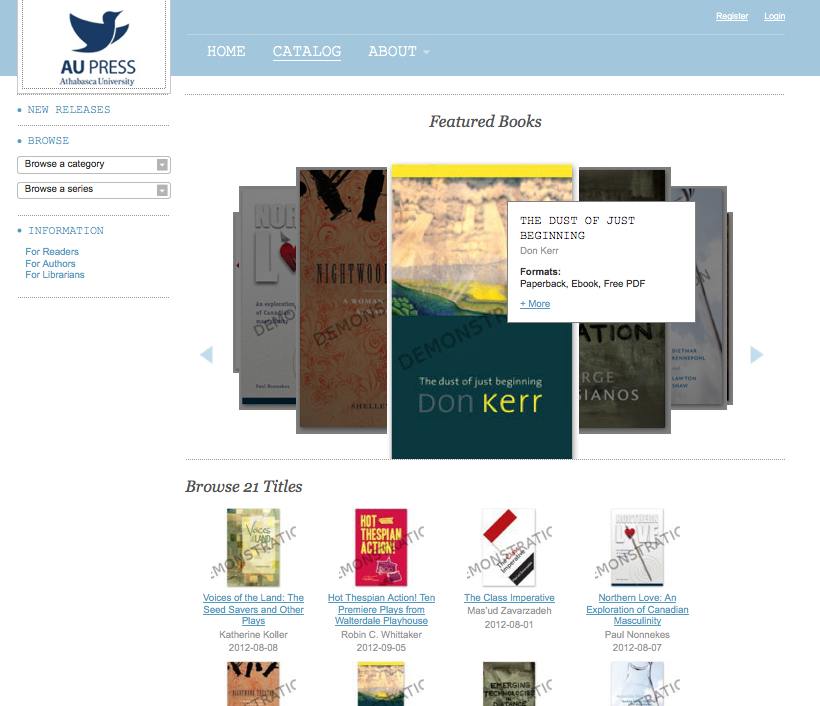
    The Public Knowledge Project (PKP) is very pleased to announce the 1.0 (Beta) release of Open Monograph Press (OMP). OMP is an open source software platform for managing the editorial workflow required to see monographs, edited volumes, and scholarly editions through internal and external review, editing, cataloguing, production, and publication. OMP will operate, as well, as a press website with catalog, distribution, and sales capacities.

    OMP has been developed to support a format that remains critical to the advancement of learning. John Willinsky, Khosla Family Professor of Education at Stanford University, Distinguished Scholar in Residence at SFU Library and Professor (Limited Term) in Publishing Studies at Simon Fraser University, and founding Director of PKP, stated, “We have worked hard to create a virtual publishing-house-in-a-box, which, in the hands of publishers and scholars, will give life to a new generation of learned books.”

    OMP is designed to assist university presses, learned societies, and scholar-publishers interested in publishing scholarly books in print-on-demand and multiple electronic formats, whether on an open access or purchase basis. OMP is intended to:

    • Handle edited volumes, with different authors for each chapter;
    • Involve editors, authors, reviewers, designers, indexers, and others in book production;
    • See submission through multiple rounds of both internal and external reviews;
    • Utilize industry standard ONIX for bookseller metadata requirements (e.g., Amazon);
    • Create document libraries for submissions, recording contracts, permissions, etc.;
    • Handle thumbnail covers in Catalog, as well as Spotlight features; and
    • Enable Series Editors to see books through review to publication.

    OMP is a completely new software module from the Public Knowledge Project. It has been developed from the ground up to take advantage of Web 2.0 technologies. It will also provide the framework for the redevelopment of OJS — now used by more journals than any other software in the world — and other PKP software to a more contemporary software architecture based on a common PKP Web Application Library. Alec Smecher, PKP’s Lead Developer, noted: “With OCS and OJS, we developed workflow tools to facilitate publishing of short- and medium-form content with academic rigor. With OMP, we have broadened these tools to support monograph-length content and written a cutting-edge user interface to manage it. By doing so with code shared by all applications via the Web Application Library, we ensure that all of our applications will benefit rapidly from this work.”

    As part of OMP’s release strategy, PKP will be working closely with several early adopters who will use OMP in a production environment. They will provide feedback in the coming months on OMP in the following areas:

    • Taking a production-destined publication through the entire workflow
    • Utilization of ONIX support and other new functional areas
    • User interface and usability review
    • Translating and using the software in a multilingual context

    OMP’s early adopters represent a variety of use cases including an established university press; a scholarly publishing group; an academic department; and an academic library providing hosting services.

    OMP was designed in consultation with and support from Athabasca University Press, which has kindly permitted us to use their books and content to populate a presentation site of OMP. OMP has been built with support from the Simon Fraser University Library, SFU Canadian Centre for Studies in Publishing, Canadian Foundation for Innovation, Alfred P. Sloan Foundation, and Stanford University. Moving forward, it is anticipated that OMP will continue to be enhanced with a particular focus on pre- and post-publication support.

    As with all PKP software, OMP can be downloaded for free and installed on a local webserver or it can be hosted by PKP Publishing Services. More information about OMP, including links to documentation, can be found on the PKP website at http://pkp.sfu.ca/omp

    Source

  • Open Access Initiative policy recommendations for the next 10 years

    Open Access Initiative policy recommendations for the next 10 years

    Ten years after the release of the Budapest Open Access Initiative, OA advocates last week released updated recommendations in support of open access around the world, touching on areas including policy, licensing, sustainability, and advocacy. Of particular interest are recommendations that urge funders to require open access when they make grants: “When possible, funder policies should require libre OA, preferably under a CC-BY license or equivalent.

  • Got Science? Australian Science on Display at Mitchelton State School

    Got Science? Australian Science on Display at Mitchelton State School

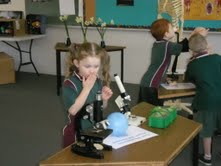
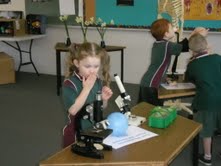
    A young scientist on the brink of discovery during National Science Week

    In my last post, I talked about the role of imagination in science and early childhood education and the U.S. efforts on encouraging students to pursue careers focused on STEM (Science, Technology, Education and Mathematics). I also mentioned that I would be featuring a primary school in Brisbane, Australia to gain an understanding of their science curriculum. If Australia was worried about their place in the global rankings of science and math test scores and working to get kids interested in science at an early age, they only need look at the example being set by Mitchelton State School. It starts with passionate and committed teachers.

    SC@M

    The Science Club at Mitchelton (SC@M) came about as an initiative of teacher Ms. Danielle Spencer. After completing an Education Queensland scholarship-funded Graduate Certificate in Primary Science, she wanted to start a club at Mitchelton dedicated to promoting students’ interest and involvement in science, and particularly to encourage girls to participate. With the support of Principal Roger Sheehan, Ms. Spencer worked collaboratively with Ms. Katie McIntyre, Head of Curriculum, and the two educators laid out the objectives for the new science club:

    1)      Promote science and a love of scientific enquiry within Mitchelton State School.

    2)      To provide opportunities and facilities that support scientific interest.

    3)      To liaise with external groups with similar objectives and aims.

    4)      To encourage girls interest in science.

    To join SC@M, students were asked to submit an application containing a series of questions about their views on science, why they wanted to join and what they wanted to do in the science club. For some of the questions they were asked whether they agreed with a statement and why or why not. For example, ‘Science has too much math in it’ and ‘Men are better at science jobs than women’. I find it fascinating the children were questioned about their views on the gender imbalances in science. This area is a personal research interest for Ms. Spencer. Once the application portion was complete, students agreed to commit, with the support and consent of their parents, to attend each week for one lunch break and participate fully (and safely) in all activities.

    Each term would be dedicated to a different area of scientific knowledge including physics, biology, chemistry and earth science driven by the children’s interests. To ensure that student activities are developmentally appropriate for the students, Mitchelton established SC@M to focus on Years 4 to 7. However, they are finding the younger kids want to join the science club too; so discussions are underway to assess the feasibility of adding a second period to the week allowing them to participate in activities geared toward their age and comprehension level. Less than two months old, I’m not sure the school was prepared for the level of enthusiasm displayed by the students to participate in SC@M once National Science Week came around and more children applied for the club. Thirty-nine children are now participating in the science club, and if numbers keep increasing they may have to initiate a cut off and place children on a waiting list.

    National Science Week

    National Science Week started 15 years ago, but this was Mitchelton’s first year participating in the nationwide event (August 11-19th) and to really shine the spotlight on it, they organised a Science Expo at the school to run for the whole week. The event included hands-on activities allowing the students to investigate the properties of slime, rocks and sound; exploring world‘s not seen by the naked eye with microscopes; and discovering natural events such as tornadoes in a bottle and exploding volcanoes. The entire school took part in the Science Expo with a poster design contest, a competition to name the school’s new skeleton, and a scientist dress-up day. The kids listened to a brief presentation from one of the SC@M coordinators and then were free to explore and interact with the exhibits for 45 minutes. Many of the children were having so much fun they did not want to leave when their time was up.

    Mitchelton opened up the Science Expo to the public for two afternoons so parents and members of the community could engage in scientific exploration with their children and others. Here the SC@M members chaired the different science stations and provided their expertise and scientific rationale to the public. In addition, the school invited members of the high school community to share the experience by presenting a Science Show to the students and hosted a representative of the Young Scientists Association. On the final day of Science Week, a group of visiting scientists presented science demonstrations at a school-wide event. These activities involving the high school students and the visiting scientists clearly demonstrate Mitchelton’s holistic thinking on identifying and building the scaffolding necessary to show students that a pathway to continue their pursuit of science does exist.

    The science club is the highlight of my week, just love it! – Danielle Spencer, Teacher at Mitchelton State School

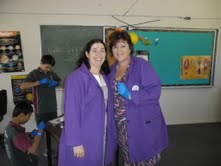
    Teachers' commitment to science: Ms. Katie McIntyre (left) and Ms. Danielle Spencer

    Australia Places National Emphasis on Early Childhood and Science

    I wanted to know if the same emphasis on early childhood instruction is placed on teachers, kids and schools in Australia, as in the U.S. Ms. McIntyre stated, “There is certainly a huge emphasis placed on early childhood development, and in more recent times, Queensland education has focused on increasing students participation in a pre-prep program similar to other states.” This has resulted in the establishment of a large number of independently run pre-prep centres housed in primary schools. She went on to say teachers are finding that the Australian Curriculum is expecting more of students at a younger age and they are adapting their teaching practice to this requirement. While the prep curriculum remains play-based, there is a growing emphasis on explicit instruction in literacy and numeracy. This is similar to what is happening with the early childhood curriculum in the U.S., though I will have to leave my compare/contrast analysis for another posting and get back to science.

    Both Ms. Spencer and Ms. McIntyre agree the Australian Curriculum endorses and provides a hands-on approach to engage children in science and develop that passion for it. Ms. McIntyre indicated that in addition to exposing children to science, it’s also essential “to develop the attributes of curiosity that are necessary to the investigations around science.” One way Mitchelton incorporates this active learning involves activities from CSIRO – The Commonwealth Scientific and Industrial Research Organisation. Ms. Spencer has used numerous activities from CSIRO, (e.g. The Helix and Scientriffic magazines) in her classroom and feels CSIRO provides a valuable resource for science teachers in Australia. She appreciates that the activities are enquiry-based and directly linked to the different strands of the Australian Curriculum. Having that link between CSIRO and the national curriculum is vital. I believe this level of collaboration demonstrates a complete feedback loop where the local level works with the state and national levels to influence and advance the science curriculum and grow the interest and passion for careers in science.

    It’s inspiring to hear and see the students at Mitchelton wanting to be involved and, in fact, demanding more science in their school day. In addition to joining SC@M, several students who displayed an increased aptitude for scientific enquiry were encouraged to enter national science competitions such as the 60Second Science Video Competition (organised by Brendan O’Brien and sponsored by the Department of Education and Early Childhood Development in Melbourne, Victoria), and the NATA Young Scientist of the Year Award. At this writing, I am pleased to report that Mitchelton swept the primary school award category for the entire state of Queensland. The winners and notable mentions are:

    1st Place: Xanthe Czerniawski

    Runner-Up: Jessamy Bryant, Jacob Schofield & Hunter Griffiths

    Highly Commended: Amelia Czerniawski

    Highly Commended: Amelia & Claudia Czerniawski

    Well done, kids!

    How Australia Must Inspire its Young Scientists 

    The Australian Curriculum has identified science and math as two of the core priorities to prepare students for further study in science and technology careers, though Ms. Spencer worries the problem Australia faces “is the declining involvement in math and science carers.” She states this is particularly notable with girls and has been the basis for numerous national studies and strategic reports. Both Ms. McIntyre and Ms. Spencer feel that the primary school setting could use more resources and funding as they are limited to the types of scientific experiments they can instruct children in. We all understand budgets are tight, but earlier exposure to quality science activities could raise the interest level of children, providing long-term benefits. Where do you put the money for the greatest return on long-term investment?

    The other investment that must be made is in teachers. Teachers who continue their professional development, who pass their love of learning for exploration and discovery in the pursuit of science, (and any discipline, really) is how kids will continue on with careers in science and technology. It’s not a guarantee of course, but teachers are that spark to the kindling that starts the fire of learning in students. It’s up to the students to carry the torch. It would be interesting to follow up later and see how many of this inaugural group of SC@M members are working to cure diseases, attempting to solve our energy problems and tackling our food security issues. Or maybe they go on to design buildings, work in government to protect our natural resources with laws and regulations, or use their social media gadgets to communicate the stories of science to others. But we’ll have to wait a few years for that. In the meantime, let’s hope their curiosity in learning continues and prepares them well for the avenues they choose to travel. They have a head start at Mitchelton.

    Special thanks to Mitchelton State School staff – Roger Sheehan, Danielle Spencer, and Katie McIntyre – for their gracious participation in the Q&A and photos for this article and the commitment they demonstrate in providing an enriched, quality education for the children in the community they serve.