Blog

  • Mysterious Mars

    Mysterious Mars

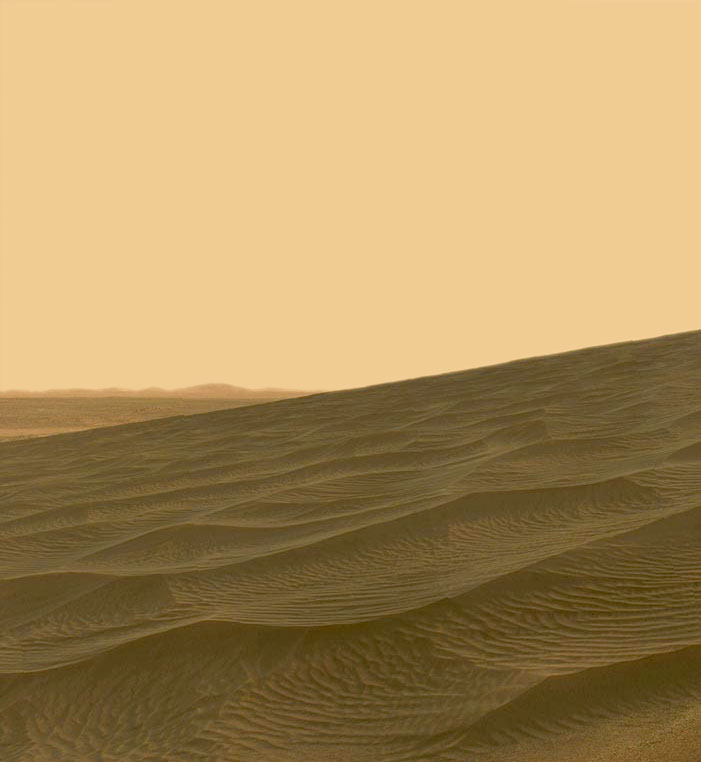
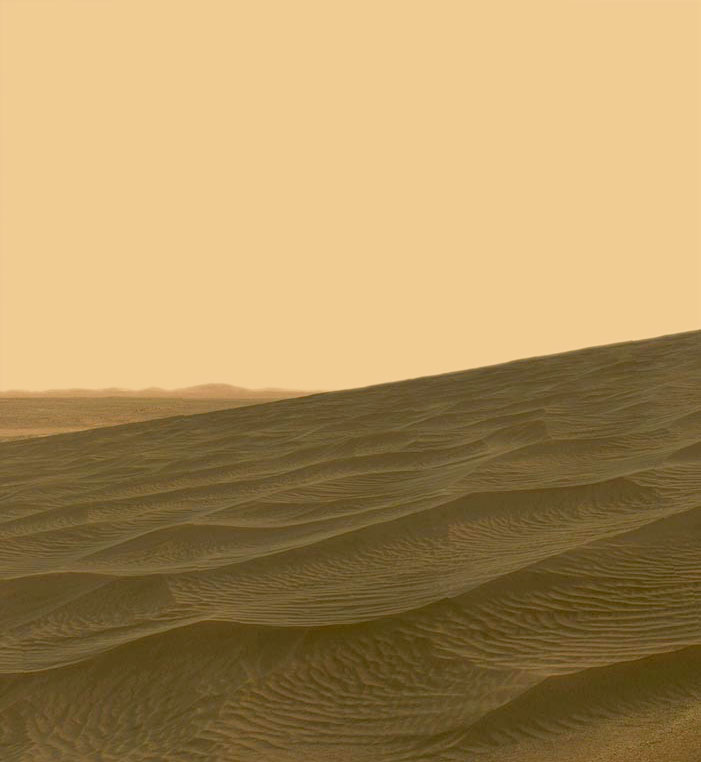
    Mars is full of secrets and mysteries. The classic definition of a desert world, our planet’s arid sibling is a parched wilderness of dunes and planetwide dust storms. With a thin carbon dioxide atmosphere and only 38% the gravitational pull of Earth, there are a lot of puzzles about this cold and frosty little planet, and a lot of scientists who are longing to solve them.

    El Dorado, Gusev Crater. Mars is a world of dust and dunes…

    By now, anyone keeping up with the news is bound to have heard that NASA’s Curiosity rover made a flawless descent through the atmosphere of Mars and is now busy eyeing up its new home in the Gale Crater. As was discussed previously here on Australian Science, a big question still on everyone’s mind is the same one which David Bowie sang about back in 1971. Is there life on Mars? However, it seems that NASA’s plans are not to answer this question directly. John Grotzinger, project scientist for the Curiosity mission, is quoted as saying; “Curiosity is not a life detection mission. We’re not actually looking for life; we don’t have the ability to detect life if it was there.” Instead, the main objective of Curiosity is to look for signs of life.

    The trouble is that looking for life directly is a difficult task. Back here on Earth, new discoveries are still being made frequently, with life being found in environments and habitats where no one was expecting. There’s a lot which we still don’t fully understand about life here on our own world. When we’re talking about another planet, it’s safe to say that all bets are off. As a result, Curiosity’s goal is to look for the various elements and chemical compounds which life might use – or might have used once upon a time when the planet may have been more hospitable. The focus has shifted from the search for life on Mars right now, to life which may once have lived there.

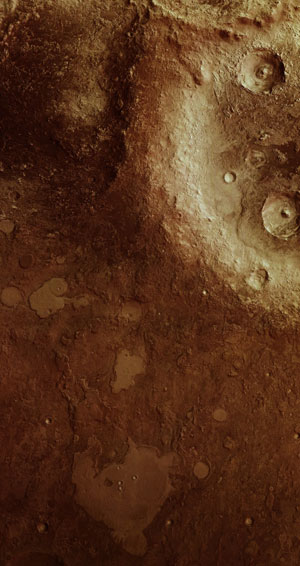
    Arabia Terra – one of the three locations on Mars where methane plumes have been spotted.

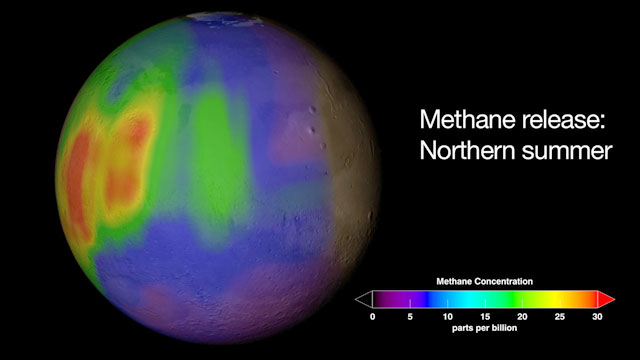
    One point which is worth remembering right now, however, is that there’s one big unsolved mystery about Mars. A gaseous mystery. Large quantities of methane have been detected in the martian atmosphere, which gives rise to a real puzzle. Methane is destroyed by sunlight, and with the thin atmosphere found on Mars, any methane should be rapidly broken apart by solar ultraviolet. The only possible conclusion is that the methane seen on Mars is being replenished somehow. There are only really two possibilities for how this might happen.

    One scenario sees the martian methane caused by a geological process called serpentinisation. This is where a type of mineral known as olivine (more familiar to us as the gemstone peridot) chemically reacts with water and carbon dioxide. The reaction creates methane and a green mineral called serpentine (commonly found in certain parts of Western Australia and Tasmania), and releases methane gas. If this is the process which is occurring, it would mean that not only is there a suitable amount of water somewhere under the surface of Mars, but there must also be geological activity for that water to continue being brought into contact with further olivine to react with. This would suggest that there are things which we don’t know about current geological processes on Mars.

    The other possibility, more radically, is that this methane is being produced by life. Here on Earth, bacteria known as methanogens are responsible for most of the methane present in Earth’s atmosphere. In fact, on Earth, methane is so regularly produced by living organisms that it can used as an indicator of biological activity.

    When three distinct plumes of methane were discovered on Mars in 2009, it was noted that there was an equal probability of either of those two scenarios being the source of the methane – and that both would be huge revelations in our understanding of our neighbouring world. So maybe the Curiosity rover isn’t set up to hunt for life, and maybe it won’t be directly looking for it. But I, for one, do hope it finds some clues about the origin of the mysterious martian methane. Just as any scientist should, I love a good mystery!

    The three methane plumes seen on Mars at South-East Syrtis Major, Nili Fossae and Arabia Terra.

    Image credits:
    Top – NASA JPL/Cornell
    Middle – ESA/DLR/FU Berlin (G. Neukum)
    Bottom – NASA

  • First Color Image of the Martian Landscape from Curiosity

    First Color Image of the Martian Landscape from Curiosity

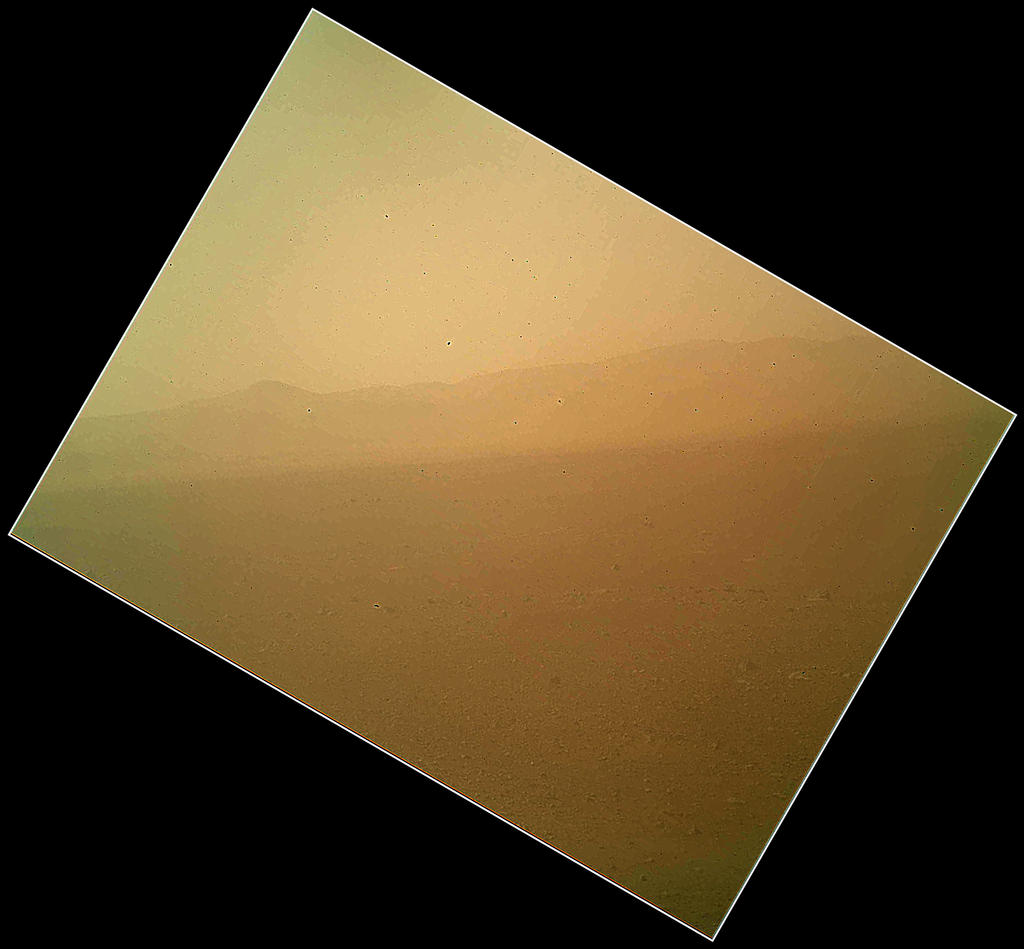
    This view of the landscape to the north of NASA’s Mars rover Curiosity acquired by the Mars Hand Lens Imager (MAHLI) on the afternoon of the first day after landing. (The team calls this day Sol 1, which is the first Martian day of operations; Sol 1 began on Aug. 6, 2012.)

    In the distance, the image shows the north wall and rim of Gale Crater. The image is murky because the MAHLI’s removable dust cover is apparently coated with dust blown onto the camera during the rover’s terminal descent. Images taken without the dust cover in place are expected during checkout of the robotic arm in coming weeks.

    First Color Image of the Martian Landscape Returned from Curiosity

    The MAHLI is located on the turret at the end of Curiosity’s robotic arm. At the time the MAHLI Sol 1 image was acquired, the robotic arm was in its stowed position. It has been stowed since the rover was packaged for its Nov. 26, 2011, launch.

    The MAHLI has a transparent dust cover. This image was acquired with the dust cover closed. The cover will not be opened until more than a week after the landing.

    When the robotic arm, turret, and MAHLI are stowed, the MAHLI is in a position that is rotated 30 degrees relative to the rover deck. The MAHLI image shown here has been rotated to correct for that tilt, so that the sky is “up” and the ground is “down”.

    When the robotic arm, turret, and MAHLI are stowed, the MAHLI is looking out from the front left side of the rover. This is much like the view from the driver’s side of cars sold in the USA.

    The main purpose of Curiosity’s MAHLI camera is to acquire close-up, high-resolution views of rocks and soil at the rover’s Gale Crater field site. The camera is capable of focusing on any target at distances of about 0.8 inch (2.1 centimeters) to infinity. This means it can, as shown here, also obtain pictures of the Martian landscape.

    Image Credit: NASA/JPL-Caltech/Malin Space Science Systems

    Source

  • An outdated appetite control system in a rapidly evolving world?

    An outdated appetite control system in a rapidly evolving world?

    Imagine yourself for a moment waiting for a meal at your favourite restaurant, local takeaway store or at home counting down the time until the oven buzzer sounds. You know you’re hungry, but we seldom think or care about the complex series of processes that go on inside our bodies that drive that hunger.

    And why should we care?

    In the developed world, for the lucky majority at least, calorie-dense food has never been more accessible. Want a pizza? Just use an app from your smartphone to order one delivered any time, day or night. The one big problem with this–human appetite has evolved over tens of thousands of years when food was tough to come by, and we had to work physically hard for a meal, now we just go to the fridge. However the series of long developed processes that drive appetite have not caught up in this time of plenty thereby contributing to the modern day upsurge in obesity.

    Obesity as a global problem

    Obesity is a global disease on the increase, the World Health Organisation estimates that by 2015 there will be an astounding 700 million adults classified as obese. From a health viewpoint this is particularly worrying as obesity is a major risk factor for cardiovascular diseases, Type-2 diabetes and some cancers.

    Also concerning, is the number of people in developing countries at risk, where the bane of obesity joins established under-nutrition. Dr Ranjan Yajnik, the director of the diabetes unit at King Edward Memorial Hospital in Pune, was recently reported by ABC News saying, “Populations which have faced under-nutrition for a long time are now exposed to the over-nutrition of the modern world through globalisation and westernisation”.

    In short, it’s the modern world and how we live in it which is driving up rates of obesity.

    An unbalanced system?

    In broad terms, the body is wired to protect against starvation and low food availability, by increasing biological and sensory processes that promote the need to eat. This makes sense, after all starvation is an immediate threat to survival and was by far one of the greatest concerns of our ancient ancestors. As excessive food was less of a concern, the regulatory processes to protect against excess consumption and weight gain appear less effective, leading to the body favouring weight gain over weight loss.
    Combine this with the increased availability of highly palatable foods, and the ability to stop eating when full is increasingly difficult. According to Dr. Joanne Harrold and colleagues, in a recent paper published in the journal Neoropharmacology, this may be especially true for many obese people, who may “possess an over-responsiveness to the reward effects of eating, which results in the appetite system of these people being effectively overwhelmed

  • Interview with lead Mars Curiosity rover driver Matt Heverly

    Interview with lead Mars Curiosity rover driver Matt Heverly

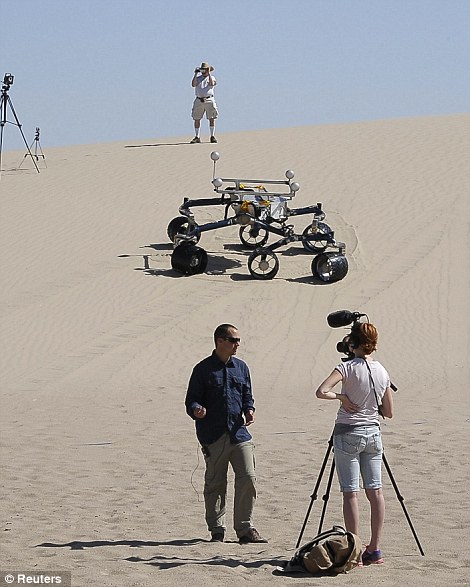
    Matt Heverly during testing of rover double "Scarecrow" in the desert near Death Valley. Source: Daily Mail UK

    When the Mars Science Laboratory – Curiosity – touches down on Mars today, one of the people there ready to take control of it will be Matt Heverly.

    Matt is an engineer with NASA’s Jet Propulsion Laboratory in Pasadena, California and has been working on the design and build of Curiosity, as well as being one of the drivers of the lone surviving rover currently on Mars – Opportunity.

    And Matt has been appointed by NASA as the lead driver for Curiosity.

    Last week I interviewed Matt about this important role, about driving rovers in general, and about the science work that he’ll be helping with.

    When Matt came online, he’d quite literally been in the “Mars Yard” conducting some testing with Curiosity’s twin, and he had parked it right behind himself before joining me on Skype. You can see the rover in the background.

    (There are a couple of spots where the Skype signal dropped down and a warning dialogue came over the screen. I wanted to get the interview posted prior to the landing day, so no finessing the video editing…)

    Interview with Matt Heverly – Mars Curiosity lead rover driver from Alan Kerlin on Vimeo.


    There are actually two “twins” of Curiosity used for testing back here on Earth. The one behind Matt is an exact twin is all respects except the plutonium power supply. The other – nicknamed Scarecrow – is a slimmed down version that is designed to weigh as much as Curiosity would in the lower gravity of Mars. It is used to test driving conditions. The following video shows you Scarecrow in action in the Mars Yard:

    We also talked about Athlete – a rover design originally destined for the Moon. Check this video of Athlete busting some moves:


  • Where to land Mars Curiosity for the best science? Interview with Marion Anderson, who helped choose the landing site.

    Where to land Mars Curiosity for the best science? Interview with Marion Anderson, who helped choose the landing site.

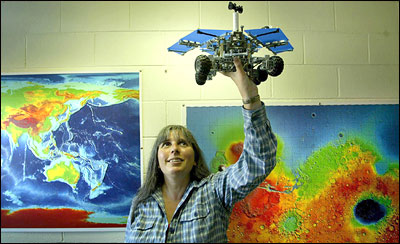
    Australian geologist Marion Anderson, with a model of Curiosity's predecessor rover Opportunity. Source: The Age

    You’ve sunk more than $2 billion into a car-sized rover and you’re ready to send it to explore Mars. But where exactly on Mars do you send it?

    Of course you want it and its controllers back here to be able to do the best possible science. So apparently that is exactly what NASA did – consulted the geology scientists of the world.

    One of those scientists was Marion Anderson of Melbourne’s Monash University.

    In this interview recorded on 2 August 2012, Marion explains to me what went into the selection of Gale Crater as the landing site for the Mars Curiosity rover, what to expect from the rover as it begins to explore the crater after its landing there on Monday 6 August, and why Curiosity is NOT looking for life, despite what many media people are saying (running time 20 mins).


    Marion also talks about her role in selecting the landing sites for those other Mars rovers Spirit and Opportunity, and where next after Mars?

    If you are interested in learning more about the geology of Mars, I highly recommend the one-hour lecture by Richard Pogge titled The Deserts of Mars from an entire – free – university course in Astrobiology from Ohio State University (also available on iTunes).

    In the interview you’ll hear Marion talk about how Mount Sharp in the centre of Gale Crater is actually higher than the surrounding crater walls – some five kilometres high. In this lecture, listen for an explanation why Olympus Mons is the highest volcanic cone in our Solar System, and probably explaining the height of Mount Sharp too.

  • Explore the World with Google Earth Engine

    Explore the World with Google Earth Engine

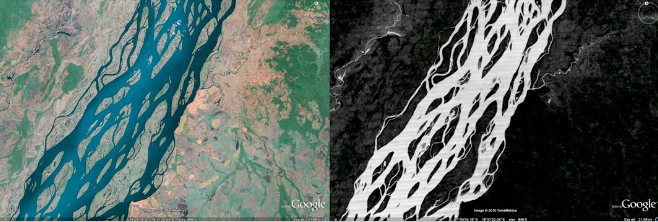
    Last week marked the 40th anniversary of the Landsat satellite program (http://landsat.gsfc.nasa.gov/) —now the longest-running continuous acquisition of satellite images of the Earth’s surface. The entire Landsat7 imagery archives are publicly accessible through Google Earth Engine (http://goo.gl/fjTZL), with a new and improved featured gallery, which includes zoomable time-lapse videos and a beautiful new interface: http://earthengine.google.org/#intro!

    Google Earth Engine enables scientists to use our extensive computing infrastructure—the Google cloud—to analyze an unprecedented amount of satellite imagery and data. The new gallery includes what may be the largest video frame ever created. At 1.78 terapixels, if you tried to view all at once, it would take 18 football fields’ worth of computer screens laid side-by-side.

    Google Earth Engine technology has already been used to compute the forested areas of Mexico (http://earthengine.google.org/#intro/MexicoTreeCover), identify deforestation in the Amazon (Monitoring Forests From the Ground to the Cloud) and map roadless areas of the world (http://earthengine.google.org/#intro/Roadless1km).

    We look forward to seeing the full potential of the Landsat archives revealed, as Google Earth Engine and other tools enable non-professionals to explore this valuable trove of data.

    Source.

  • A Tankful of Sugar

    A Tankful of Sugar

    E=Sugar^3

    Remember those toy trucks, the 18-wheelers (tractor-trailers) that gas companies manufactured? If you grew up in the 80’s, and were a boy or had a brother, or just loved trucks, your dad probably bought one for Christmas. My brother and I would build towns out of Lincoln Logs and Legos and we would wait for the weekly delivery of gasoline from my brother’s Amoco truck to our “town’s

  • Social networks and culture among dolphins

    Social networks and culture among dolphins

    Recently published research in Nature Communications ‘Social networks reveal cultural behaviour in tool-using using dolphins‘ is exploring social networks of dolphins. In particular, it finds evidence for homophily on a learned skill which leads that there’s an exclusion and cultural contagion even among cetaceans.

    Abstract

    Animal tool use is of inherent interest given its relationship to intelligence, innovation and cultural behaviour. Here we investigate whether Shark Bay bottlenose dolphins that use marine sponges as hunting tools (spongers) are culturally distinct from other dolphins in the population based on the criteria that sponging is both socially learned and distinguishes between groups. We use social network analysis to determine social preferences among 36 spongers and 69 non-spongers sampled over a 22-year period while controlling for location, sex and matrilineal relatedness. Homophily (the tendency to associate with similar others) based on tool-using status was evident in every analysis, although maternal kinship, sex and location also contributed to social preference. Female spongers were more cliquish and preferentially associated with other spongers over non-spongers. Like humans who preferentially associate with others who share their subculture, tool-using dolphins prefer others like themselves, strongly suggesting that sponge tool-use is a cultural behaviour.

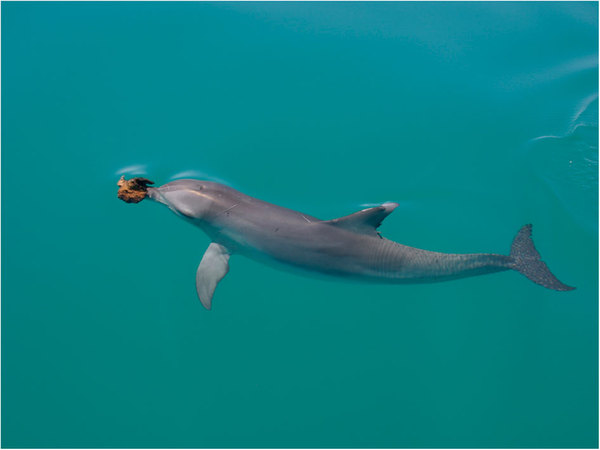
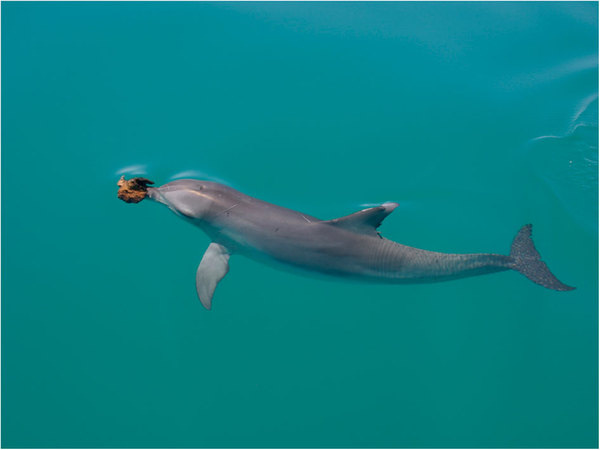
    Photo by Ewa Krzyszczyk; http://www.monkeymiadolphins.org.
    For centuries, philosophers and scientists have debated whether cultural behaviour distinguishes Homo from all other taxa12. Whether non-human animals have at least rudimentary culture is contested, partly because scholars disagree on the definition of culture and/or what type of supporting evidence is needed2. To empirically investigate whether or not a given species has ‘culture,’ the term must be operationally defined. Regardless of discipline, scholars agree that some form of social learning is a prerequisite and that culture is a source of uniformity within groups and differences between groups3, but the consensus ends here. Social learning is defined as learning (behaviour matching) that is influenced by observation of, or interaction with another animal or its products45. Some definitions of culture require more complex cognitive social learning mechanisms, such as pedagogy, theory of mind and imitation67. In most animal culture studies, examination of behavioural variation within and between groups is fairly straightforward as animals are either geographically or socially segregated2. However, ‘group’ is not easily defined in all animal societies. Like humans, Shark Bay bottlenose dolphins live in an open community, characterized by high fission–fusion dynamics where members maintain long-term preferential bonds, but associations are temporally and spatially variable across minutes, days and years8. The question is therefore whether dolphins that use sponge tools (spongers) to extract prey910 exhibit homophily (the tendency to associate with similar others), based on this socially learned foraging tactic1011.

    In Shark Bay, Australia, a subset of the community of Indo-Pacific bottlenose dolphins (Tursiops sp.) procure and wear basket sponges on their beaks while lightly scouring the seafloor for prey in deep (8–13 m) channels (Fig. 1)9101112. Sponging is the best-documented case of tool use by wild cetaceans and is unique among wildlife in that only a small subset of the population uses tools. This exceptional case of tool-use heterogeneity allows us to test for preferential affiliation based on tool-use. To date, 55 dolphins have been documented habitually using sponges in the eastern gulf of Shark Bay12, although sponging also occurs in the western gulf13. Only calves of spongers become spongers (24 offspring to date), but 8 offspring of spongers never adopted sponging. Sponging is a solitary activity, but calves accompany their mothers during sponging and vertical social learning is strongly implicated as the primary mechanism of transmission101114, consistent with mitochondrial DNA analysis1315

    Full paper link.

  • Open Linked Data, DBpedia, Serendipity, and the Future of Web – Interview with Kingsley Idehen

    Open Linked Data, DBpedia, Serendipity, and the Future of Web – Interview with Kingsley Idehen

    Being a Semantic Web, Open Linked Data, Open Source enthusiast, and at some point the contributor to the AP for the FOAF and other metadata standards, recently I had an opportunity to talk with Kingsley Idehen on his current projects,  views on the use of the Web technologies, Open Linked Data,  WebID, serendipity, and certain aspects of the Internet that influence our everyday lives.
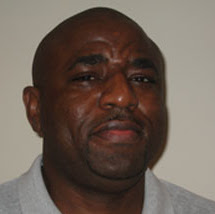
    Kingsley Idehen is the Founder & CEO of OpenLink Software. He is a recognized technology enthusiast and expert in areas such as: Data Connectivity middleware, Linked Data, Data Integration, and Data Management.  He is also a founding member of DBpedia project via OpenLink Software. Kingsley’s  background is quite varied: he had planned to become a scientist in the genetic engineering realm but ended up being more fascinated by the power Information Technology and its potential to reshape mankind. From science, accounting, and programming, he followed his scientific instincts to architect OpenLinkVirtuoso, a powerful and innovative open source virtual database for SQL, XML, and Web services. The Virtuoso History page tells the whole story about Kingsley’s vision and accomplishments. You can follow him on Twitter and read his Google+ posts.

    Would you explain to our readers a bit about the OpenLink Software, for those in the Web technology who may not be familiar with it? Can you give us a story about the inception, history, work and achievements of the OpenLink Software?

    OpenLink Software develops, deploys, and supports bleeding edge technology covering the following realms:
    1. Relational Database Connectivity Middleware — ODBC, JDBC, ADO.NET, OLE-DB, and XMLA Drivers/Providers
    2. Disparate Data  Virtualization
    3. Personal & Enterprise Collaboration
    4. Relational Tables (RDBMS) and Relational Property Graph (Graph DB) based Database Management Systems
    5. Federated Identity Management.

    I founded OpenLink in 1992 with open database connectivity middleware supporting  all major RDBMS products as our focus. By 1998 we evolved our vision to include RDBMS virtualization, and by 2000 we decided that the Semantic Web technology stack provided all the critical standards that would enable us extend data virtualization to include other data sources and formats beyond the RDBMS.

    OpenLink was initially associated with dispelling the performance myth that undermined the early promotion of the Open Database Connectivity (ODBC) standard from Microsoft. In the Semantic Web and Linked Data realms our Virtuoso hybrid data server underlies critical parts of the Linked Open Data cloud (starting with DBpedia which lies at the core) as well as offering the largest publicly accessible Linked Data space on the planet, against which anything (human or machine) can perform ad-hoc queries that drive lookups while also aiding the emergence of other Linked Data Spaces on the LOD cloud.
    Naturally, our technologies are used extensively across enterprises worldwide due to performance, scalability, and security that underlies every item in our product portfolio.

    Is there any existing tools and methodologies developed by either you or your team in the OpenLink Software or others that you would like to mention? 

    * High-Performance ODBC Drivers for all the major RDBMS databases
    * ODBC Drivers for the World Wide Web — yes, the World Wide Web of Linked Data (or LOD cloud) is exploitable and accessible to any ODBC, JDBC, ADO.NET, or OLE-DB compliant application
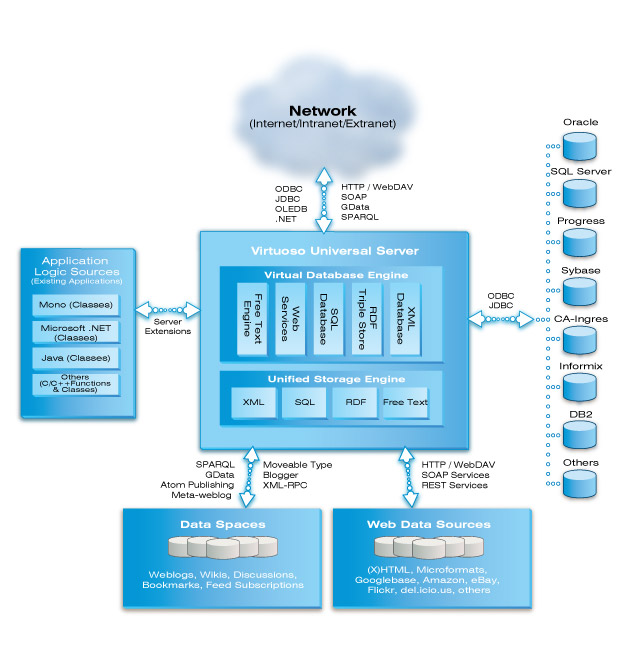
    * Virtuoso — high-performance and massively scalable hybrid DBMS (relational tables and property graphs).
    * Linked Data Middleware — that transform output from a plethora of Web 2.0 and SOA services into structured Linked Data
    * URIBurner — a public instance of the middleware mentioned above that enables anyone transform existing data into Linked Data
    * OpenLink Data Spaces — platform for enterprise and personal data spaces that includes in-built Federated Identity and sophisticated Linked Data functionality
    * DBpedia — Linked Open Data Cloud nexus that runs on Virtuoso (re. Linked Data Deployment and Data Management).

    Some useful links and downloads: ODBC Drivers for the World Wide WebVirtuoso Commercial EditionVirtuoso Open Source Edition,  Linked Data MiddlewareURIBurnerOpenLink Data Spaces, and DBpedia.

    Do you collaborate with similar organisations/institutions worldwide in the field of the Open Linked Data? Would you tell us more about your involvement within the DBpedia project?

    Yes, as demonstrated by DBpedia (Frei University and University of Leipzig), Sindice (DERI), and Bio2RDF(Carleton University and others).

    Virtuoso is the Linked Data Publishing and Database Management system behind DBpedia. Net effect of Virtuoso is you have a massive collection of Linked Data derived from Wikipedia that’s available to the entire public. This instance enables you browser through pages that describe entities while also delivering ad-hoc query functionality via a Web Service that supports the SPARQL query language, results serialization formats, and HTTP based wire protocol.

    In addition to providing the live instance, we also provide quality assurance, support and maintenance. Publishing and maintaining DBpedia is a challenge, and we even offer packages that enable others instantiate personal or service specific instances via Amazon EC2 AMIs (virtual machines).

    DBpedia is basically germination of the seed planted by the Linked Data meme published by TimBL circa. 2005. In turn, DBpedia enabled the emergence of the massive Linked Data Cloud that exists today.

    In his recent keynote, at the WWW2012, Tim Berners-Lee talked about the importance of the openness and urged for governments to embrace the movement of open data. Following that, you showed me how one can successfully kill spam using the WebID protocol as a Web-scale verifiable identity mechanism. Thus, for those who are not familiar with WebID – beside allowing to identify self online and exchange the WebID with other people and social web services – are there some other uses aimed at solving real problems? 

    Here are the fundamental problems solved by unadulterated open data connectivity:
    1. generating capital from high quality government data via open data initiatives the leverage Linked Data principles — this is better than dysfunctional financial engineering that’s plunged the world into an economic fragility
    2. big data and small data virtualization that simplifies the process of discovering and sharing insights for individuals and enterprises alike
    3. achieving the goals above without compromising privacy and security.

    There’s nothing more useful than 1-3 and there’s no technology to date that’s achieved that without some kind of platform specificity that ultimately becomes a dysfunctional silo. This is where the Web is unique, as its impact on mankind has already demonstrated with aplomb.

    I always ask people who are in the ICTs (Information-Communication Technologies): do you think that Web is one big serendipity machine from the computing and the scientific point of view?  

    It is. See: SDQ (Serendipitous Discovery Quotient) and The Future of SEO? Or an Abstract Concept? – another SDQ article.

    As the links to structured data increase on the Web, its density increases, which ultimately means that you require fewer and fewer link hops to find whatever you seek, with precision.
    For instance, you can Find all Blog Posts about a Subject Matter Topic based on the attributes of the topic since the Post, Topic, and their Connection are all denoted (named) using hyperlinks (de-referencable) URIs. These URIs resolve to content in the form of fine-grained links taking the form: entity-attribute-value or subject-predicate-object. See my presentation that covers the basics of structured of data.

    Do you think that Web apps and software architects are killing the serendipity moment with their search algorithms, mechanical turks and other mechanisms?  

    No, the worst that can happen is artificial protraction of a journey to an inevitable destination i.e., the Web as mankind’s distributed database and serendipity machine.

    What are you currently working on? What’s your current projects and research about? What can we expect from the OpenLink Software in the upcoming period?

    Addressing the Read-Write dimension of the Web, hence the recent emphasis on WebID and the WebID authentication protocol. Verifiable Identity is a critical piece of the Web that hasn’t manifested coherently until the emergence of the WebID and Read-Write Web community groups from the W3C.

    All our products are WebID enabled, so our current focus is getting the world to understand why federated identity matters by product offerings that address:

    1. Personal Data Spaces or Data Lockers — how users take full control of their identity, profiles, data, and privacy
    2. Data Wikis – basically reapplying the Wiki Content pattern to Linked Data such that crowdsourcing and social networking add new virtuous dimensions to Linked Data product and quality.

    What is taking up the most my time these days is finalizing a boat load of new product releases that increasingly simplify the power inherent in our products and the infrastructure provided by the World Wide Web. Also, OpenLink Software is finalizing new editions of Virtuoso, OpenLink Data Spaces, and its suite of ODBC and JDBC compliant data access drivers which support all major DBMS engines.

    Thank you Kingsley for taking your time to talk with me! 
  • The Devil’s Technology

    The Devil’s Technology

    Biotechnology is rarely considered to be good for the environment. In fact, environmental campaigners frequently claim that genetically modified organisms represent a major threat to biodiversity and ecosystems. However, the study of the Tasmanian Devil Facial Tumour disease (DFTD) using genetic technologies is an example where biotechnology has been used to create a definite environmental benefit.
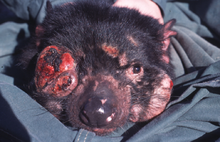
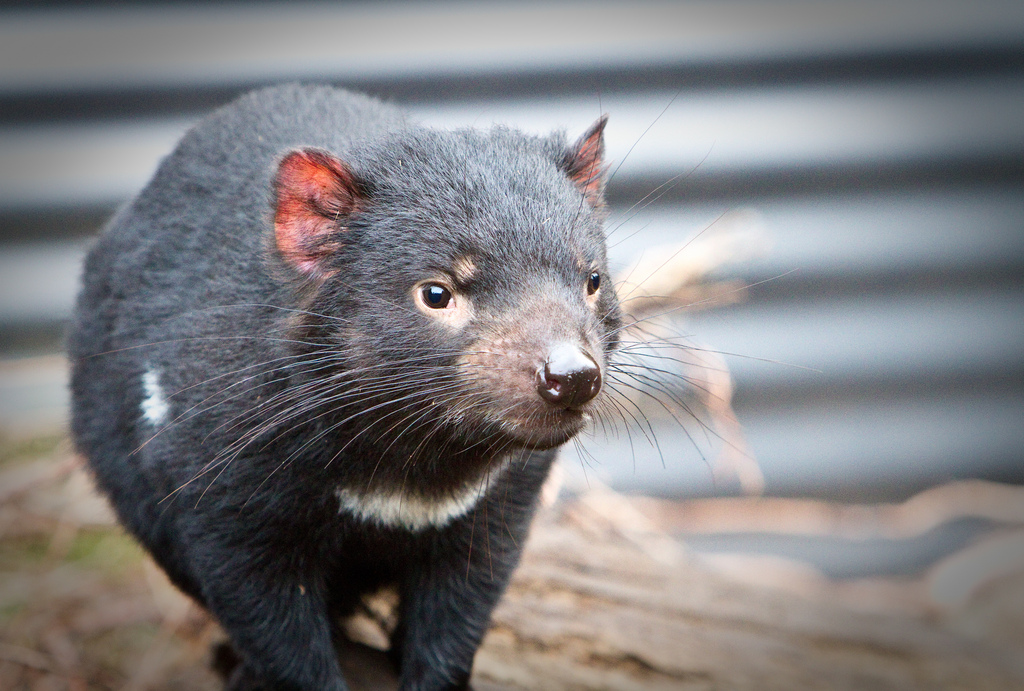
    The Tasmanian Devil (Sarcophilius harrisi) is Australia’s largest surviving carnivore and endemic to the island of Tasmania. DFTD induces cancerous tumours on the face and inside the mouth of affected animals which die within months. The condition was first observed in north-eastern Tasmania in 1996. DFTD, like other cancers, is caused when mutations within a cell prompt it to switch from normal function into tumorous growth. Cancers are considered non-contagious as the tumour is contained within the body and is unable to spread to alternative hosts. Furthermore, the immune system of any alternative host would normally recognise any foreign tumour cells that managed to invade the body, and quickly kill them before the disease becomes established. However, the DFTD is exceptional in that it is readily transmitted between individuals of the same species, and this has resulted in the disease rapidly sweeping across the island and threatening the entire species with extinction.

    In order to better understand the DFTD, an international team of scientists has sequenced the entire genome of the Tasmanian Devil and identified mutations underlying DFTD. The results were recently published in the scientific journal Cell. This biotechnological research surprisingly identified that none of the tumours originated in any of the hosts examined. Instead, they were able to trace them all back to one cancerous cell from within a female devil, possibly in the early 1990s. This radical and unusual tumour had developed the ability to jump from individual to individual in a uniquely contagious manner, so spreading the disease across the species.

    The Tasmanina devil facial tumour.

    Using the genetic sequence information, the researchers were able to discount the involvement of a virus in the transmission of DFTD. Instead they were able to identify a new and radical form of transmission. Devils often bite each other in the face during eating and feeding behaviours. During biting, fragments of tumour from an affected individual become implanted in an almost vampiric manner in a new and healthy individual.

    The scientists also discovered that the DFTD tumour carries a mutation in a gene that plays a critical role in regulating the host’s immune reaction. From this, they concluded that the tumour cells are able to interfere with the host’s immune system immediately after implantation, The disrupted immune system is unable to kill the tumour, thereby ensuring the survival of the disease in the new individual.

    The results of this study have provided valuable insight into the management of the DFTD and the conservation of the Tasmanian Devil. Because the condition is only transmitted through the bite from a diseased individual, the disease can be effectively controlled by quarantining healthy populations from diseased. The condition will then be naturally eliminated as diseased individuals die off from within the affected population. Such a policy has already been implemented with the Tasmanian Department of Primary Industries, Water and Environment who have been identifying and quarantining disease free populations within the island. Individuals from the protected population may then be re-introduced into the Tasmanian Devil’s former habitat once the disease threat has passed.

    Despite the frequently cited threats that biotechnology poses to the environment, the application of gene sequencing technologies to the DFTD is an example of how biotechnology might be adopted to solve major environmental problems. In fact, the outcome of this gene sequencing project has contributed to a management plan that might yet save the Tasmanian Devil from extinction and conserve an important component of Australia’s unique biodiversity.

    Image source

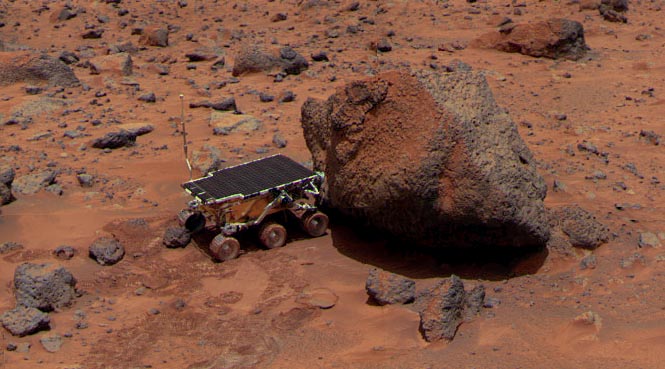
  • Is there life on Mars?  Sojourner, Spirit, Opportunity and Curiosity go roving

    Is there life on Mars? Sojourner, Spirit, Opportunity and Curiosity go roving

    The NASA rover Curiosity is expected to be landing on Mars at 3:31 am August 6, 2012 (AEST).  It’s mission, lasting one Martian-year (98 Earth weeks),  is of scientific significance and perhaps even of human significance.  Curiosity will be fulfilling the prospecting stage of a step-by-step program of exploration, reconnaissance, prospecting and mining evidence for a definitive answer to the question “Has life existed on Mars?

  • Did life’s building blocks crash land?

    Did life’s building blocks crash land?

    In 1969, on September 28, the skies near Murchison, Victoria (not to be confused with Murchison, Western Australia) were illuminated by a dramatic sight. A spectacular fireball blazed its way through Earth’s atmosphere, its outer layers heated to extreme temperatures by its speed. Residents of the town reported seeing the fireball split into three pieces before it faded from view, leaving a trail of smoke in its wake. Seconds later, a tremor was heard as meteorite fragments crashed into the ground, signalling the arrival of what would become one of the most well studied meteorites ever.

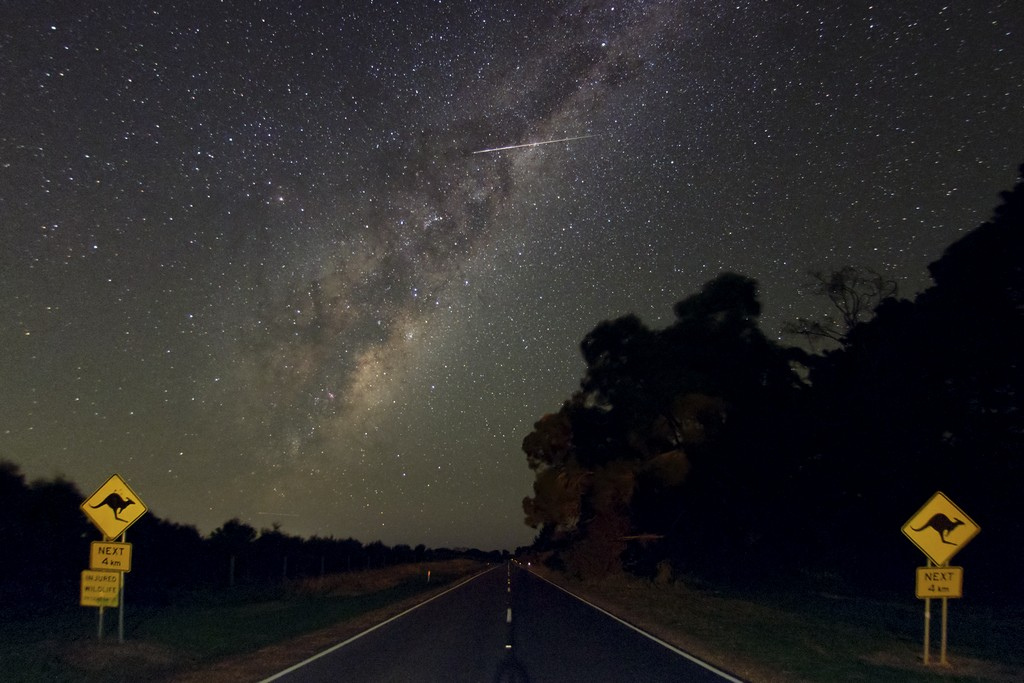
    A meteorite streaks across the Australian night sky, in front of the Milky Way. But just what might it be carrying with it? Image credit: Alex Cherney/terrastro.com

    If you like to watch the sky at night, chances are good that you’ve seen a meteor or two streaking across the night sky, and while many of them burn up in the atmosphere, it’s quite possible that one which you’ve seen might have eventually reached the ground. Meteorites strike Earth a lot more frequently than most people realise. By most estimates, a few hundred tons of meteorite material make it to our planet’s surface every day. Large meteorites like the Murchison meteorite, however, are a lot less common.

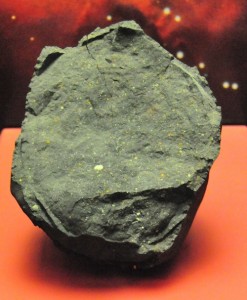
    A fragment of the famous Murchison meteorite. Image credit: Art Bromage, Wikimedia Commons

    While the Murchison meteorite shattered into fragments before it landed (known as an “airburst”), over 100 kg of meteorite have been collected from around Murchison, and scientists have been analysing those fragments ever since. This particular meteorite is a specific type known as a carbonaceous chondrite. These meteorites are fascinating to scientists, because carbonaceous chondrites are chemically very primitive – they’re thought to be very close in composition to the solar nebula from which the Sun and planets condensed 4.5 billion years ago. In other words, the meteorite which crash landed in Murchison 43 years ago was probably older than our entire planet!

    Several things about the Murchison meteorite are very interesting. For one, it shows evidence that it was altered by water. This would have happened a long time ago, wherever this meteorite originally formed, and certainly a long time before it landed on Earth. Secondly, it’s peppered with Calcium-Aluminium-Inclusions (CAIs). These humble crystals are older than the Sun itself. When they formed, the Sun itself was little more than a huge cloud of warm hydrogen gas. Most interestingly to some scientists, however, is the fact that the Murchison meteorite is full of amino acids.

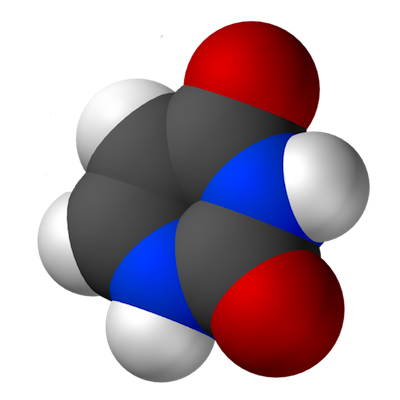
    Uracil, one of the four "nucleobases" used by DNA to encode genetic information, was discovered inside the Murchison meteorite.

    Amino acids are one of the basic building blocks of all living things. The proteins which make up almost everything in your body are made from these small molecules. To date, over 100 amino acids have been found inside the meteorite, including many of those used by life on Earth. Several things about the chemical and isotopic compositions of these molecules suggest that they didn’t come from Earth, but were in this meteorite when it landed. As an example, amino acids have two forms, referred to as left-handed and right-handed. Earth life only uses the left-handed forms, while the acids discovered in this meteorite are a mixture of the two (known to chemists as a racemic mixture). Other Earthly molecules which frequently show up as contaminants were absent from the samples analysed, suggesting that these molecules, the bare essentials of life, are extraterrestrial in origin.

    These amino acids aren’t the only familiar molecules in the Murchison meteorite either. Amongst over 14000 different molecules found inside the meteorite, the chemists who were analysing the meteorite discovered ring-shaped molecules called purines and pyrimidines. These ring molecules are from the same family as the four nucleobases which make up DNA.One of the molecules found was one called uracil, which is actually used by DNA. This same molecule is in every strand of DNA in your body.

    While some still argue over the validity of these studies, if they’re correct then the overall conclusion is a breathtaking one. This space rock is older than the Sun, and it already contained all of the basic ingredients for life to form back when Earth was nothing more than a patch of interstellar dust. We might never know exactly how life started on Earth. Though maybe in the distant past, life’s raw materials crash landed here on Earth in meteorites, just like one meteorite did in Murchison that night 43 years ago.

  • Horticultural Tourism as a form of Sustainable Tourism

    Horticultural Tourism as a form of Sustainable Tourism

    Hedgework, source: http://www.flickr.com/photos/mithril/4382135401/in/photostream/

    Tourism industry has a significant effect on the Australian economy. The tourism industry was accounted for 2.5% of Australia’s GDP at a rate of $35 billion to the national economy in the financial year of 2010/2011.This is comparable with $94.8 million contribution of tourism a day to the Australian economy. (Australian Bureau of statistic. “Tourism Satelite account 2010-2011: Key Figures

  • Open Knowledge In Action: Open Data Academic Research #CfP

    Open Knowledge In Action: Open Data Academic Research #CfP

    The 2012 theme of OKFestival is Open Knowledge in Action, looking at the value that can be generated by opening up knowledge, the ecosystems of organisations that can benefit from such sharing, and the impacts that transparency can have in our societies. What kinds of new professions, ideas and community initiatives can emerge within our governments, markets, networks and neighbourhoods as a result of these engagements?

    Open knowledge is a comprehensive concept that involves sharing knowledge in all its forms – from genes to geodata, from literature to programming code – so that it can be freely used, modified and shared by anyone. This idea, based on the Open Definition, provides an opportunity for positive transformation within our information society, where old hierarchies are replaced by agile, diverse, networked and experimental progress and cooperation.

    In an era of global digital communications, significant benefits are gained in all sectors of the society by opening up knowledge, including science, culture, governance and economy.

    Academics and researchers can find the Open Data Academic research session at this year’s OKFestival very interesting, and  a great opportunity for those who are engaging with open data in academic environments to speak to new colleagues working on similar initiatives from around the world.

    **2nd Call for Papers: Open Data Academic Research at OKFest**

    The Open Data research session will focus on the impact of Open Data research within the academic environment. The session will bring together the latest research concerning Open Data and Open Government Data, forming an interdisciplinary mix of short presentations followed by a discussion panel.

    The panel will be 2 hours long, and invites submissions from a broad range of disciplines. See below for potential topic ideas.

    The aim of the workshop is to publish the accepted papers and outcomes in a relevant journal/proceedings – more information to follow.

    ## Submissions

    Submissions should consist of a 2 page extended abstract of a position paper of current research. Accepted authors will require to produce a 4-6 page paper and 15 minute presentation to be given at the workshop.

    Please send submissions to: academictrack.okfest@gmail.com
    Submission Deadline: 20th July
    Accepted Papers to be selected by 3rd August

    ## Possible Topics

    • Mapping the movement: What histories can illuminate current open data practice? How should we understand the idea of an open data movement? What can research tell us about the future directions a movement might take?
    • Open data impacts: What impact is open data having in different fields? What methods can be used to trace the impacts of open data?
    • Open data internationally: What impact is open data having in different countries? How is open data supporting transparency as well as participatory engagement?
     Open data and democracy: How is open data being used to support democratic engagement, or impacting upon the democratic sphere?
    • Open data as a tool for research: Exploring how open data can be used in research, and tools for open data-driven research.

    If you have any questions, please contact: academictrack.okfest@gmail.com