Author: Editorial Board

  • Study Finds That Reading Tolstoy & Other Great Novelists Can Increase Your Emotional Intelligence

    Study Finds That Reading Tolstoy & Other Great Novelists Can Increase Your Emotional Intelligence

    tolstoy-social-intelligence

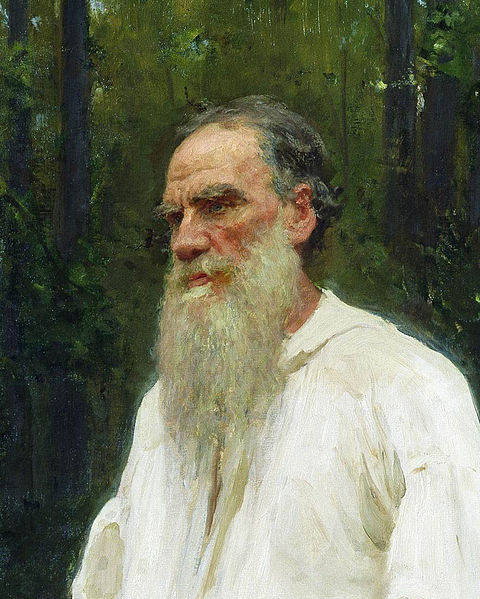
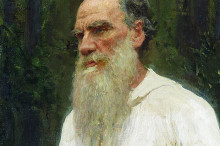
    A new study published this month in Science concludes that you may get something unexpected from reading great literary works: more finely-tuned social and emotional skills.

    Conducted by Emanuele Castano and David Comer Kidd (researchers in the psych department at the New School for Social Research), the study determined that readers of literary fiction (as opposed to popular fiction or non-fiction) find themselves scoring better on tests measuring empathy, social perception and emotional intelligence. In some cases, it took reading literary fiction for only a few minutes for test scores to improve.

    The New York Times has a nice overview of the study, where, among other things, it features a quote by Albert Wendland, an English professor at Seton Hall, who puts the relationship between literature and social intelligence into clear terms: “Reading sensitive and lengthy explorations of people’s lives, that kind of fiction is literally putting yourself into another person’s position — lives that could be more difficult, more complex, more than what you might be used to in popular fiction. It makes sense that they will find that, yeah, that can lead to more empathy and understanding of other lives.

  • The Podcast Project: a tool for fun and sustainable language learning

    The Podcast Project: a tool for fun and sustainable language learning

    A bad night´s sleep, a nervous stomach and sweaty hands. This scenario that students typically face before their obligatory English exam may be a thing of the past at the University of Wismar, Germany. Since June 2012, over 90 students from various degree programmes have produced podcasts – or vodcasts – as part of their assessed course requirements in the ESP module (English for Specific purposes). The result? Involvement, enthusiasm and students who confess to enjoying their learning.  And what´s more, engaging and educational teaching and learning material for the following courses. 

    The project was kick-started by our increasing frustration with the lack of stimulating, authentic teaching and learning material in the field of ESP. Motivated by the success of a method called ‘learning through teaching’, in which students address a certain topic and give so-called mini-lessons for their peers, we started wondering whether students couldn’t also create tailor-made language learning content themselves.

    How ESP podcasts are produced

    Groups of two to four students are tasked with producing a ten-minute video podcast. It has to feature both specific vocabulary and skills practised in the English course, such as negotiating, managing discussions, intercultural communication etc. Students are free to choose the podcast’s format: whether they decide on news productions, talk and reality shows, role-plays and educational lectures – the main objective is for the podcast to be both educational and engaging.

    To prepare, students gather information on content and language, create a storyline and practise dialogues. Using props, pictures, background images and sound effects to enrich the impact, the story is adapted as a screenplay and outlined in a storyboard.

    For the podcast recording, we are lucky enough to be able to offer students a real studio experience on our production site for elearning applications (PELA). Many students use the studio to record their podcasts, where they get a 90-minute recording slot as well as support in the postproduction process. But you do not need a studio to produce impressive results. We have seen some great productions from students using just a smart phone!

    Finally, students are asked to reflect on the results: they provide feedback on their peers’ podcasts and submit a written analysis of their own. Grading creative group work is not easy. But clear structures and transparent criteria go a long way. We are using a concept for productassessment, which differentiates between information, subject-specific quality, which in this case is mainly the language, and design, which is the creative aspect. We also apply a mix of individual and group assessment.

    Benefits

    For me personally, there are two extremely valuable aspects of the project. First there is the educational and fun value of tailor-made teaching and learning content for future generations of students, as the material produced can be reused again. Secondly, and perhaps most importantly, students really enjoy the project, as these two comments show:

    “This exciting and fun project combines many aspects: text, speaking, organisation, preparation and group processes. We are still talking about the project many months later and enjoy the memories.

  • Peter Higgs awarded Nobel Prize in Physics

    Peter Higgs awarded Nobel Prize in Physics

    King’s College London is celebrating the award of the 2013 Nobel Prize for Physics to its alumnus, Fellow and Honorary Doctor Professor Peter Ware Higgs CH CBE FRS FRSE FKC, jointly with François Englert.

    The award is the 11th Nobel Prize awarded to a member of King’s or its associated institutions, and it also highlights the remarkable tradition of discoveries in physics by members of the College, starting with James Clerk Maxwell in the 1860s.

    Peter Higgs came to King’s as an undergraduate in 1947 to read natural sciences in the field of physics. After graduating with a first-class BSc in 1950 he took an MSc in physics in 1952 and studied for his doctorate in molecular physics under the supervision of Charles Coulson and Christopher Longuet-Higgins. He was awarded his PhD in 1954 for a thesis entitled ‘Some problems in the theory of molecular vibrations’: a work that signalled the start of his life-long interest in the application of the ideas of symmetry to physical systems. He was a senior student at King’s and had already published four scientific papers by the time he left the College in 1954 to take up a post at the University of Edinburgh.

    Among the many honours and awards Professor Higgs has received are the Fellowship of King’s in 1998 and the College’s Honorary Doctorate of Science in 2009.

    The College’s tradition of world-changing discoveries in physics began in the19th century. In particular, the great 19th-century physicist James Clerk Maxwell was Professor of Natural Philosophy at King’s from 1860 to 1865. During this time he demonstrated that magnetism, electricity and light were different manifestations of the same fundamental laws, taking a major step towards a theory unifying the forces of nature.

    150 years later, the discovery in July 2012 by teams at CERN of a new particle consistent with the Higgs boson followed pioneering research on this particle by King’s current James Clerk Maxwell Professor of Theoretical Physics, John Ellis CBE FRS. Professor Ellis is considered one of the UK’s most influential and eminent particle physicists, and he has also made important contributions to astrophysics, cosmology and quantum gravity. He has been influential in setting CERN’s strategic direction over recent decades.

    In 2012 King’s inaugurated an annual Higgs Lecture in the School of Natural & Mathematical Sciences, with Professor Higgs giving the inaugural Higgs lecture on the theme ‘Putting Maxwell in his place’ on 10 December 2012 at the Strand Campus to an audience of King’s staff and students, science professionals and colleagues from other universities, and engaging in a lively question and answer session. A short video of the highlights and the full length video can beviewed online.

    Professor Sir Richard Trainor, Principal of King’s, said: ‘This is wonderful news and we send our warmest congratulations to Professor Higgs. King’s is extremely proud and honoured that our alumnus has been awarded the world’s greatest scientific prize, and we look forward to being able to congratulate him in person in the near future.’

    Professor John Ellis said: ‘In 1964 Peter Higgs was among the theoretical physicists who discovered a way to give masses to elementary particles. This is now the basis for the Standard Model that describes immensely successfully all the visible matter in the Universe. Peter Higgs pointed out that this theory required the existence of a new kind of particle, commonly called the Higgs Boson, which was discovered by the ATLAS and CMS experiments at CERN in 2012, providing dramatic experimental confirmation of his theoretical ideas.

    ‘We are proud that Peter Higgs was a student in the King’s Physics Department, and that his links with King’s continue. Research on the properties of the Higgs Boson and related aspects of particle physics is an active theme of research in the King’s Physics Department.’

    Source and image. 

  • Does my virtual forehead look big in this?

    Does my virtual forehead look big in this?

    The days of stalling online purchases in fear of products “not quite looking like they did on the model

  • Australia’s Marine National Facility to farewell its research vessel Southern Surveyor

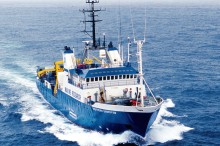
    Australia’s Marine National Facility to farewell its research vessel Southern Surveyor

    The Director of the Marine National Facility, Mr Ron Plaschke, said the research achievements onboard Southern Surveyor have not only been to Australia’s benefit, but also understanding the global importance of our surrounding seas and oceans.

    Southern Surveyor has made a major contribution to Australia’s blue-water research effort,” Mr Plaschke said.

    On board Southern Surveyor, scientists from a diverse range of universities, institutions and government organisations have, among many other things:

    Discovered massive submarine volcanoes between Fiji and Samoa, offering evidence of mineral deposits such as copper, zinc and lead. This research is helping us understand the origins of our continent and how geological resources are formed, which in turn guides exploration activities.

    Played an important role in the deployment and recovery of buoys as part of the Australian Tsunami Warning System.

    Deployed the Integrated Marine Observing System (IMOS) moorings in the oceans around Australia, which have been pivotal in collecting data for Australian and international weather and climate research.

    Observed changes to our ocean currents that influence rainfall, weather patterns and in turn fisheries, from the Indian, to the Pacific and Southern Oceans and also helped to uncover the southward movement of the East Australian Current.

    Mapped our seafloor – only 12 per cent of Australia’s Exclusive Economic Zone has been mapped.

    Discovered the final resting places of historically significant shipwrecks, like the MV Limerick and HMAS Australia.

    “The 42 year old Southern Surveyor is a former North Sea trawler converted into a research vessel and, while being well maintained, the ability to carry a wide range of scientific equipment and larger scientific teams is becoming increasingly limiting,” Mr Plaschke said.

    “It will be a sad day when Southern Surveyor is sold and departs from Hobart, but there is growing excitement about the upcoming arrival of the replacement vessel Investigator,” Mr Plaschke said.

    Source and image: http://www.csiro.au/en/Portals/Media/Australias-Marine-National-Facility-to-farewell-its-research-vessel-Southern-Surveyor.aspx

  • Interview: Lana Ostojic, an applied scientist in the field of forensic biology

    Interview: Lana Ostojic, an applied scientist in the field of forensic biology

    Lana Ostojic pictureLana Ostojic is a young applied science professional with the real-world experience in criminal forensics. She is a researcher at the Research and Development Department at the Office of Chief of Medical Examiner (OCME), NYC. Lana is also a PhD candidate at the University of Belgrade, Faculty of Molecular Biology and Physiology. Her primary field is molecular biology and physiology. Recently, July 2012, she got in house OCME creativity award for developing an interesting new method where organic glue is used to collect cell samples for forensic purposes in a much more efficient way than the traditional methods.

    Welcome to Australian Science. Would you, please, tell our readers a little bit more about yourself? Where do you come from, both geographically and philosophically? What is your scientific background, and your professional scope?

    I think my early childhood experiences shaped my passion for learning and work ethic at a very early age.  My family has lived for 3 generations in Vukovar, Yugoslavia, currently known as Republic of Croatia.  Having withstood the bombing of Vukovar in WWII by Allied forces, and rationing that followed, my Grandmother instilled in me at a very early age to make the best of what you have and to be resourceful. This is a lesson I would learn firsthand at age 9 when bombs fell again in Vukovar in 1991 marking the beginning of a bitter and bloody civil war.  We left our classroom as tanks rolled in our streets and fled to Belgrade.  There I found a supportive academic culture of learning to be fascinating and quickly immersed and excelled in a school specializing in Math and Sciences, achieving the maximum grade point average.  The bombing would fall again as I applied to Universities as NATO cruise missiles and fighters took aim on Belgrade leveling bridges and power plants. Despite the difficulties of an economic embargo, I was accepted under a rare full scholarship grant program by Belgrade University specializing in Molecular Biology and Physiology. After graduation I was granted an opportunity to continue my work at the University of Milan to conduct research on a skin cancer, it was fascinating to work in the presence of such talented scientists.  I accepted an opportunity to immigrate to the US under resident status to work at the Office of the Chief Medical Examiner in NYC as a Criminalist.   There I specialized in the applied science of DNA testing for a Crime Lab along with testifying in court as an expert witness on behalf of the District Attorney.  It is fascinating work with many more advancements in forensic science yet to be applied. So to reflect back on what drives my interest in my field of applied science, I have to say that helping people through Science is rewarding for me, especially if it means someone life will be saved or justice will be served because of my work.

    Would you explain to our readers a bit about Department at the Office of Chief of Medical Examiner (OCME), for those in the science and technology who may not be familiar with the Office? 

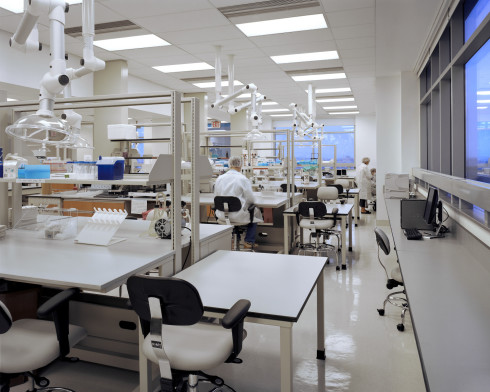
    The City of New York Office of Chief Medical Examiner investigates all sudden, violent, or unexpected deaths in New York City, performs pathologic examinations necessary to determine cause and manner of death, identifies decedents, provides for the disposition of unclaimed human remains, and performs forensic anthropology, toxicology and DNA analysis as appropriate. The OCME houses the country’s largest public forensic DNA laboratory, and is a leader in technology and research. The Department of Forensic Biology is staffed by more than 150 forensic scientists, performing DNA testing on biological evidence from all types of crimes committed in New York City.  The lab is widely regarded for utilizing progressive methods and generating exceptionally high quality results.   The OCME is the only public forensic laboratory in the nation accredited to perform High Sensitivity DNA testing on samples from which very small amounts of DNA are recovered, and is one of the few public forensic laboratories in the nation that performs mitochondrial DNA testing.

    The Office of the Chief Medical Examiner in New York City. Credit: http://www.perkinseastman.com/project_2400273_new_york_city_ocme_dna_forensics_biology_laboratory
    The Office of the Chief Medical Examiner in New York City.
    Credit: http://www.perkinseastman.com/project_2400273_new_york_city_ocme_dna_forensics_biology_laboratory

    What’s your main role at the OCME?

    At OCME I have a double role, being a Criminalist and being a research scientist. As a Criminalist I am examining the crime scene evidence for the presence of the biological material. I am involved in entire DNA testing process, analysis and interpretation of the results along with testifying in court as an expert witness on behalf of the District Attorney Office. As a research scientist I am helping developing more sensitive and effective methodologies for DNA testing process.

    Do you collaborate with similar organisations/institutions worldwide in the field of the criminal forensics ? Would you tell us more about your involvement within projects in the Office?

    OCME is an independent agency. Our collaborations are more involved in sharing scientific knowledge and experiences with other institutions that conduct forensic DNA testing worldwide. Many of our employees are also faculty members at New York City’s colleges, which allow us to extend our facility as a resource to accomplish graduate degree work for students at our research and development labs. The major focus of OCME is casework rotation. Criminalists, such as me, working on casework rotation aim to generate DNA profiles to identify the source of biological material found on crime scene evidence. Storing eligible DNA profiles in CODIS (Combined DNA Index System) which is primarily managed by FBI (Federal Bureau of Investigation), we are helping solving other crimes in reminder of NY state and other states of USA. As a research scientist I am co-investigator on an NIJ funded project (National Institute of Justice) where we are trying to minimize or eliminate mixtures via micromanipulation techniques as well as optimize testing method for biological materials that contain degraded or minute amounts of DNA.

    Finally, what are you currently working on? What’s your current projects and research about? In current project we are evaluating manual and robotic micromanipulation techniques to efficiently lift the cells from a piece of mock evidence and developing DNA testing method that displays higher level of sensitivity than traditionally used method, we are aiming to obtain database eligible DNA profiles.

    Thank you Lana for taking your time to talk with us! 

  • World authority leads ocean energy research

    World authority leads ocean energy research

    One of the world’s authorities on offshore oil spill countermeasures has taken the helm of CSIRO’s Wealth from Oceans National Research Flagship.

    Dr Ken Lee will head a multidisciplinary team of over 200 CSIRO scientists and technical staff to provide the science to support the healthy and sustainable coexistence of the ocean energy industry with all other marine industries and communities.

    Dr Lee, a Canadian, was formerly the Executive Director of Canada’s Centre for Offshore Oil, Gas and Energy Research, a Centre for Expertise in the Canadian Department of Fisheries and Oceans.

    He is internationally recognised for his expertise on the environmental impacts of offshore oil and gas production and oil spill counter-measures.

    Dr Lee led the Canadian contingent helping to deal with the 2010 Deepwater Horizon, BP oil spill in the Gulf of Mexico. He contributed to a recent report on the oil spill by the US National Research Council which noted the importance of understanding the wider economic and social impacts of the spill, in addition to immediate ecological and environmental damage.

    Dr Lee said Australia has the potential to lead the world in ocean energy research and setting environmental protection standards. To achieve this,
    his research team plans to increase its collaboration with the Australian and international oil and gas industry.

    “Offshore oil and gas will play a critical part in Australia’s future energy needs,

  • New study finds one in three jobs in Europe generated by IPR-intensive industries

    New study finds one in three jobs in Europe generated by IPR-intensive industries

    The European Commission welcomed the publication of the first-ever EU-wide study of the impact of Intellectual Property Rights (IPR) on the European economy in terms of GDP, employment, wages and trade.

    Carried out jointly by the Office for Harmonization in the Internal Market (OHIM) acting through the EU Observatory on Infringements of Intellectual Property Rights and the European Patent Office (EPO), the study finds that about 40% of total economic activity in the EU (some €4.7 trillion annually) is generated by IPR-intensive industries, and approximately 35% of all employment in the EU (77 million jobs) stems from such industries that have a higher than average use of IP rights. The report also finds that average remuneration in IPR-intensive industries is more than 40% higher than in other industries. 

    Internal Market and Services Commissioner Michel Barnier said: “I am convinced that intellectual property rights play a hugely important role in stimulating innovation and creativity, and I welcome the publication of this study. It will help us to further underpin our evidence-based policy making. What this study shows us is that the use of intellectual property rights in the economy is ubiquitous: from high-tech industries to manufacturers of sports goods, games, toys and computer games, all are making intensive use of not just one, but often several types of IP rights.”

    Benoît BattistelliPresident of the European Patent Office (EPO) said: “This report shows that the benefits of patent and other IPRs is not just economic theory. For innovative companies intangible assets have become extremely important. Especially for SMEs, but also research centres and universities, patents often open the door to capital and business partners. In order to remain competitive in the global economy, Europe needs to encourage even further the development and use of new technology and innovations.”

    António Campinos, President of the Office for Harmonization in the Internal Market (OHIM) said: “This study is the result of a detailed collaboration between experts drawn from different agencies and countries, using a transparent and replicable methodology. It tackles the fundamental question of the extent to which IPR-related industries matter to jobs, GDP and trade in the EU. We now have a clear answer. They do matter, they matter a lot.”

    The study, “Intellectual Property Rights intensive industries: contribution to economic performance and employment in Europe”, takes into account all the major IP rights: patents, trademarks, designs, copyrights and geographical indications. It focuses on the EU economy and covers a total of 321 IPR-intensive industries, identified as such either because they register more Intellectual Property Rights per employee than other industries, or because the use of IPR is an intrinsic characteristic of the industry’s activity. These industries were selected at EU-level, i.e. using EU-wide measures of IPR intensity.

    According to the report, about half of all EU industries are IP-intensive, with engineering, real estate, financial and insurance activities, manufacture of motor vehicles, retail, computers and pharmaceuticals among the top 20 IPR intensive industries in Europe. Another finding is that IP-intensive industries account for approximately 90% of the EU’s trade with the rest of the world.

    A list of all IPR-intensive industries is included in the Appendix to the report.

    This research follows on the heels of a similar study carried out in 2012 by the US Patent and Trademark Office together with the Economics and Statistics Administration, which resulted in comparable findings for the US economy. The share of employment and GDP in IPR-intensive industries is even higher in Europe than in the US.

    Further information:

    Study on the website of the European Patent Office

    Study on the website of the Office for Harmonization in the Internal Market (OHIM)

  • Outback Rover helps sharpen satellite signals

    Outback Rover helps sharpen satellite signals

    A prototype autonomous vehicle, or rover, developed by CSIRO is helping scientists improve the accuracy of Earth observation satellites that provide valuable data to our mining and agricultural industries.

    Just as the Mars Rover Curiosity is gathering information about our neighbouring planet, CSIRO’s affectionately nicknamed ‘Outback Rover’ is helping to calibrate satellites that provide clues to Earth’s soil condition, mineralogy and vegetation.

    Accompanied by researchers from Japan, China, Israel and France, CSIRO scientists recently took the rover prototype on a mission to Lake Lefroy – a huge salt lake in remote Western Australia – to see if they can automate the satellite calibration process.

    Professor Arnold Dekker, Director of Earth Observation and Informatics at CSIRO, explains that this is where information gathered by satellites is matched against measurements taken on-ground and compared for accuracy.

    “Satellite data is used for resource exploration, environmental monitoring and agricultural management such as soil mapping. So it must be regularly cross-checked to ensure that observations are accurate.

    “This process is called vicarious calibration and is undertaken by ground crews who walk in grids or transects, taking measurements with hand-held devices known as spectrometers as satellites travel overhead,

  • Astronomers find missing link pulsar

    Astronomers find missing link pulsar

    An international team of astronomers has used X-ray telescopes in space and ground-based telescopes, including two of CSIRO’s, to identify a pulsar that switches between emitting X-rays and emitting radio waves. This is the first direct evidence of one kind of pulsar turning into another.

    An international team of astronomers using CSIRO radio telescopes and other ground and space-based instruments has caught a small star called a pulsar undergoing a radical transformation, described today in the journal Nature.

    “For the first time we see both X-rays and extremely fast radio pulses from the one pulsar. This is the first direct evidence of a pulsar changing from one kind of object into another – like a caterpillar turning into a butterfly,” said Dr Simon Johnston, Head of Astrophysics at CSIRO’s Astronomy and Space Science division.

    The cosmic drama is being played out 18,000 light-years away, in a small cluster of stars (M28) in the constellation of Sagittarius.

    The pulsar (called PSR J1824-2452I) has a tiny companion star, with about a fifth the mass of the Sun. Although small, the companion is fierce, pounding the pulsar with streams of matter.

    Normally the pulsar shields itself from this onslaught, its magnetic field deflecting the matter stream into space.

    But sometimes the stream swells to a flood, overwhelming the pulsar’s protective ‘force field’. When the stream hits the pulsar’s surface its energy is released as blasts of X-rays.

    Eventually the torrent slackens. Once again the pulsar’s magnetic field re-asserts itself and fends off the companion’s attacks.

    “We’ve been fortunate enough to see all stages of this process, with a range of ground and space telescopes. We’ve been looking for such evidence for more than a decade,” said Dr Alessandro Papitto, the Nature paper’s lead author. Dr Papitto is an astronomer of the Institute of Space Studies (ICE, CSIC-IEEC) of Barcelona.

    The pulsar and its companion form what is called a ‘low-mass X-ray binary’ system. In such a system, the matter transferred from the companion lights up the pulsar in X-rays and makes it spin faster and faster, until it becomes a ‘millisecond pulsar’ that spins at hundreds of times a second and emits radio waves. The process takes about a billion years, astronomers think.

    In its current state the pulsar is exhibiting behaviour typical of both kinds of systems: millisecond X-ray pulses when the companion is flooding the pulsar with matter, and radio pulses when it is not.

    “It’s like a teenager who switches between acting like a child and acting like an adult,” said Mr John Sarkissian, who observed the system with CSIRO’s Parkes radio telescope.

    “Interestingly, the pulsar swings back and forth between its two states in just a matter of weeks.”

    The pulsar was initially detected as an X-ray source with the European Space Agency’s INTEGRAL satellite. X-ray pulsations were seen with another satellite, ESA’s XMM-Newton; further observations were made with NASA’s Swift. NASA’s Chandra X-ray telescope got a precise position for the object.

    Then, crucially, the object was checked against the pulsar catalogue generated by CSIRO’s Australia Telescope National Facility, and other pulsar observations. This established that it had already been identified as a radio pulsar.

    The source was detected in the radio with CSIRO’s Australia Telescope Compact Array, and then re-observed with CSIRO’s Parkes radio telescope, NRAO’s Robert C. Byrd Green Bank Telescope in the USA, and the Westerbork Synthesis Radio Telescope in The Netherlands. Pulses were detected in a number of these later observations, showing that the pulsar had ‘revived’ as a normal radio pulsar only a couple of weeks after the last detection of the X-rays.

    The astronomers involved in these investigations work at institutions in Australia, Canada, Germany Italy, The Netherlands, Spain, Switzerland, and the USA.

    Source and image: http://www.csiro.au/en/Portals/Media/Astronomers-find-missing-link-pulsar.aspx
  • Saving Australia’s Dodo

    Saving Australia’s Dodo

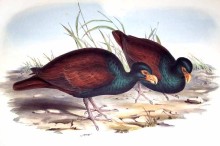
    The legendary Dodo bird was lost to the world in the 1600’s, when it was hunted to extinction on the island of Mauritius, but few Australians would realise that a flightless island bird here has narrowly avoided the same fate – thanks to an amazing story of dedication, skill and cooperation.

    The Woodhen: A Flightless Island Bird Defying Extinction is a fascinating book from CSIRO Publishing, authored by renowned ornithologist Clifford Frith.

    A native of the magnificent Lord Howe Island, the iconic local Woodhen (also known as the Lord Howe Rail) was at the very brink of extinction, with just 15 individuals found in 1980. Bold and risky actions were taken to save it.

    “For millennia it fearlessly walked unmolested,” Mr Frith notes.  “Within a mere 138 years of human settlement, the trusting and highly edible bird was all but gone from the face of the Earth – with as few as five breeding pairs still alive.”
    Pristine Lord Howe Island was discovered in 1788 and was permanently settled in the 1830s, with the arrival of humans and rats wiping out many local birds.   The book documents the various species driven to extinction – a fate that almost befell the Woodhen.

    The Woodhen examines the origins of Lord Howe Island and its wildlife, as well as the origins, evolution and extinction of flightless rails.

    The book details our early knowledge of the Lord Howe Island Woodhen, the decimation of its population, and the bold management plan that is slowly reviving the species.

    Just as humans took the Woodhen to the brink of extinction, it has been intrusive and intensive methods that have come to the rescue – in the form of a smart and dedicated team.

    Mortality in the wild remains a significant issue and Frith argues that even more should be done, by setting up breeding programs on predator-free islands and at reputable institutions. For despite great gains, the Woodhen remains in danger.

    The Woodhen: A Flightless Island Bird Defying Extinction   Author: Clifford B. Frith

    Source: CSIRO media.  Illustration By John Gould (1804-1881).


  • Seeing more than carbon for the trees

    Seeing more than carbon for the trees

    Schemes that offer economic incentives for growing trees for carbon present an opportunity to reverse trends in land clearing but also to restore ecosystem services – such as pest control, pollination, soil and water conservation.

    ‘Best practice’ carbon farming that considers more than just the carbon in trees is needed if the full benefits of trees in the landscape are to be realised by farmers, landholders, and the community.

    CSIRO-led research confirms that tree plantings in rural lands have significant potential to remove carbon dioxide from the atmosphere and, if done well, can provide a stream of other benefits to farmers, local communities and the environment.

    “Schemes which offer economic incentives for growing trees for carbon present an opportunity to reverse trends in land clearing but also to restore ecosystem services – such as pest control, pollination, soil and water conservation – that provide important benefits to farmers and the broader community,” according to CSIRO’s Dr Brenda Lin.

    Past removal of trees have disrupted many natural processes such as refuges for native insects that control pests, pollination, carbon sequestration, organic matter accumulation and water and soil conservation that are important for sustainable farming and the environment.

    “The ability of carbon tree plantings to restore some of these other benefits that support agricultural production may be a key factor in encouraging farmers and landholders to take up this type of carbon farming,” Dr Lin said.

    “Land-use models show that policies aimed solely at maximising carbon storage may not produce additional agricultural and environmental benefits and may even produce unwanted outcomes for farmers, landowners and communities.

    “For example, studies of past revegetation in agricultural landscapes show that in some locations intensive single-species (or monoculture) plantations can affect water flows, increase invasive pests and lead to biodiversity loss, be fire prone and have poor growth rates. Poorly located vegetation could reduce the availability of land for food production.”

    Alternatively, there are many opportunities for tree plantings, if planned and implemented properly, to provide additional benefits to the farmer beyond just carbon.

    “By revegetating unused, marginal or degraded cropping land, using multiple species of trees and shrubs, we could see improvements to pest control, pollination and water quality, increased wind protection and reduced soil erosion and salinity,” Dr Lin said.

    “For example, we know that remnant native vegetation patches that currently persist in agricultural landscapes, if they are well managed and contain few weed species, support a range of insect and spider predators and parasitic wasps that can attack pests of grain crops.”

    The benefits for local communities and the public could include increased water quality, reduced pesticide use, more habitat for species such as birds, and other cultural benefits.

    The research, published in the American BioScience journal, highlights the need to better understand these private, public and shared benefits and tradeoffs so that future policies and initiatives encourage ‘best practice’ tree plantings that maximise the positives while also storing carbon.

    Source.

  • Circadian Neuroscientist from the University of Oxford Explains: Why do we sleep?

    Circadian Neuroscientist from the University of Oxford Explains: Why do we sleep?

    Russell Foster is a circadian neuroscientist: he studies sleep and its role in our lives, examining how our perception of light influences our sleep-wake rhythms. And he asks: What do we know about sleep? Not a lot, it turns out, for something we do with one-third of our lives. In this talk, Foster shares three popular theories about why we sleep, busts some myths about how much sleep we need at different ages — and hints at some bold new uses of sleep as a predictor of mental health.

    Russell Foster studies sleep and its role in our lives, examining how our perception of light influences our sleep-wake rhythms. He and his team at the University of Oxford are exploring a third kind of photoreceptor in the eye: not a rod or a cone but a photosensitive retinal ganglion cell (pRGC) that detects light/dark and feeds that information to the circadian system. As Foster explains: “Embedded within our genes, and almost all life on Earth, are the instructions for a biological clock that marks the passage of approximately 24 hours.”  Light and dark help us synchronize this inner clock with the outside world.

    The research on light perception hits home as we age — faced with fading vision, we also risk disrupted sleep cycles, which have very serious consequences, including lack of concentration, depression and cognitive decline. The more we learn about how our eyes and bodies create our sleep cycles, the more seriously we can begin to take sleep as a therapy.

    Russell Foster on the Web  www.eye.ox.ac.uk

    Image source.

  • 3D Mapping a ‘Pisa’ Cake by Australian Scientists

    3D Mapping a ‘Pisa’ Cake by Australian Scientists

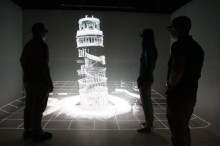
    Australian researchers have created the first ever interior 3D map of Italy’s iconic Leaning Tower of Pisa by using a breakthrough mobile laser mapping system.

    Developed by the CSIRO, Australia’s national science agency, the Zebedee technology is a handheld 3D mapping system incorporating a laser scanner that sways on a spring to capture millions of detailed measurements of a site as fast as an operator can walk through it. Specialised software then converts the system’s laser data into a detailed 3D map.

    While the tower’s cramped stairs and complex architecture have prevented previous mapping technologies from capturing its interior, Zebedee has enabled the researchers to finally create the first comprehensive 3D map of the entire building.

    “This technology is ideal for cultural heritage mapping, which is usually very time consuming and labour intensive. It can often take a whole research team a number of days or weeks to map a site with the accuracy and detail of what we can produce in a few hours,